On 24 November 2026, the Federal Housing Finance Agency (FHFA) announced the conforming loan limits for 2027. For a one-unit home in most of the United States, the limit rises to $855,400, up $22,650 from the 2026 limit of $832,750.
That is a 2.72% increase, and it takes effect on 1 January 2027. It matters if you are buying a home next year, because the limit decides whether your mortgage is a conforming loan or a jumbo loan, and that difference can change your rate and your down payment.
Here is what the change means for your money.
The short answer
If your mortgage is under $832,750, nothing changes for you. If you are borrowing between $832,750 and $855,400, you can now get a conforming loan instead of a jumbo loan, which usually means a lower rate and easier rules. If you are borrowing more than $855,400, you still need a jumbo loan, unless you live in a high-cost area.
The quick framework:
- Check the new limit for your county. Most counties use the $855,400 baseline.
- If your loan sits between the old and new limits, the change helps you.
- Compare the conforming rate with the jumbo rate before you choose.
- Remember the rate matters more than the limit. A 30-year fixed rate is near 7.3%.
Quick decision guide:
- Buying under $832,750? This news does not change your loan.
- Buying a home priced near $900,000 with a small down payment? The new limit may keep you in a conforming loan.
- Buying in a high-cost area like Los Angeles? Your ceiling is $1,283,100.
- Buying in 2026, not 2027? The old limit of $832,750 still applies until 1 January.
What a conforming loan limit actually is
Fannie Mae and Freddie Mac are the two companies that buy most home mortgages from lenders and bundle them into securities. A conforming loan is one that meets their rules, including the size limit set by the FHFA each year. A loan above the limit is a jumbo loan, and lenders keep those on their own books instead.
Because Fannie Mae and Freddie Mac can buy conforming loans, lenders can offer them more cheaply. Jumbo loans often carry higher rates, larger down payment requirements and stricter checks on income and reserves. That is why the limit matters: crossing it can raise the cost of the same house.
The FHFA sets the limit from home prices. Its House Price Index showed average US home values rose 2.72% between the third quarter of 2025 and the third quarter of 2026, so the limit rose by the same 2.72%. The FHFA said limits will be higher in all but 24 US counties or county equivalents.
| Property | 2027 limit | 2026 limit | Increase |
|---|---|---|---|
| One unit | $855,400 | $832,750 | $22,650 |
| Two units | $1,095,250 | $1,066,250 | $29,000 |
| Three units | $1,323,900 | $1,288,800 | $35,100 |
| Four units | $1,645,350 | $1,601,750 | $43,600 |
Source: Federal Housing Finance Agency, “FHFA Announces Conforming Loan Limit for 2027,” 24 November 2026; Freddie Mac loan limit notice.
Who the higher limit helps
The change helps a narrow group: buyers whose loan falls in the $22,650 gap between the old limit and the new one. Take a buyer putting 10% down on a $950,000 home. The loan is $855,000. Under the 2026 limit, that is a jumbo loan. Under the 2027 limit, it is a conforming loan.
High-cost areas get a bigger ceiling. Where the local median home value is high enough, the limit is 150% of the baseline, or $1,283,100 for a one-unit home in 2027. Los Angeles County sits at that $1,283,100 ceiling, and New York County is $1,224,750. In Alaska, Hawaii, Guam and the US Virgin Islands, the baseline itself is $1,283,100, with a ceiling of $1,924,650.
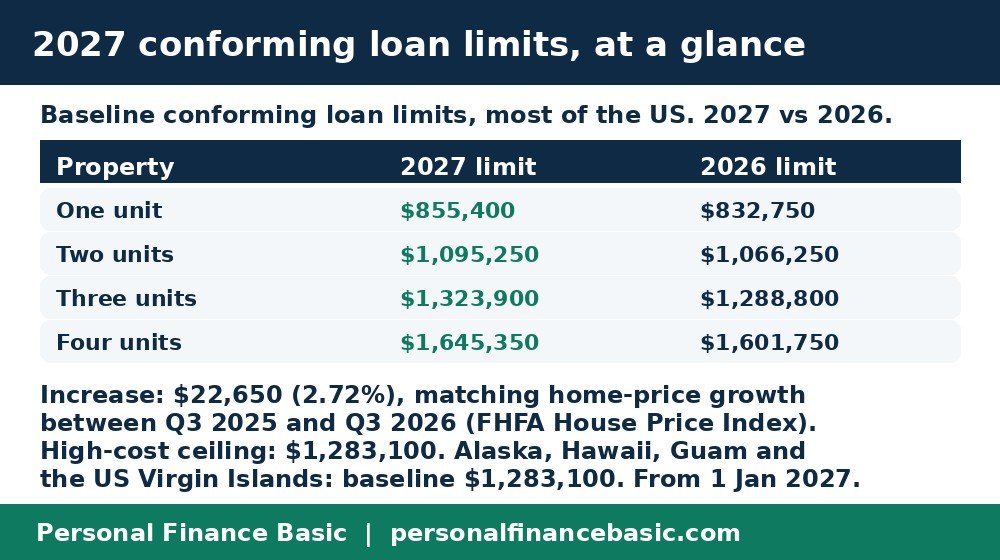
2027 conforming loan limits, at a glance.
- Best for: buyers borrowing just above the old $832,750 limit, and buyers in high-cost counties where the ceiling is much higher.
- Not for: most buyers. The typical loan is well under the limit, so the change touches only the top end of the market.
What the higher limit does not fix
The bigger cost is still the mortgage rate. Freddie Mac’s weekly survey put the 30-year fixed rate at 7.28% on 19 November 2026, and daily measures put it near 7.32% on 24 November. On an $855,400 loan at 7.28% over 30 years, the monthly principal and interest payment is about $5,857. That is the number that decides whether a home is affordable, not the limit.
The rise is also smaller than in recent years, because home-price growth slowed. The 2.72% increase is the smallest in several years, which the FHFA tied to a weaker housing market and higher mortgage rates. And a higher limit does not raise home prices or lower them. It only changes which loans Fannie Mae and Freddie Mac can buy.
If you are buying in 2027, check the limit for your county on the FHFA website before you make an offer. Some counties hold their old limit when local prices fall, and the FHFA does not lower a county’s limit, so a few counties will sit above the baseline.
At a glance
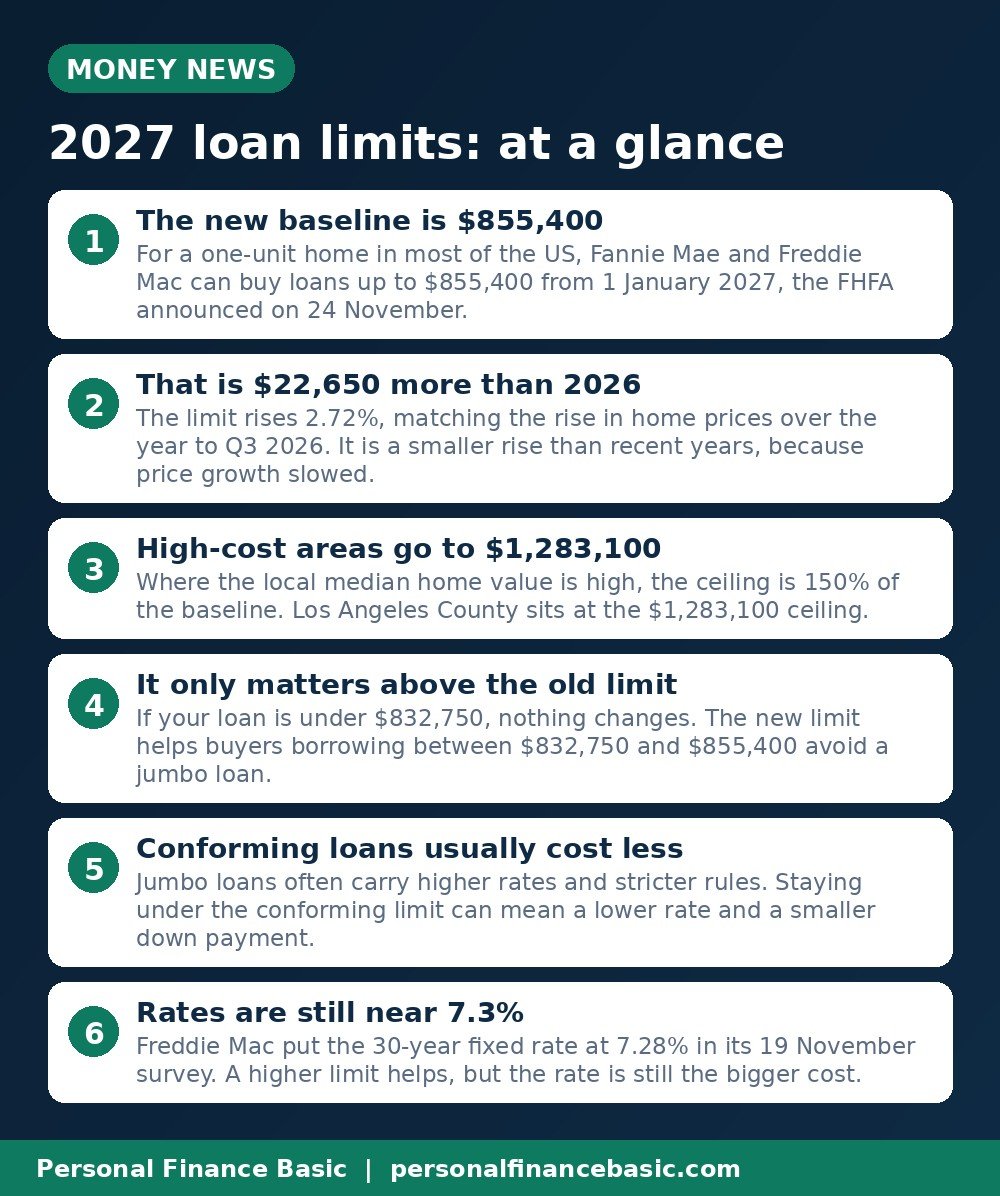
The main points from this guide, in one picture.
Frequently asked questions
What is the 2027 conforming loan limit?
It is $855,400 for a one-unit home in most of the United States, up $22,650 from $832,750 in 2026. The FHFA announced it on 24 November 2026, and it takes effect on 1 January 2027.
What is the difference between a conforming loan and a jumbo loan?
A conforming loan meets Fannie Mae and Freddie Mac rules, including the size limit, so those companies can buy it. A jumbo loan is larger than the limit, stays with the lender, and usually carries a higher rate and stricter rules.
Does the new limit help me if I am buying a $500,000 home?
No. If your loan is under the old limit of $832,750, the change makes no difference to you. It only helps buyers borrowing between $832,750 and $855,400, or in high-cost areas.
What is the limit in high-cost areas?
The ceiling is $1,283,100 for a one-unit home in 2027, which is 150% of the $855,400 baseline. Los Angeles County is at that ceiling. Alaska, Hawaii, Guam and the US Virgin Islands have a baseline of $1,283,100.
When do the new limits take effect?
On 1 January 2027. Loans closed in 2026 still use the 2026 limit of $832,750.
The bottom line: the 2027 limit rises to $855,400, which helps buyers borrowing just above the old limit avoid a jumbo loan. For most buyers, the mortgage rate near 7.3% matters far more than the limit. Check your county’s number before you make an offer.
This post is general education, not financial advice. Loan limits and mortgage rates change; check the FHFA website and your lender for the figures that apply to your purchase.
Related reading: How to Save for a House Down Payment and What Is a Good Credit Score in the US? (300–850 Explained)