Your first job hands you a form: how much of your pay goes into the 401(k)? Then a friend says to open a Roth IRA, and someone else says a traditional IRA is better for the deduction.
Here is the short version. A 401(k) lets you put in $24,500 in 2026 if you are under 50. An IRA, traditional or Roth, lets you put in $7,500. The real difference is when you pay tax, and whether your employer adds money on top.
The short answer
All three hold retirement savings that grow without yearly tax inside the account. What differs is the tax timing: a traditional 401(k) and a traditional IRA give you the tax break now and tax you on withdrawal, while a Roth IRA taxes you now and lets qualified withdrawals come out tax-free later.
The quick framework:
- Get the full 401(k) match first.
- Then open a Roth IRA, if your income allows.
- Then add more to the 401(k).
- Use a traditional IRA if you have no workplace plan.
Quick decision guide:
- Employer matches? Start there, every time.
- Low bracket now, higher later? A Roth IRA usually fits better.
- High bracket now, lower in retirement? Pre-tax usually fits better.
- No workplace plan at all? An IRA, traditional or Roth, is your main account.
The 401(k): the workplace account
A 401(k) comes through your employer: you choose a percentage of each paycheck, and the money comes out before you see it. For 2026, the limit is $24,500 under 50, or $32,500 at 50 or older.
Most 401(k)s are pre-tax: you pay tax on withdrawal, not now. Many employers also offer a Roth 401(k), taxed now like a Roth IRA.
The big advantage is the employer match, commonly 50% of the first 6% of pay. On a $60,000 salary, 6% means $3,600 from you and $1,800 from your employer. The trade-off is choice: your employer picks the options, and withdrawals before 59 1/2 usually face a 10% penalty on top of tax.
- Best for: anyone with an employer match, or anyone saving more than $7,500 a year.
- Not for: picking your own investments, or withdrawing before retirement without a penalty.
The traditional IRA: the do-it-yourself deduction
A traditional IRA is an account you open yourself, with no employer involved. For 2026, the limit is $7,500 under 50, or $8,600 at 50 or older. Your total across all IRAs cannot pass that limit.
Like a pre-tax 401(k), it can lower your taxable income now, but the deduction phases out if you are covered by a workplace plan: $81,000-$91,000 single, $129,000-$149,000 joint in 2026. Above that, no deduction.
You pay tax when you take the money out, and withdrawals before 59 1/2 usually face the 10% penalty. Traditional IRAs also have required minimum distributions: the IRS makes you start withdrawing at a certain age.
- Best for: someone with no workplace plan who wants a deduction now, or a high earner expecting a lower bracket in retirement.
- Not for: someone covered by a 401(k) with income above the phase-out range. The deduction disappears.
The Roth IRA: pay tax now, nothing later
A Roth IRA is also an account you open yourself, with the same $7,500 limit for 2026. You contribute money you have already paid tax on, so there is no deduction now. In exchange, qualified withdrawals in retirement are tax-free, including all the growth.
The Roth IRA has an income ceiling: for 2026, direct contributions phase out from $153,000-$168,000 single, $242,000-$252,000 joint. Above that, you cannot contribute directly. A Roth 401(k) has no income limit.
It is also the most flexible of the three. You can take out what you contributed, not the earnings, at any time, without tax or penalty. And unlike the other two accounts, a Roth IRA has no required minimum distributions for the owner.
- Best for: younger savers and anyone in a low tax bracket now.
- Not for: anyone above the income phase-out range, or anyone who needs the deduction this year.
The three accounts, side by side
| 401(k) | Traditional IRA | Roth IRA | |
|---|---|---|---|
| 2026 limit (under 50) | $24,500 | $7,500 | $7,500 |
| Tax break | Now, if pre-tax | Now, if eligible | Later, tax-free |
| Employer match | Often yes | No | No |
| Income limit | None | Deduction phases out | $153,000-$168,000 single |
| Withdrawals before 59 1/2 | Usually taxed plus 10% | Usually taxed plus 10% | Contributions free, earnings taxed |
2026 limits and phase-outs, per the IRS (IR-2025-111, 13 November 2025).
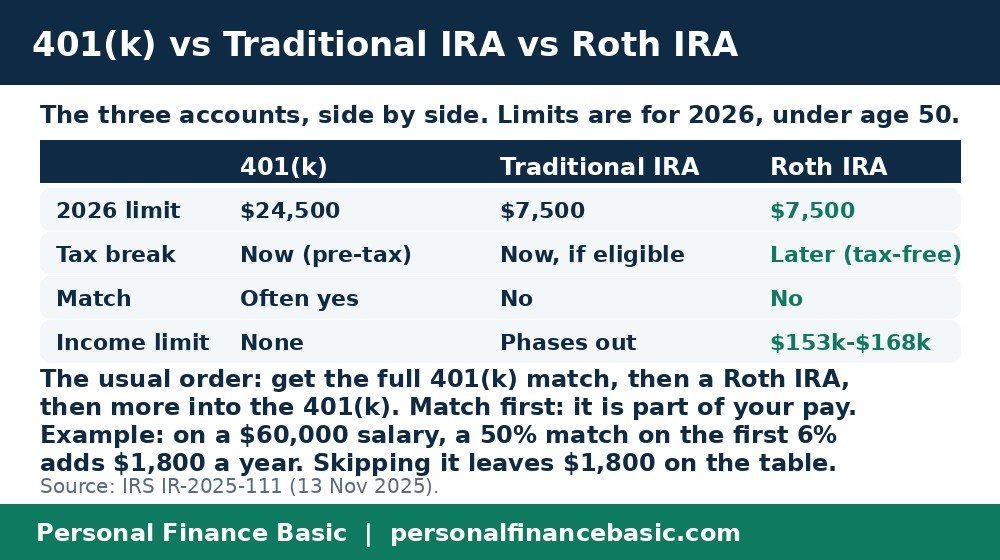
401(k) vs Traditional IRA vs Roth IRA.
Two numbers matter most: the limit, $24,500 against $7,500 — if you can save more than $7,500 a year, you need a 401(k) — and the tax timing: a dollar saved pre-tax at a 22% rate saves 22 cents now, while a dollar in a Roth costs those 22 cents now and saves tax on the growth later.
The order that usually works
Take a worker earning $60,000 a year, in the 22% bracket, with a 50% match on 6% of pay.
Step 1: get the full match. Contribute 6% of pay, $3,600 a year. The employer adds $1,800: a 50% return on day one, before any investment growth.
Step 2: open a Roth IRA. Contribute what you can, up to $7,500. At a 22% rate, the tax cost of a $6,000 Roth contribution is $1,320 this year, paid once, and the withdrawals are tax-free later.
Step 3: go back to the 401(k). Once the Roth IRA is full, raise the 401(k) contribution above 6%, up to $24,500.
Step 4: check the traditional IRA last. If you have no workplace plan, the traditional IRA’s deduction is worth real money. If you do have a 401(k) and your income is above the deduction phase-out, use the Roth IRA instead.
Saving $500 a month at an assumed 7% a year grows to about $86,500 in 10 years, about $260,000 in 20 years, and about $610,000 in 30 years, before tax. That is hypothetical, not a promise.
At a glance
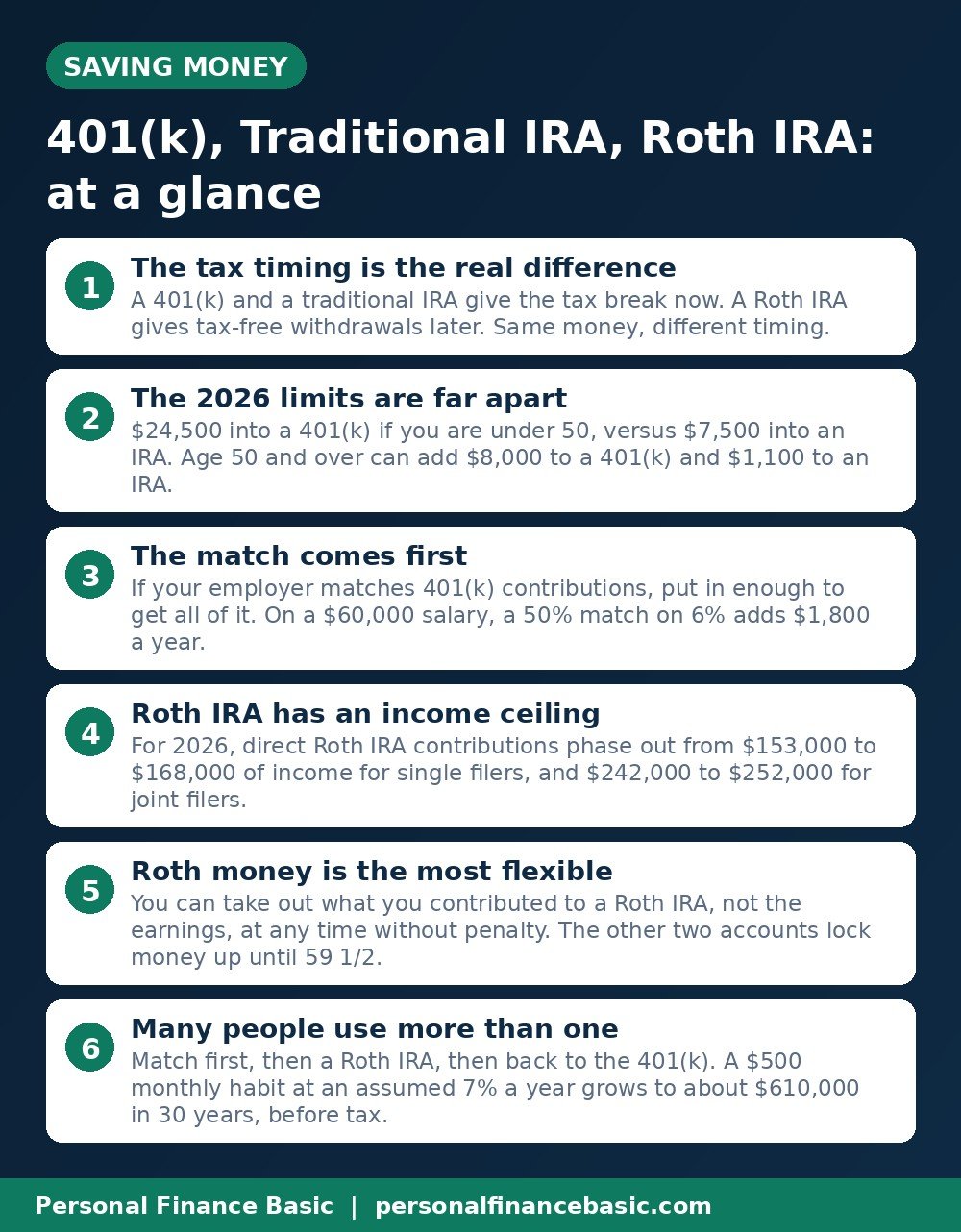
The main points from this guide, in one picture.
Frequently asked questions
Can I have a 401(k) and an IRA at the same time?
Yes. The limits are separate: $24,500 into a 401(k) and $7,500 into IRAs in 2026, if you are under 50. The traditional IRA deduction phases out above $81,000 single or $129,000 joint if you are covered by a workplace plan.
Is a Roth IRA better than a 401(k)?
Neither is better in general. A 401(k) holds far more and often comes with a match; a Roth IRA gives tax-free withdrawals and more flexibility. The usual order is the match first, then a Roth IRA, then more into the 401(k).
What happens if I earn too much for a Roth IRA?
For 2026, direct Roth IRA contributions phase out from $153,000 to $168,000 for single filers, and $242,000 to $252,000 for joint filers. A 401(k), including a Roth 401(k), has no income limit.
Can I take money out of a Roth IRA before retirement?
You can take out your contributions at any time without tax or penalty, because you already paid tax on them. Taking out earnings before 59 1/2 usually means tax plus a 10% penalty.
Do I have to take money out of a Roth IRA in retirement?
No, not during your lifetime. Roth IRAs have no required minimum distributions for the owner, unlike traditional IRAs and 401(k)s.
The bottom line: the match comes first, because it is part of your pay. After that, a Roth IRA usually fits a younger or lower-bracket saver, and the 401(k) takes anything beyond the $7,500 IRA limit.
This post is general education, not financial advice. Limits and rules change; check the current IRS figures before you contribute.
Related reading: 401(k) Match Explained: The Part of Your Pay You Should Not Skip and Traditional IRA vs Roth IRA: What Is the Difference?