You have $1,800 to invest, and the market has been jumping up and down for weeks. Invest it all today and the price might drop tomorrow. Wait for a better day and you might wait for months while the market climbs without you.
Dollar-cost averaging is a way out of that stuck place. You invest the same amount on a regular schedule, say $200 every month, and you stop trying to pick the right day. The price decides how many shares you get, and the schedule decides when you buy. Here is how it works, what the math looks like, and where it falls short.
The short answer
Dollar-cost averaging means putting a fixed dollar amount into an investment on a regular schedule, such as $200 a month, no matter what the price is doing. When the price falls, your amount buys more shares. When it rises, it buys fewer. Over time, your average cost per share often ends up below the average price.
The quick framework:
- Pick an amount you can invest every month without missing it.
- Pick a date, usually payday, and automate the transfer.
- Buy the same investment each time, on the same schedule.
- Keep going when prices fall; that is when your money buys the most shares.
- Check in once or twice a year, and leave it alone the rest of the time.
Quick decision guide:
- Investing from each paycheck? Dollar-cost averaging is already how you invest.
- Sitting on a lump sum and nervous about timing? Averaging it in over 6 to 12 months can help you start.
- Want the best expected return on paper? A lump sum usually wins when markets rise over time.
Step 1: See the math with a simple example
Suppose you invest $300 a month for six months into a fund, and the price moves like this: $50, $45, $55, $40, $60, then $50 again. Each month, your $300 buys a different number of shares.
In month one, $300 at $50 buys 6 shares. In month four, at $40, the same $300 buys 7.50 shares, the most of any month. After six months you have spent $1,800 and own 36.62 shares, at an average cost of $49.15 a share.
The average price over those six months was $50, so your average cost came in below it. That gap is the whole point: your fixed amount bought more shares at the low prices. A $1,800 lump sum at $50 in month one would have bought only 36 shares.
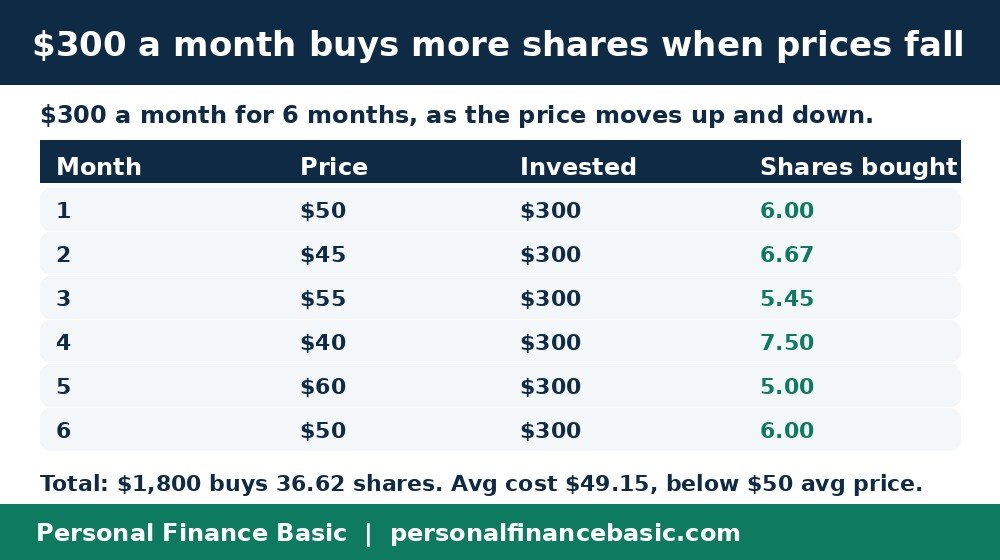
$300 a month buys more shares when prices fall, and fewer when they rise.
This example is illustrative, and the gap is small: 0.62 extra shares on $1,800. Dollar-cost averaging is not a way to beat the market. It is a way to start without needing to be right about timing, and to keep investing when prices fall instead of freezing.
- Best for: anyone investing a little from each paycheck, or anyone with a lump sum who keeps putting off investing because the timing never feels right.
- Not for: someone looking for a guaranteed edge. There is none here; the benefit is behavioral, not mathematical.
Step 2: Automate it on payday
The method only works if it happens without a decision each month. Set the transfer for payday, so the money moves before you can spend it or second-guess it. Most brokerages and retirement plans let you set a recurring investment in a few clicks.
The amount should be small enough that you will not need to stop it in a tight month. A $200 monthly investment you keep for five years beats a $500 one you cancel after three months. If $200 is too much, $50 a month still builds the habit.
What you buy matters more than the schedule. Most beginners use a broad, low-cost fund that holds hundreds of companies at once. Dollar-cost averaging into a single risky stock is still risky; the schedule does not fix a bad pick.
Step 3: Keep buying when prices fall
The hardest part of the method is also the part that makes it work. When prices fall, your fixed amount buys more shares, but it feels like the worst time to invest. The schedule says to buy anyway.
Think of it the other way round: a falling price is a sale on the same investment. In the example above, the $40 month bought 7.50 shares, half again as many as the $60 month.
That does not mean falling prices are always a bargain. If the investment itself is broken, buying more only loses more money. The method works best with broad funds held for years.
| Approach | How it works | Main risk | Best for |
|---|---|---|---|
| Dollar-cost averaging | Same amount every month | Missed gains if markets rise steadily | Paycheck investing, nervous beginners |
| Lump sum | Everything at once | Bad timing if prices fall right after | Money already saved, long horizon |
Illustrative comparison. Past market behavior does not guarantee future results.
Step 4: Know what it cannot do
Dollar-cost averaging does not remove risk. If the investment falls and stays down, regular buying loses money too, just more slowly. It smooths the ride; it does not guarantee a gain.
It also usually earns less than a lump sum invested at once: a well-known Vanguard study found that a lump sum beat averaging about two-thirds of the time. The choice for most people is not between a lump sum and averaging, it is between averaging and not investing at all.
- Best for: regular investing from income, and getting a nervous lump sum into the market over 6 to 12 months.
- Not for: money you need in the next year or two. Short-term money belongs in savings, not in the market.
Step 5: Set it, then check in twice a year
Once the automation is running, the job is mostly to leave it alone. Check in twice a year: is the amount still right, and has anything about your goals changed? If your pay rose, raise the amount. Do not check the balance every day; daily prices are noise, and the method works because it takes the daily decision away from you.
At a glance
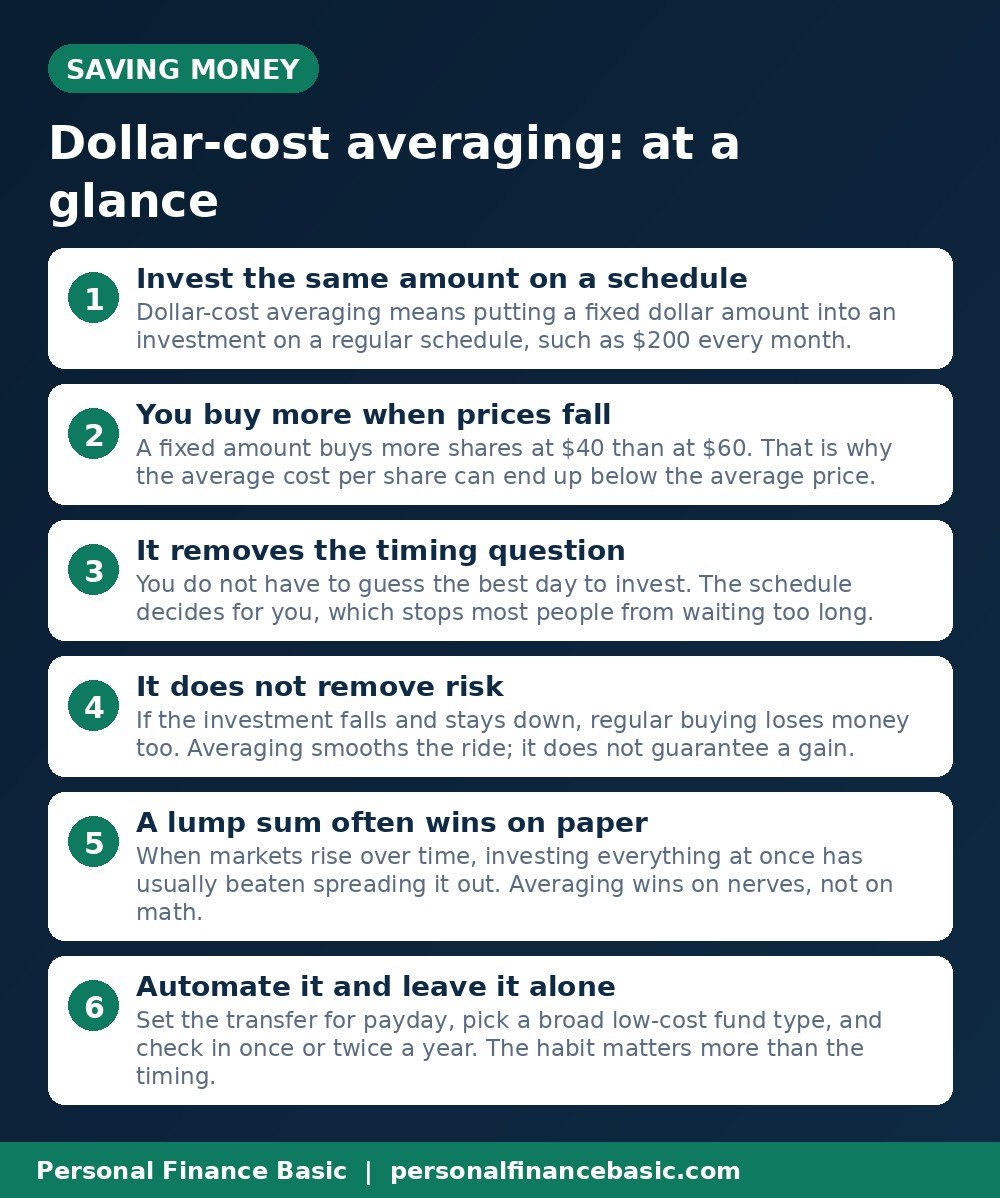
The main points from this guide, in one picture.
Frequently asked questions
How much should I invest each month?
As much as you can afford without missing it. For many beginners that is $50 to $200 a month.
How often should I invest: weekly or monthly?
Monthly is fine for most people, and it matches payday. Weekly investing buys slightly more often, but the difference over years is tiny.
Does dollar-cost averaging work in a falling market?
It buys more shares as prices fall, which lowers your average cost. But if the investment never recovers, you still lose money.
Should I average in a lump sum or invest it all at once?
On paper, investing it all at once has usually done better. But if a lump sum makes you nervous enough to keep waiting, averaging it in over 6 to 12 months beats leaving it in cash for years.
Can I dollar-cost average in my 401(k)?
Yes, and most people already do. Every paycheck, part of your pay goes into your 401(k) and buys shares at that month’s price.
The bottom line: dollar-cost averaging is not a trick for beating the market. It is a schedule that takes timing off your plate: the same amount, every month. Set it up on payday, pick a broad low-cost investment, and let the habit do the work.
This post is general education, not financial advice. The $300-a-month example is illustrative; investing involves risk, including possible loss of principal, and past performance does not guarantee future results.
Related reading: What Is Compound Interest? Simple Examples That Make It Click and What Is an Index Fund? A Beginner Explanation