Maya earns $3,000 a month after tax. By the 20th, she is checking her balance before every purchase. She is not a big spender. She just never decided where the money should go before it arrived.
That is the problem zero-based budgeting fixes. It is a plan you write before the month starts, where every dollar gets a job: rent, food, fun, savings, extra debt payments. When the plan is done, income minus planned spending equals zero.
Here is how it works, step by step, with a full $3,000 example you can copy and adjust.
The short answer
Zero-based budgeting means you assign all of your take-home pay to categories before the month begins. If you take home $3,000, your plan adds up to $3,000. Nothing is left floating.
Zero does not mean you spend it all. Savings and debt payments are jobs too. A plan that sends $700 to savings and debt still ends at zero, and it is the version that builds wealth.
The method has four moves:
- List your take-home pay for the month.
- List every expense, including savings and fun.
- Give each dollar a category until nothing is left unassigned.
- Track spending weekly and move money between categories when life changes.
Quick decision guide:
- Money runs out before the month does? Zero-based budgeting fits you. It shows exactly where the leak is.
- Your income changes every month? It still works, but build the plan from your lowest recent month, not your best one.
- You already save on autopilot and never overspend? A lighter method, like the 50/30/20 rule, may be enough.
- You hate detail? Start with five big categories instead of twenty small ones. Detail can come later.
How a $3,000 zero-based plan looks
Take Maya. Her take-home pay is $3,000 a month. Her plan: $1,500 for housing, bills and food, $600 for fun and eating out, $700 for savings and extra debt payments, and $200 for sinking funds. Add it up and it equals $3,000. Nothing is left unassigned.
Her savings are not an afterthought. The $700 is split: $400 to her emergency fund and $300 extra toward her credit card. Over a year, that is $4,800 into savings and $3,600 of extra debt payments.
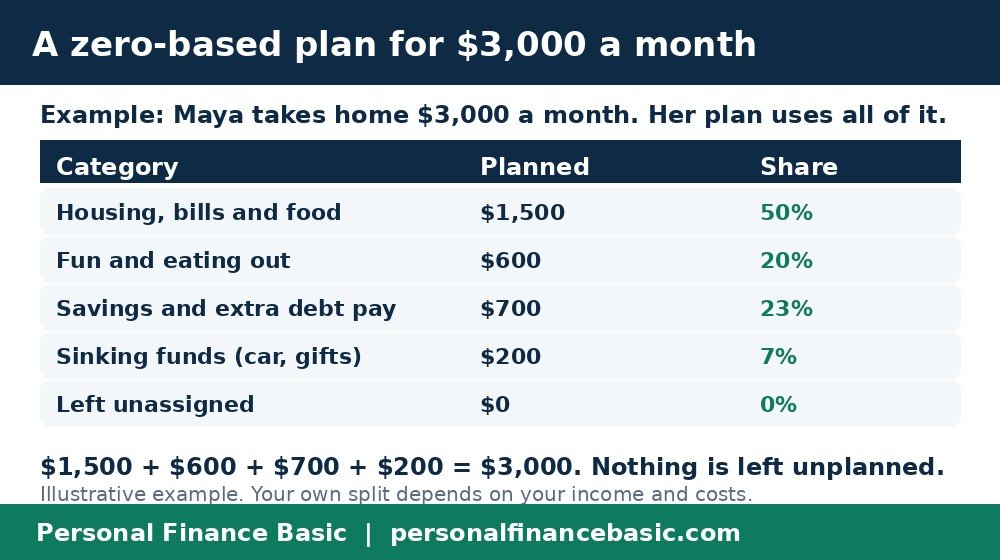
A zero-based plan for $3,000 a month. Every dollar has a job, including savings.
Notice what the plan does not do. It does not cut fun to zero. Maya has $600 for eating out and weekends. A plan with no fun in it fails by the second week.
Zero-based vs 50/30/20 vs pay yourself first
Zero-based budgeting is one of three simple methods beginners use. The right one depends on how much control you want and how much time you will give it.
| Method | How it works | Time per month | Best for |
|---|---|---|---|
| Zero-based | Every dollar assigned; total equals income | About 1 hour to build, 5 minutes a week | People who overspend or want full control |
| 50/30/20 rule | 50% needs, 30% wants, 20% savings and debt | About 20 minutes | People who want a quick check on their split |
| Pay yourself first | Move savings out on payday, spend the rest freely | About 10 minutes | People who already spend within their means |
Illustrative time estimates, based on a typical monthly routine.
- Best for tight months: zero-based budgeting. When money is short, knowing where every dollar goes matters more than a rough split.
- Best for busy months: the 50/30/20 rule. On Maya’s $3,000, that is $1,500 for needs, $900 for wants and $600 for savings and debt.
- Best for steady savers: pay yourself first. If your spending is already under control, automating savings on payday may be all you need.
Step 1: List your take-home pay
Use the money that actually lands in your account, not your salary before tax. If you are paid biweekly, two months a year bring three paychecks. Plan the normal two-paycheck months and treat the extra one as a bonus for savings or debt.
If your income varies, use your lowest month from the last three as the base. Any month that comes in higher is a good surprise, not a reason to raise every category.
Step 2: List every expense, including the irregular ones
Start with last month’s bank statement, not your memory. Memory forgets the $12 subscription and the $40 of takeout. The statement does not.
Then add the irregular costs: car insurance every six months, gifts in December, car repairs. Divide each yearly cost by 12 and put that amount in a sinking fund every month. A $600 insurance bill becomes $50 a month.
Step 3: Give each dollar a job until the total hits zero
Add up your categories. If the total is more than your income, something has to move. Cut a want first, not savings. If the total is less than your income, the leftover dollars still need a job: send them to savings or debt.
Here is the catch most beginners miss: the plan has to add up exactly. A plan that leaves $150 floating is not zero-based. That $150 will get spent on nothing in particular.
Step 4: Track it once a week, in five minutes
Check your categories every Friday. If food is $80 over and fun is $80 under, move the money. That is not failure. That is the system working.
Do not rebuild the whole plan every week. Move money between categories, keep the total at zero, and save the big rethink for next month. Most people need two or three months before the numbers fit.
Three mistakes that sink the first plan
First, guessing instead of checking. A plan built from guesses is wrong on day one. Use last month’s real spending as the base.
Second, forgetting the irregular costs. The plan that skips car insurance, gifts and repairs looks fine until one of them lands. Sinking funds fix this.
Third, quitting after a bad month. One month over budget is data, not proof the method fails. Adjust the categories and try again.
At a glance
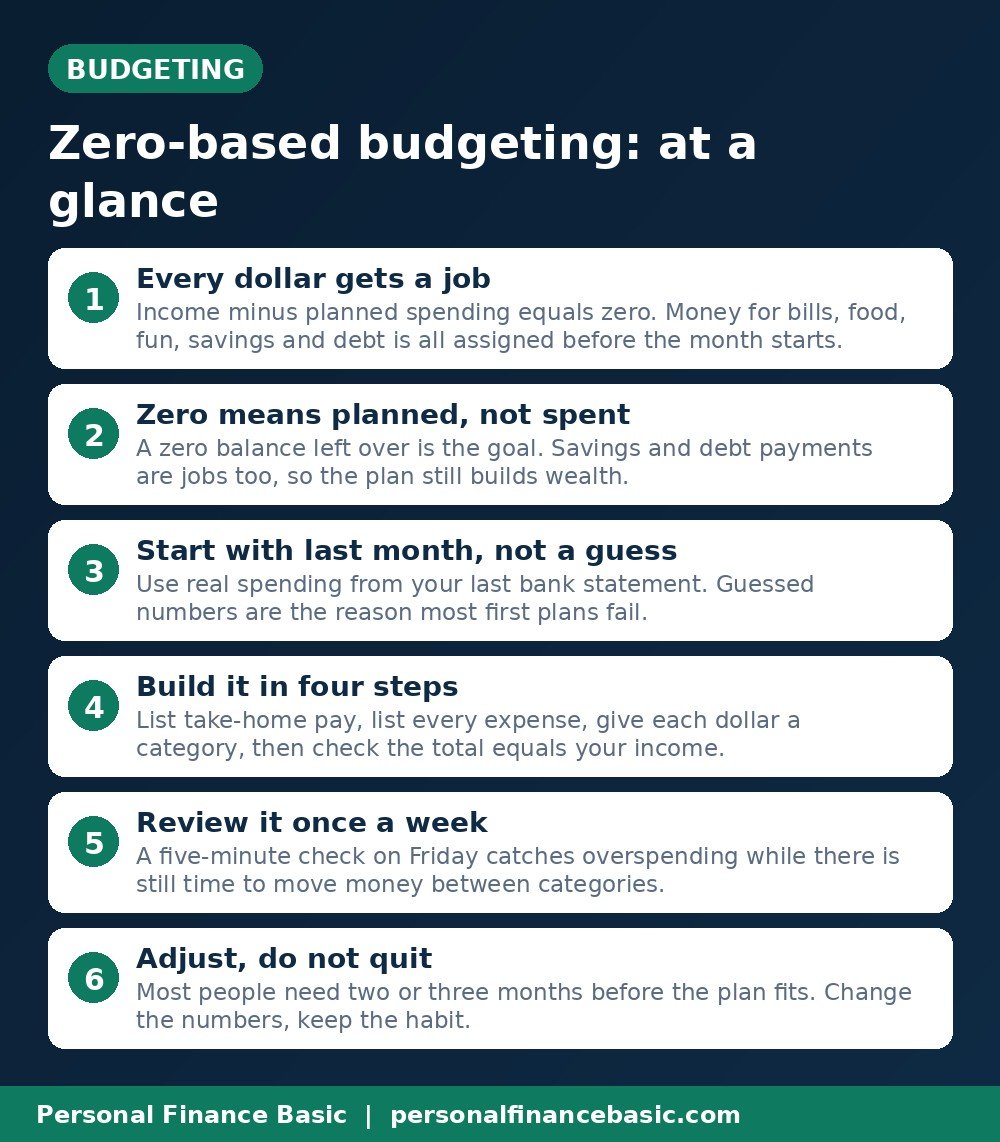
The main points from this guide, in one picture.
Frequently asked questions
Does zero-based budgeting mean I spend all my money?
No. Zero means every dollar is assigned, not spent. Savings, debt payments and sinking funds are assignments. A good plan sends money to savings first, then spends the rest on purpose.
How is this different from the 50/30/20 rule?
The 50/30/20 rule splits your income into three buckets: 50% needs, 30% wants, 20% savings and debt. Zero-based budgeting assigns every dollar to a named category, so it gives more detail and control, but it takes more time.
What if my income changes every month?
Build the plan from your lowest recent month. When a better month arrives, give the extra dollars a job right away, usually savings or debt.
Do I need an app or a spreadsheet?
No. A sheet of paper works. A spreadsheet helps because it adds the categories for you, and many budgeting apps are built around this method. Pick the tool you will actually open each week.
How long does it take to set up?
About an hour for the first plan, mostly spent looking at last month’s spending. After that, about five minutes a week to check categories and about 30 minutes at the start of each month to write the next plan.
The bottom line: give every dollar a job before the month starts, including the dollars that go to savings. Start with last month’s real spending, keep the plan at zero, and check it once a week. Month two will fit better than month one.
This guide is general education, not financial advice. Your income and expenses decide what applies to you.
Related reading: The 50/30/20 Rule With US Examples ($3,000 a Month) and How to Budget When Your Income Changes Every Month