Sam has $10,000 set aside for a house down payment in about a year. It sits in a checking account, earning nothing. A savings account would pay interest, but Sam also wants to write a check when the time comes.
A money market account does both. It is a deposit account at a bank or credit union that pays interest like a savings account and usually comes with check writing and a debit card. The FDIC national average rate was 0.63% in November 2026, about $63 a year on Sam’s $10,000.
Here is how it works, how it compares with the two accounts people confuse it with, and when it is the right place for your cash.
The short answer
A money market account is a bank deposit that earns interest and lets you spend from it with checks or a debit card. Your money is insured by the FDIC at a bank, or the NCUA at a credit union, up to $250,000 per depositor, per bank.
It fits cash you may need in the next few months to a year: an emergency fund, a down payment, or a tax bill. It is not built for long-term growth, and it is not an investment.
Work through it in four moves:
- Check the account is at an FDIC- or NCUA-insured bank or credit union.
- Compare the rate with a plain savings account.
- Check the minimum deposit and any monthly limits.
Quick decision guide:
- Need interest plus a check or debit card for cash you will spend soon? A money market account fits.
- Just parking savings and never touching it? A plain savings account does the same job, often with no minimum.
- Want the highest rate on cash inside a brokerage account? That is a money market fund, a different product, and it is not insured.
- Saving for retirement or growth over years? Neither account is the right tool.
How a money market account works
You open the account at a bank or credit union, deposit money, and the bank pays you interest on the balance. The rate is variable: the bank sets it and can change it. Interest is usually paid monthly, and it compounds.
What makes it different from a savings account is access. Most money market accounts let you write checks or use a debit card. A plain savings account usually offers neither, so getting money out takes an extra step.
That access comes with limits. The Consumer Financial Protection Bureau notes these accounts usually limit check, debit card, and electronic transactions, and many ask for a minimum deposit. Going over the limit can mean a fee.
How it compares with a savings account
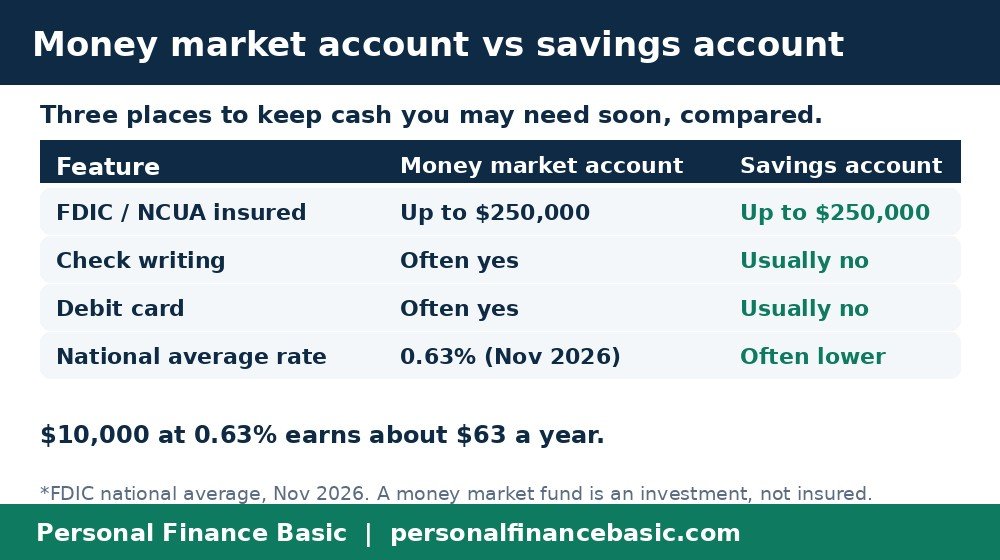
Money market account vs savings account. Both are insured deposits; the difference is access.
On Sam’s $10,000, the national average of 0.63% pays about $63 a year. Some banks pay much more and some much less.
| Account | Insurance | Check writing | Best for |
|---|---|---|---|
| Money market account | FDIC / NCUA up to $250,000 | Often yes | Cash you will spend soon |
| Savings account | FDIC / NCUA up to $250,000 | Usually no | Cash you will not touch |
| Money market fund | Not insured | Sometimes | Cash inside a brokerage |
Illustrative comparison. Rates and features vary by bank and can change.
- Best for: an emergency fund you want to reach fast, a down payment fund, or money set aside for a bill due in a few months.
- Not for: money you will not touch for years. The rate is too low for long-term growth.
Do not confuse it with a money market fund
The names are nearly identical, and the mix-up is common. A money market fund is a mutual fund, not a bank deposit: you buy shares in a fund that invests in short-term debt like Treasury bills. The fund aims to keep its share price at $1, but that price is not guaranteed.
The difference that matters is insurance. A money market account at an insured bank is protected by the FDIC up to $250,000 if the bank fails. A money market fund is not FDIC insured: if the brokerage fails, SIPC may restore missing shares, but not a fall in value.
In late 2026, money market funds paid far more than the average money market account, because fund yields track short-term rates while banks set their own. On 30 October 2026, the 13-week Treasury bill yielded 4.08%. That gap is a trade: the fund pays more and carries investment risk, while the account pays less and carries deposit insurance.
Step 1: Check the insurance first
Before you look at the rate, check that the bank or credit union is insured: FDIC membership at a bank, NCUA insurance at a credit union. Both cover up to $250,000 per depositor, per institution, per ownership category.
That limit is per bank, not per account. The FDIC’s own calculator can confirm your coverage before you move a large sum.
Step 2: Compare the rate, not the name
Rates vary widely. The national average was 0.63% in November 2026, but some banks pay several times that and some pay almost nothing.
When you compare, check whether the rate applies to your whole balance or only above a threshold, and whether it is a short-term teaser rate. A rate that drops after three months is not the rate you earn for the year.
Step 3: Check the minimums and the limits
Many ask for a minimum deposit to open, often $1,000 or more, and some ask you to keep a minimum balance to earn the stated rate or avoid a monthly fee. A $10 monthly fee wipes out the interest on a $10,000 balance at the national average rate.
Also check the transaction limits: some accounts cap checks, debit purchases, and transfers each month. For regular spending, a checking account is the better tool.
At a glance
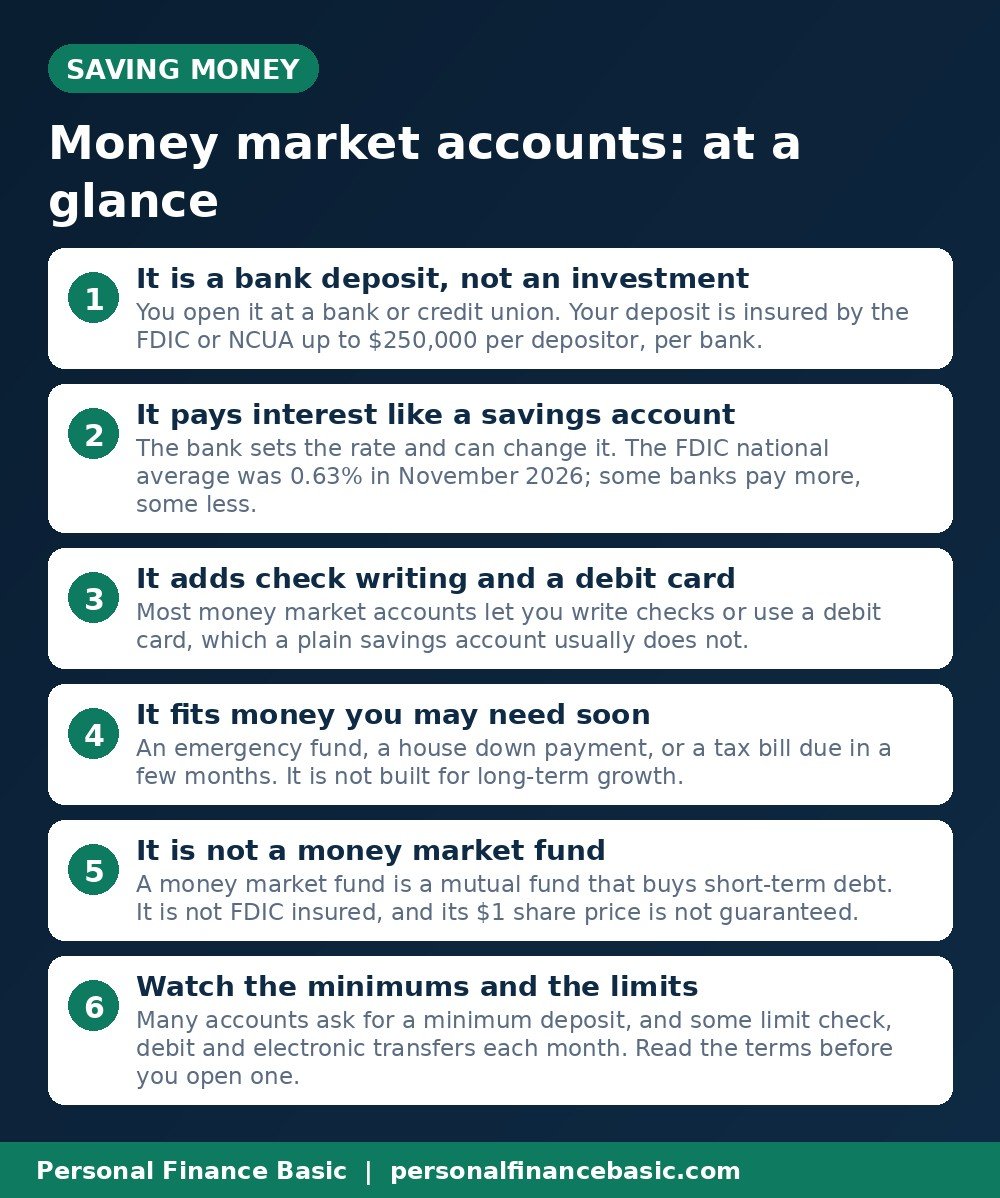
The main points from this guide, in one picture.
Frequently asked questions
Is my money safe in a money market account?
At an FDIC-insured bank or NCUA-insured credit union, deposits are insured up to $250,000 per depositor, per bank, per ownership category. That covers the bank failing. It does not cover investments, because a money market account holds none.
Can I lose money in a money market account?
Your deposit does not fall in value the way an investment can. The risks are smaller: the rate can fall, a monthly fee can eat the interest, and inflation can shrink what the balance buys. Those are real costs, but not a loss of principal.
How is it different from a money market fund?
A money market account is a bank deposit, insured by the FDIC or NCUA. A money market fund is a mutual fund that buys short-term debt. The fund is not insured, its $1 share price is not guaranteed, and it can pay more.
Do money market accounts have monthly fees?
Some do. Many waive the fee if you keep a minimum balance, often $1,000 or more. A $10 monthly fee costs $120 a year, more than the interest on a $10,000 balance at the national average rate.
Can I use a money market account as my main checking account?
It is not built for that. Most accounts limit checks, debit purchases, and transfers each month, which makes daily spending awkward. Keep a checking account for daily spending.
The bottom line: a money market account is a savings account with a checkbook. For interest, insurance, and quick access to cash you will spend soon, it fits. For the highest rate or long-term growth, look elsewhere.
This guide is general education, not financial advice. Rates, minimums, and terms vary by bank and can change.
Related reading: High-Yield Savings Accounts: What to Look For and How Much Emergency Fund Do You Need? With $ Examples