
You earned $25 an hour at your old job, so you charge $25 an hour as a freelancer. It feels fair. It is also a pay cut.
As an employee, your employer paid half your Social Security and Medicare tax, gave you paid time off, and covered part of your health insurance. As a freelancer, all of that comes out of your rate, including the 15.3% self-employment tax, which you pay in full.
Here is how to set a rate that covers the real costs.
The short answer
Start from the take-home pay you want, add back tax and business costs, then divide by the hours you can actually bill. A common shortcut: take your old salary, multiply it by 1.5, and divide by your billable hours. The 1.5 covers the tax, benefits, and unpaid time your old job absorbed.
- Pick the yearly take-home pay you need after tax.
- Add back the self-employment tax of 15.3% and your income tax.
- Add your yearly business costs and benefits.
- Divide by your billable hours, not your total working hours.
- Check the result against what clients in your field pay, then set the rate.
Quick decision guide:
- Just starting out? Use the formula below and treat the answer as your minimum.
- Have clients paying your old wage? Raise new clients to the formula rate first.
- Competing on price? Cut the scope, not the rate.
- Unsure what the market pays? Ask three working freelancers in your field first.
A worked example: from $60,000 to $79 an hour
Take Alex, a freelance designer who wants $60,000 a year of take-home pay. The business costs $6,000 a year: software, a laptop fund, and a phone plan. Alex sets aside 30% of gross income for all taxes and can bill about 1,200 hours a year.
The formula: hourly rate equals the take-home target plus business costs, divided by the after-tax share, divided by billable hours. That is ($60,000 plus $6,000) divided by 0.70, giving $94,286 of gross income needed. Divide by 1,200 billable hours and the rate is $78.57 an hour, rounded up to $79. The figures are an example: your tax rate, costs, and billable hours are your own numbers.
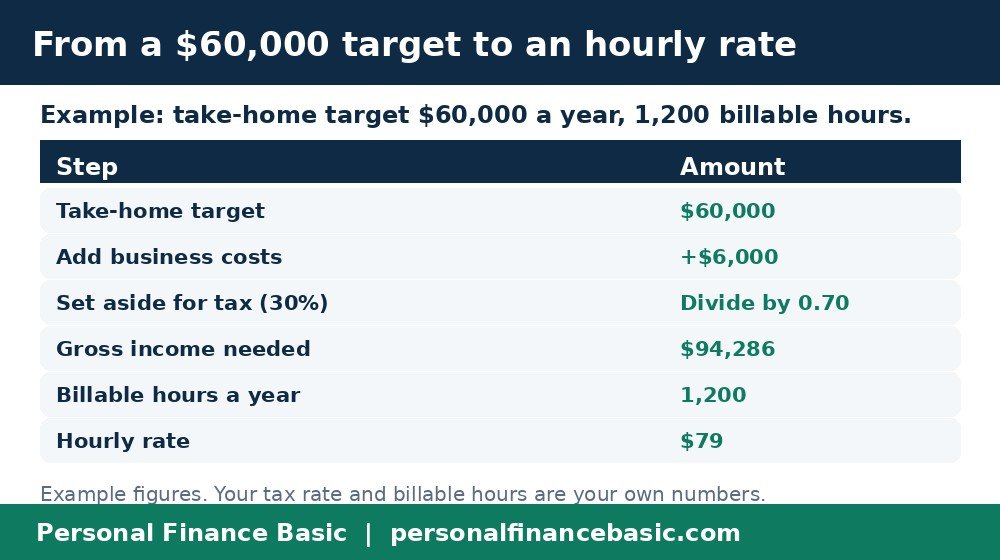
From a $60,000 target to an hourly rate.
Three ways to charge, compared
| Method | How it is priced | Best for |
|---|---|---|
| Hourly | Rate times hours worked | Open-ended work |
| Per project | One fixed price for the whole job | Work with a clear scope |
| Retainer | A set monthly fee for set hours or tasks | Regular monthly work |
Price a project from your hourly rate, not from a guess. Estimate the hours, multiply by your rate, then add 30% for scope creep: a 10-hour job at $79 an hour is $790, and with the buffer it prices at about $1,030. If the client wants a lower price, offer a smaller scope, not a lower rate.
- Best for beginners: hourly: easy to quote, track, and raise later.
- Best for experienced freelancers: per project: a fast worker earns more, because the price is tied to the result.
- Best for steady income: a retainer: monthly pay smooths out the quiet weeks.
Step 1: Start from the take-home you want
Pick the yearly pay you need after tax, the amount that covers your rent, food, bills, and saving. Do not start from the market rate or your old salary.
If you want $60,000 after tax, that is the starting point. If you want $40,000 while you learn, start there. The formula works at any size.
Step 2: Add back the self-employment tax
Self-employment tax is 15.3% of your net freelance income: 12.4% for Social Security and 2.9% for Medicare, according to the IRS. As an employee, your employer paid half; as a freelancer, you pay both. The tax is figured on 92.35% of net earnings, and half of it is deductible from income tax.
On top of that comes income tax, federal and state. Set aside 25 to 30% of every payment for all taxes combined, in a separate account, the day you are paid. Quarterly estimated tax payments are due four times a year.
Step 3: Add your business costs and benefits
List what your old employer used to pay for: health insurance, retirement contributions, paid holidays, sick days, software, and equipment. A freelancer pays for all of it.
Add the yearly total to your target before you divide by hours. Skipping this step is why many freelancers feel busy and broke at the same time: the rate covers the work, but nothing else.
Step 4: Divide by billable hours, not all hours
Most freelancers bill only 1,000 to 1,500 hours a year, about 50 to 70% of a full-time schedule. The rest goes to finding clients, emails, invoicing, and time off. Dividing by 2,000 hours gives a rate that is far too low.
Be honest about your billable hours. Track one month and count the hours a client actually paid for. If you bill 25 hours a week for 48 weeks, that is 1,200 hours. Use that number, not the one you wish were true.
Step 5: Check the market, then set the rate
The formula gives you a floor, not a sticker price. Check what other freelancers in your field charge, and charge the market rate if it pays more than your floor.
Quote the rate with confidence and in writing. A client who balks at a fair rate is telling you the budget is too small, or they never valued the work.
Step 6: Raise your rate over time
Review your rate every six months, and raise it when your costs rise, your skills improve, or you are turning work away. New clients pay the new rate from day one; existing clients get a month of notice. A small rise every year, 5 to 10%, keeps your pay in line with your costs.
At a glance
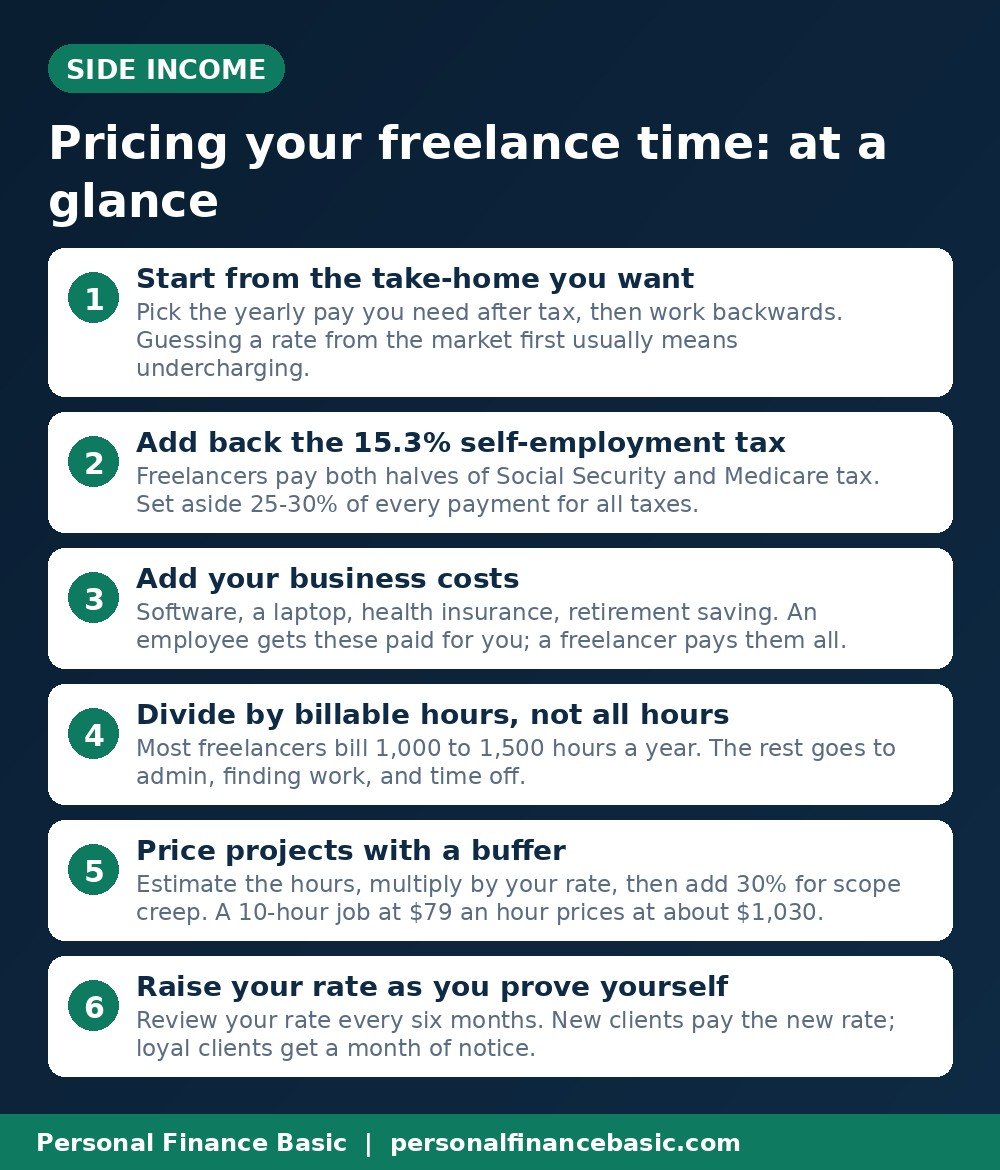
The main points from this guide, in one picture.
Frequently asked questions
What if my old salary was low? Should my freelance rate be low too?
No. Your freelance rate must cover tax, benefits, and unpaid time your old job absorbed, so it should be higher than your old hourly wage. Run the formula from the take-home pay you need.
How much should I set aside for taxes as a freelancer?
Set aside 25 to 30% of every payment for all taxes combined. The self-employment tax alone is 15.3%, and income tax comes on top. Your real rate depends on your total income and your state.
Should I charge by the hour or by the project?
Start by the hour while you learn how long jobs take. Move to project pricing once you can estimate a job well: it pays you for the result rather than the hours. Use the hourly rate to set the project price, then add a 30% buffer.
What if a client says my rate is too high?
Offer a smaller scope at the same rate, not the same work at a lower rate. A smaller job at a fair price keeps the relationship and your pay intact.
How often should I raise my freelance rate?
Review it every six months and raise it when your costs rise or your skills grow. A rise of 5 to 10% a year is normal. Give existing clients a month of notice.
The bottom line: work backwards from the pay you need, add the tax and the costs your old job used to cover, and divide by the hours you can really bill.
This guide is general education, not financial or tax advice. Your income, costs, and tax situation decide what applies to you.
Related reading: How to Start Freelancing on the Side While You Have a Job and Do You Pay Tax on Side Income in the US? Beginner Basics