Your job pays the bills, but the pay does not stretch far enough. A side income would help, and you already have a skill someone would pay for.
Freelancing on the side is the lowest-risk way to start. You keep the steady paycheck while you test whether clients will pay you, and you find out what the work is really like before you commit to it.
The trap is the tax. Freelance income has no withholding, and the self-employment tax adds 15.3% on top of income tax. Here is how to start clean and keep your day job safe.
The short answer
Pick one skill you already have, check that your job contract allows side work, set a rate that covers the 15.3% self-employment tax, and find your first clients through people you already know. Set aside 25 to 30 percent of every payment for tax.
The setup in five steps:
- Check your job contract for rules on side work and competitors.
- Pick one service to sell and name your price.
- Find your first three clients, starting with your own network.
- Open a separate account and set aside 25 to 30 percent of every payment for tax.
- Cap your freelance hours and keep the day job until the income proves itself.
Quick decision guide:
- Need cash fast? Start with small jobs on a freelance platform.
- Have a skill from your day job? Sell it directly to small businesses.
- Want steady income? Aim for one or two repeat clients on a monthly retainer.
What $500 a month of freelance income looks like
Take Jordan, who designs social media posts on weekends and earns $500 a month: $6,000 a year. After $600 of costs, the net profit is $5,400. Self-employment tax is 15.3% of 92.35% of that net, about $763 for the year, or $64 a month, and income tax comes on top. Setting aside 25 percent of each payment, $125 a month, covers it with room to spare. The figures are an example: your tax depends on your total income.
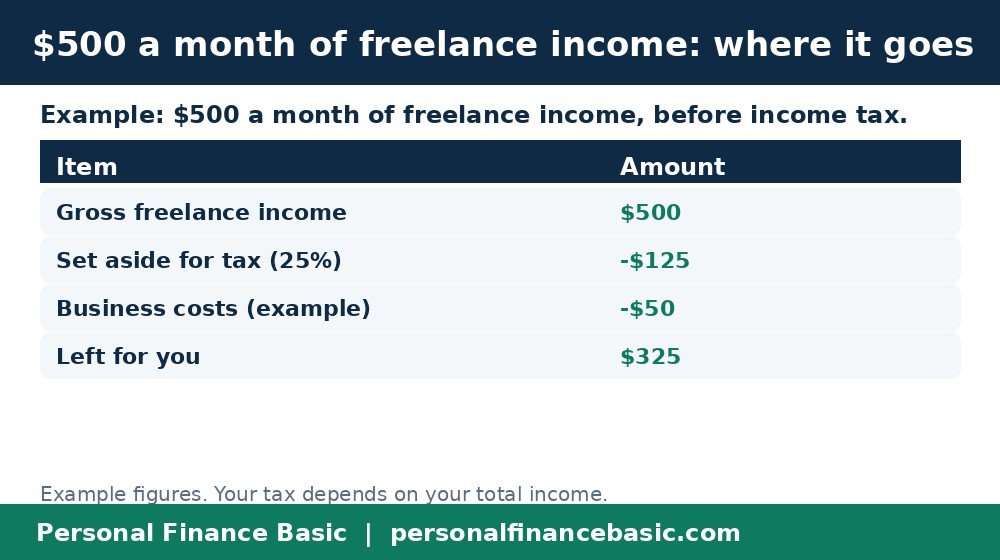
$500 a month of freelance income: where it goes.
Three ways to charge, compared
| Method | How you charge | Best for |
|---|---|---|
| Hourly | A set rate for each hour worked | Work with an unclear scope |
| Per project | One flat price for the finished job | Work you can do fast and well |
| Retainer | A fixed monthly fee for ongoing work | Steady income from repeat clients |
Per-project pricing usually pays best once you know how long a job takes. Hourly is safer while you are learning. Clients only agree to a retainer after they trust your work.
- Best for beginners: hourly, until you know your speed.
- Best for steady income: a monthly retainer with one or two clients.
- Not for: charging your old hourly wage. A job covers tax, insurance, and paid time off. Freelance work does not, so the rate has to be higher.
Step 1: Check your job contract first
Before you take a client, read your employment contract and any handbook rules on outside work. Some employers ban side work outright, and many ban work for competitors.
If the rules are unclear, ask. A short email to HR beats losing your job over a side project. Never use company equipment, time, or contacts for freelance work.
Step 2: Pick one skill to sell
Start with work you already know: writing, design, bookkeeping, coding, tutoring, video editing, or admin help. One clear service beats five vague ones.
Write the offer in one sentence: who it helps and what they get. “I write product descriptions for small online shops” gets clients; “I do marketing” does not.
Step 3: Set your rate with the tax in mind
Freelancers pay the 15.3% self-employment tax a job normally splits with you, plus income tax on top. Your rate has to cover both.
To keep $30 an hour after setting aside 30 percent for tax, you need to charge about $43 an hour ($30 divided by 0.70). That is the rate to quote, not $30. Check what others charge for the same work, then set your rate near that range.
- Best for: pricing by the value of the finished work, not by the hour you spent on it, once you know your speed.
Step 4: Find your first three clients
Your first clients usually come from people you already know: former colleagues, friends with small businesses, and local shops. Tell them what you do and ask who they know that needs it.
Freelance platforms can fill the gaps, but they take a cut and pay less at first. Use them for practice and reviews, then move good clients to direct work.
Step 5: Set up the money side
Open a separate bank account for freelance money, even a basic checking account. It keeps business costs apart from personal spending and makes the tax return far easier.
Set aside 25 to 30 percent of every payment for tax, the day you are paid. Self-employment tax starts once your net profit reaches $400 for the year. If you expect to owe $1,000 or more, the IRS wants quarterly payments: April 15, June 15, September 15, and January 15.
Clients must send a 1099-NEC for 2026 payments of $2,000 or more, but all freelance income is taxable whether you get a form or not. Track every payment and cost from day one.
Step 6: Protect your time and keep the job
Set a weekly cap, such as five to eight hours, and stick to it. Work that eats your evenings will wear you out, and tired work loses clients.
Let the side income prove itself for a few months before you change anything about your day job. A good test is three steady months that cover at least one real bill, such as groceries or the car payment.
At a glance
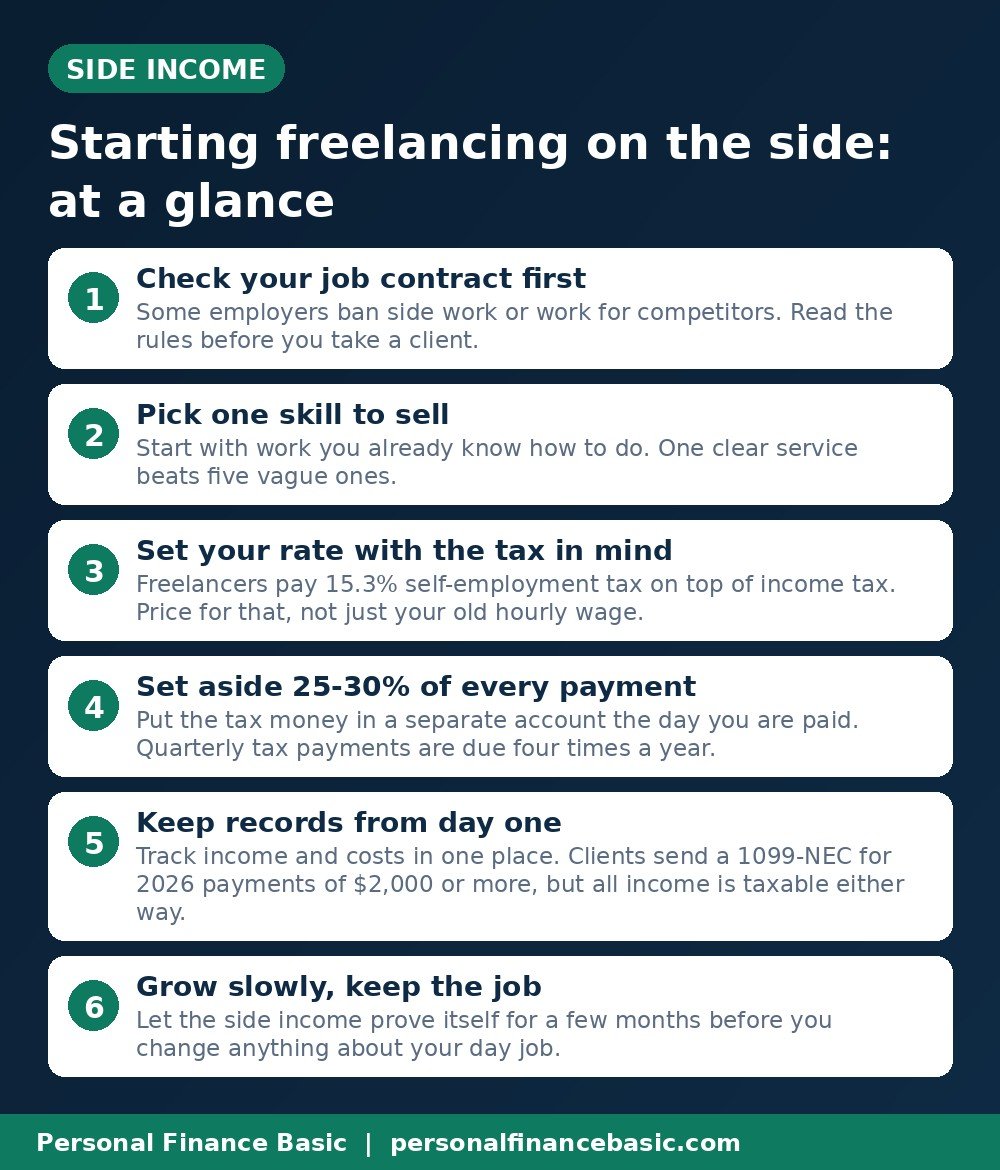
The main points from this guide, in one picture.
Frequently asked questions
Do I need to register a business to freelance?
No. You can start as a sole proprietor using your own name, and report the income on Schedule C with your tax return. Check local rules first: some cities want a business license.
How much tax should I set aside from freelance pay?
Set aside 25 to 30 percent of every payment. That covers the 15.3% self-employment tax plus income tax for beginners. If your day job puts you in a higher bracket, set aside more.
What if I earn less than $600 from a client?
You still report it. For 2026 payments, clients must send a 1099-NEC at $2,000 or more, but that is the client’s reporting duty, not yours. All freelance income is taxable, even $50, even with no form.
Can my employer stop me from freelancing?
Sometimes. Your contract may ban side work, work for competitors, or work in the same field. Read it first, and ask HR if it is unclear. Never freelance for your employer’s clients or on company time.
When can I quit my job to freelance full time?
Not on one good month. Wait until freelance income covers your bills for three to six steady months, you have three months of expenses saved, and you have a health insurance plan. Until then, the day job is your safety net.
The bottom line: keep the job, sell one skill, set the rate for the tax, and save 25 to 30 percent of every payment. Freelancing works best as a slow build, not a leap.
This guide is general education, not financial or tax advice. Tax rules depend on your situation and change over time. Consider speaking with a qualified tax professional about your own circumstances.
Related reading: 10 Side Hustles You Can Start With No Money in the US and Do You Pay Tax on Side Income in the US? Beginner Basics