A mistake on your credit report is more than an annoyance. A balance that is too high, a late payment you never made, or an account that is not yours can lower your credit score, raise the interest rate on a loan, or cost you a rental application. Federal law gives you a clear way to fix it for free.
The Fair Credit Reporting Act, the federal law that governs credit reports, gives you the right to dispute anything you believe is wrong. The credit bureau has to investigate, usually within 30 days, and correct or remove anything it cannot verify. You do not need a lawyer or a credit repair company.
What counts as an error?
Not every item you dislike is an error. A late payment that really happened is accurate information, and disputing it will not remove it. An error is information that is factually wrong.
Start with the accounts. Check that every account listed belongs to you, that the balances are right, and that the payment history is correct. A card you closed years ago showing as open, a loan balance that never went down after you paid it off, or a payment marked late in a month you paid on time are all errors worth disputing.
Then check the personal details. A wrong address, a misspelled name, or a Social Security number that is not yours can mean someone else’s information got mixed into your file. Also look for duplicate accounts and old negative items that should have fallen off. Most negative information, such as a late payment or a collection account, cannot stay on your report for more than seven years from the date of the first missed payment.
Get your three reports, free
You cannot dispute what you have not seen. The only site authorized by federal law to give you free credit reports is AnnualCreditReport.com. The three major bureaus, Equifax, Experian and TransUnion, offer free reports every week through that site. Avoid lookalike sites with similar names. Many try to sell you a paid service.
Pull all three reports, not just one. The bureaus do not share the same data. A lender may report to only one or two of them, so an error can appear on your Experian report and nowhere else. Check each report line by line, and write down every error you find, along with which bureau shows it. You will need to file a separate dispute with each bureau that has the error.
Gather your proof before you file
A dispute works best when you send evidence with it. Bank statements and payment confirmations are the strongest proof for a wrong balance or a payment marked late. A payoff letter proves a loan is closed.
For each error, write one short sentence that says what is wrong and what the correct information is. For example: “This account shows a balance of $1,840. The correct balance is $0. I paid it in full on 3 March 2026.” Being specific helps the bureau check the right thing.
Keep copies of everything you send, and note the date you filed. If you file by mail, use certified mail with a return receipt, so you have proof of when the bureau received your dispute. That date starts the clock on the investigation.
File the dispute with the bureau
You can file online, by mail, or by phone. Online is the fastest. Mail gives you the best paper trail, which matters if you later need to show what you sent and when. If you phone, ask for a confirmation number and write it down.
Your dispute should include your full name, address, and date of birth, the account name and number, a clear statement of what is wrong, the correction you are asking for, and copies of your supporting documents.
File with every bureau that shows the error. If the same wrong late payment appears on all three reports, that means three disputes, one to each bureau. The bureaus do not fix each other’s files.
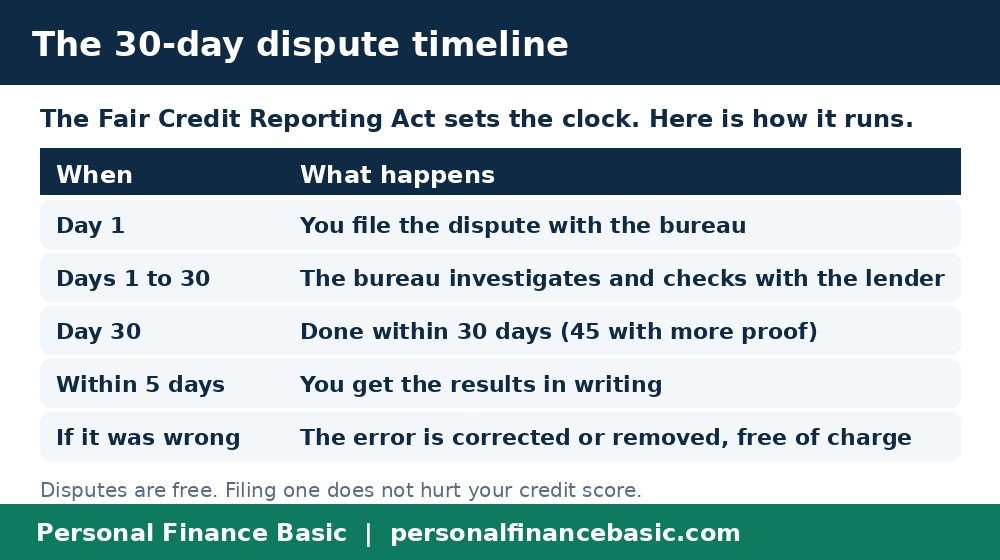
The 30-day dispute timeline under the Fair Credit Reporting Act.
What happens after you file
Once the bureau receives your dispute, it forwards it to the lender that reported the information, called the furnisher. The furnisher checks its own records and reports back. The bureau must finish the investigation within 30 days, or 45 days if you send more information during that period.
When the investigation is done, the bureau must send you the results in writing within five business days. If the information was wrong, it must correct or remove it and send you a free copy of your updated report. If it was verified as correct, the item stays.
While the dispute is open, the bureau marks the item as disputed on your report. That note does not hurt your score by itself, and it tells any lender reading the report that the item is under review. Filing a dispute is free, and it does not lower your credit score.
If the bureau says no
A denial is not the end of the road. Dispute the same error directly with the lender that reported it. Lenders have their own dispute process and must also investigate. Sometimes the lender finds the mistake even when the bureau did not.
If that does not work, add a statement of up to 100 words to your credit file, explaining your side. Any lender who pulls your report will see it. It does not change your score, but it adds context.
You can also complain to the Consumer Financial Protection Bureau at consumerfinance.gov. The agency forwards your complaint to the bureau and asks for a response, usually within 15 days. Many stalled disputes get a second look after a complaint.
If the error caused real harm, for example a loan denial, you have the right to ask the bureau for a description of how it checked the information. Under the law, it has to send that to you within 15 days. Keep that letter.
At a glance
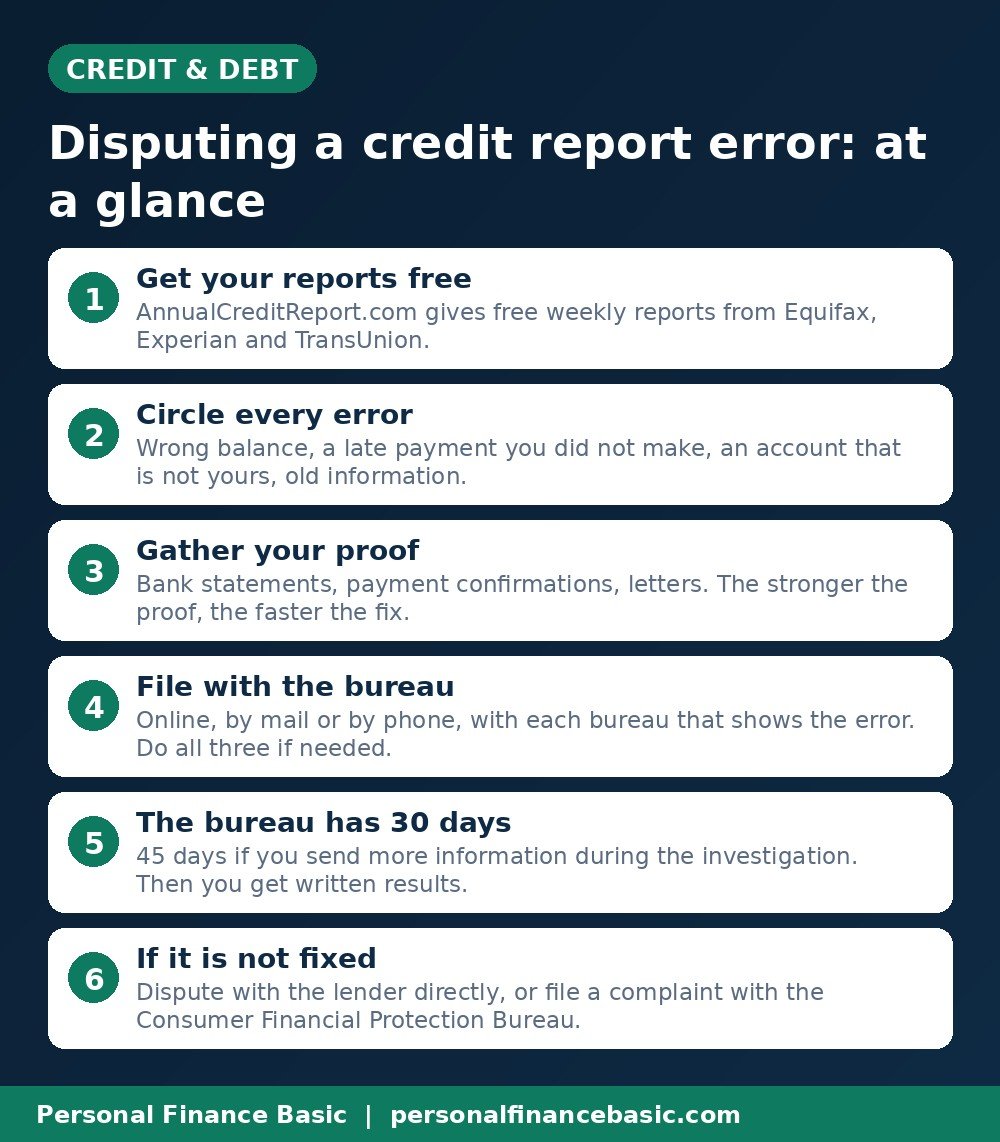
The main points from this guide, in one picture.
Frequently asked questions
How do I get my credit reports for free?
Go to AnnualCreditReport.com, the only site authorized by federal law. All three bureaus offer free weekly reports there. Pull all three, because an error can appear on one report and not the others.
How long does a credit bureau have to investigate my dispute?
Usually 30 days from the day the bureau receives your dispute, or 45 days if you send more information during that time. The bureau then has five business days to send you the written results.
Does filing a dispute hurt my credit score?
No. Filing a dispute is free, and it does not lower your score. The disputed item is marked as under review, and if the information was wrong, removing it can raise your score.
What if the error is only on one bureau’s report?
File only with the bureau that shows the error. The bureaus keep separate files. If the same error appears on two or three reports, file a separate dispute with each one.
What should I do if the bureau denies my dispute?
Dispute the same error directly with the lender, add a 100-word statement to your credit file, or complain to the Consumer Financial Protection Bureau at consumerfinance.gov. You can also ask the bureau for a written description of how it investigated.
This guide is general education, not financial or legal advice. Credit reporting rules are set by federal law, and your rights can depend on your situation. Consider speaking with a qualified financial adviser or consumer lawyer about your own case.
Related reading: How to Improve Your Credit Score in 6 Months and Does Checking Your Own Credit Score Hurt It?