
On 5 November 2026, the Internal Revenue Service published the federal tax numbers for 2027. The standard deduction goes up, the tax brackets get wider, and the child tax credit rises by $100. The tax rates themselves do not change.
These are the numbers that will apply to the money you earn in 2027, on the tax return you file in early 2028. They do not change the return you file in April 2027. That return still uses the 2026 numbers. Here is what changed and what it is worth.
The standard deduction goes up
The standard deduction is the amount of income you do not pay federal income tax on. You subtract it from your income before the tax rates apply. Most filers take the standard deduction instead of listing individual deductions, so this is the number that matters most for most people.
For 2027, the IRS set the standard deduction at $33,200 for married couples filing jointly, up $1,000 from $32,200 in 2026. For single filers and married people filing separately, it is $16,600, up $500 from $16,100. For heads of household, it is $24,925, up $775 from $24,150.
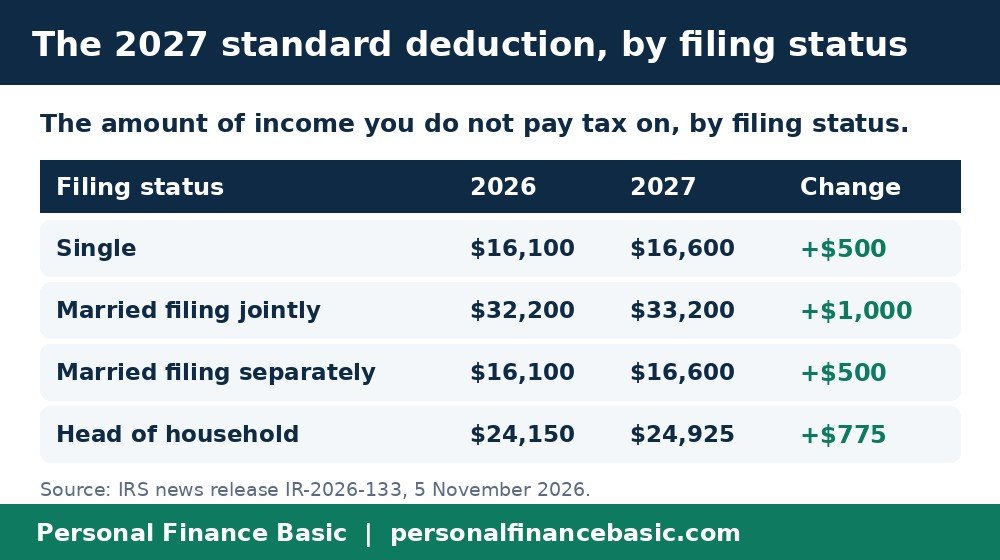
The 2027 standard deduction, by filing status. Source: IRS news release IR-2026-133, 5 November 2026.
People who are 65 or older, or blind, get an extra amount on top of the standard deduction. For 2027 that extra amount is $1,700 for each qualifying married person, or $2,100 for someone who is unmarried and not a surviving spouse. A married couple filing jointly in 2027 with both spouses 65 or older would have a standard deduction of $36,600.
What is the extra deduction worth? A single filer in the 12% bracket saves $60 on the extra $500 of deduction. The same filer in the 22% bracket saves $110. A married couple filing jointly saves $120 in the 12% bracket and $220 in the 22% bracket on their extra $1,000.
The tax brackets get wider
The seven federal income tax rates stay the same for 2027: 10%, 12%, 22%, 24%, 32%, 35% and 37%. What moves is the income range each rate applies to. The IRS adjusts the brackets for inflation each year, and for 2027 the adjustment is about 3.2%.
For a single filer in 2027, the 10% rate applies to taxable income up to $12,800. The 12% rate starts above that, the 22% rate starts above $52,025, and the 24% rate starts above $109,125. The top rate of 37% starts above $661,375. For married couples filing jointly, the same rates start at double those amounts in most cases: 22% above $104,050, 24% above $218,250, and 37% above $793,650.
Take a single filer who earns $60,000 in 2027 and takes the standard deduction. Taxable income is $60,000 minus $16,600, or $43,400. The first $12,800 is taxed at 10% ($1,280) and the remaining $30,600 at 12% ($3,672), for a federal income tax of $4,952 before any credits.
Wider brackets mean a little more of your income is taxed at the lower rates, which helps when your pay rises with inflation.
The child tax credit and other numbers
The maximum child tax credit for 2027 is $2,300, up $100 from $2,200 in 2026. The refundable part of the credit, the amount you can get back even if you owe no tax, rises to $1,800, also up $100.
The annual gift tax exclusion rises to $20,000 per recipient, up from $19,000. That means you can give up to $20,000 to any one person in 2027 without using any of your lifetime gift tax exclusion or filing a gift tax return for that gift. The estate tax exclusion rises to $15.48 million per person.
The IRS release covers almost 70 tax provisions in all. The full tables are in Revenue Procedure 2026-35 on the IRS website.
What has not changed, and what is still missing
First, the 2027 contribution limits for 401(k) plans and IRAs have not been published yet. The IRS announces those in a separate release, usually in late November. Until that release lands, do not plan on a 2027 limit number you saw in a headline. The 2026 limits still govern: $24,500 for 401(k) deferrals, with an $8,000 catch-up for people 50 and older and $11,250 for ages 60 to 63.
Second, nothing in this release changes the tax return you file in April 2027. That return covers income earned in 2026 and uses the 2026 numbers: a $16,100 standard deduction for single filers and $32,200 for married couples filing jointly, and a $2,200 child tax credit. Mixing up the two years is the easiest mistake to make with this news.
What to do now
There is no form to fill in and no deadline tied to this announcement.
Check your first pay stub of January 2027. Employers update their payroll withholding tables for the new year, so your take-home pay should reflect the wider brackets and higher standard deduction automatically. If a January stub looks wrong, that is the time to ask your payroll department.
If you give money to family, note the $20,000 gift exclusion for 2027. Gifts you make in the rest of 2026 still fall under the 2026 limit of $19,000 per person.
If you are planning 2027 retirement contributions, wait for the IRS retirement limits release before you set a number.
Finally, if you itemize deductions, compare your total with the new standard deduction when 2027 arrives. If your itemized total is lower, the standard deduction is the better choice.
At a glance
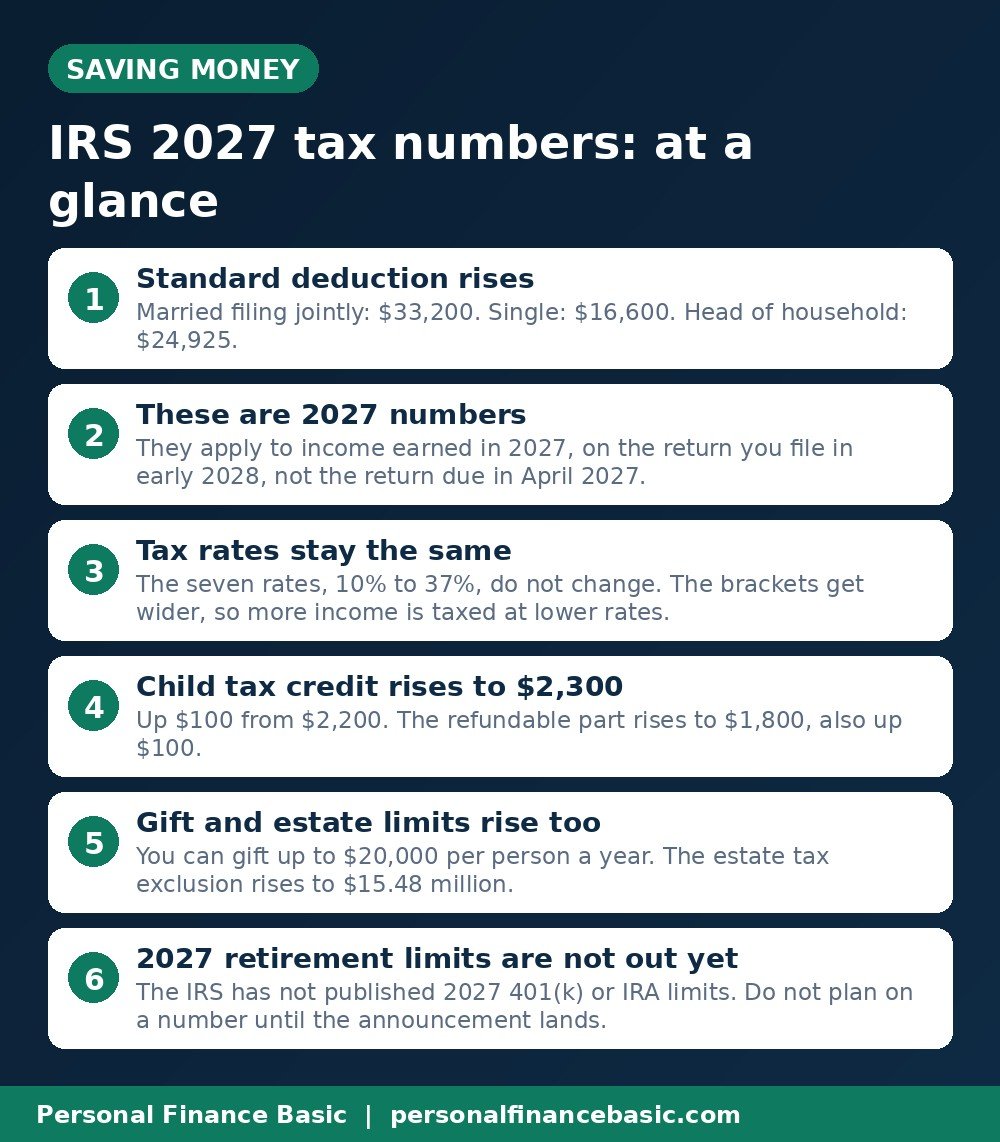
The main points from this guide, in one picture.
Frequently asked questions
When do the 2027 tax numbers apply?
They apply to income earned in 2027, on the tax return you file in early 2028. The return due in April 2027 covers 2026 income and uses the 2026 numbers.
Did tax rates go up or down for 2027?
Neither. The seven rates, from 10% to 37%, are unchanged. The income ranges each rate applies to got wider, which means more of your income is taxed at the lower rates.
How much money will the higher standard deduction save me?
It depends on your tax bracket. A single filer saves $60 in the 12% bracket and $110 in the 22% bracket from the extra $500 of deduction. A married couple filing jointly saves $120 in the 12% bracket and $220 in the 22% bracket from the extra $1,000.
What about the 2027 401(k) and IRA limits?
The IRS has not published them yet. They come in a separate announcement, usually in late November. The 2026 limits still apply until then.
Should I stop itemizing deductions now that the standard deduction is higher?
Compare the two when 2027 arrives. If your itemized deductions add up to less than the new standard deduction, the standard deduction is the better choice.
This guide is general education, not financial or tax advice. The right amounts depend on your income, costs, and goals. Consider speaking with a qualified tax professional about your own situation.
Related reading: Roth IRA for Beginners: How It Works and Who It Suits and 401(k) vs Roth IRA: Which Should a Beginner Choose First?