Every year has bills that do not arrive monthly: car repairs, holiday gifts, a car insurance premium, a vet visit, back-to-school costs. They are not surprises, you know they are coming, but they still wreck the month they land in. A sinking fund is the simple fix: you save a little for each one, every month, so the money is already there when the bill arrives.
It is one of the oldest budgeting ideas around, and it works because it turns a big, irregular cost into a small, regular one: a $1,200 insurance bill becomes $100 a month. This guide explains what sinking funds are, how they differ from an emergency fund, and how to set up your first ones.
What a sinking fund is
A sinking fund is money you set aside, a little at a time, for a specific planned expense. You pick the expense, work out what it will cost, and divide that total by the months until you need it. Each month you move that amount into the fund, and when the bill comes you pay it from the fund instead of that month’s paycheck.
Many people keep each fund in its own labeled savings bucket, sometimes called a sub-account, inside one savings account. Others track the same thing in a spreadsheet or a budgeting app. The container matters less than the habit: one expense, one target, one regular transfer.
Common sinking funds cover car maintenance and repairs, annual insurance premiums, car registration, holiday gifts, birthdays, vacations, home repairs, and medical and dental costs. Start with the expenses that hurt your budget most last year: look at your last 12 months of bank statements and the answer is usually obvious.
Sinking fund vs emergency fund
Sinking funds and emergency funds look alike, both are savings, but they do different jobs. A sinking fund is for a cost you can see coming, such as a car repair you know is due. An emergency fund is for a cost you cannot, such as a job loss.
They come in an order. If your budget only has room for one right now, build a small starter emergency fund first, often $500 to $1,000, then layer in sinking funds as cash flow allows. The starter fund stops the first surprise from going on a credit card. The sinking funds stop the predictable bills from doing the same.
Keep them separate. Mixing the two means a holiday fund quietly becomes the car repair fund, and then neither is ready when its turn comes.
The formula, worked out in dollars
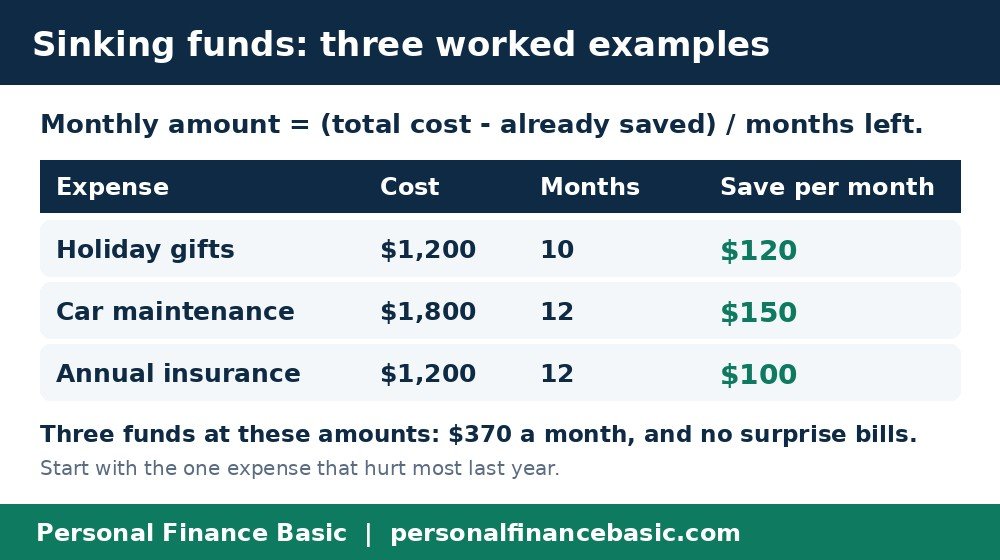
Monthly amount = (total cost minus what you already saved) divided by months left.
The formula is short: monthly amount equals the total cost minus anything saved, divided by the months until you need it. A holiday budget of $1,200 with ten months to go means $120 a month. Car maintenance of $1,800 over twelve months means $150 a month. An annual insurance bill of $1,200 means $100 a month.
Those three funds together come to $370 a month, which sounds like a lot, so start with one or two funds, not all of them at once. Pick the expense that caused the most stress last year, fund that one, and add the next when the habit feels routine. Three to five funds is a sensible number for most households once the system is running.
If the monthly number comes out too high, start earlier, lower the target, or split the expense. A $1,200 holiday budget started in January costs $100 a month. Started in July it costs $200 a month. The earlier you start, the smaller the monthly bite.
How to set up your first sinking funds
Step one is to list the expenses that do not arrive every month. Go through the last 6 to 12 months of bank and card statements and write down every non-monthly charge that knocked your budget sideways: car repairs, annual insurance, gifts, vacations.
Step two is to put a cost and a date on each one. Use last year’s real number where you have it: if your car cost $1,800 in maintenance last year, use $1,800. A guess is fine for a new expense, but a real number from your own records is better.
Step three is to run the formula and write down the monthly amount for each fund. Step four is to open the buckets: many savings accounts let you create named sub-accounts for free, or you can track them in a spreadsheet. Label each bucket with the expense and the target date.
Step five is to automate it. Set a transfer for the day after payday so the money moves before you can spend it. If your budget is tight, start small: even $10 to $25 per paycheck gets the habit going. Check in once a month to see each fund is on track, and move money between funds only when a date or a cost changes.
Where to keep the money
A savings account is the usual home. The money earns a little interest, it is FDIC insured up to $250,000 per depositor, per bank, and you can reach it when the bill comes. A high-yield savings account earns a fair rate while the money waits.
Do not put sinking fund money in investments. The money has a job and a date, and stocks can fall in the same month the bill arrives. Do not keep it as cash at home either: cash earns nothing, it is not insured, and it is too easy to spend.
Mistakes to avoid
The first mistake is starting too many funds at once. Twelve funds at $5 each feels like nothing is working. Start with three and add more later.
The second is treating a sinking fund as spare cash. When the holiday fund is full in November and a sale appears in October, it is tempting to borrow from it. If you do, pay it back before the bill arrives.
The third is forgetting to adjust. Insurance goes up, the car gets older, the list grows. Review each fund once a year, or whenever a cost changes, and update the monthly amount.
At a glance
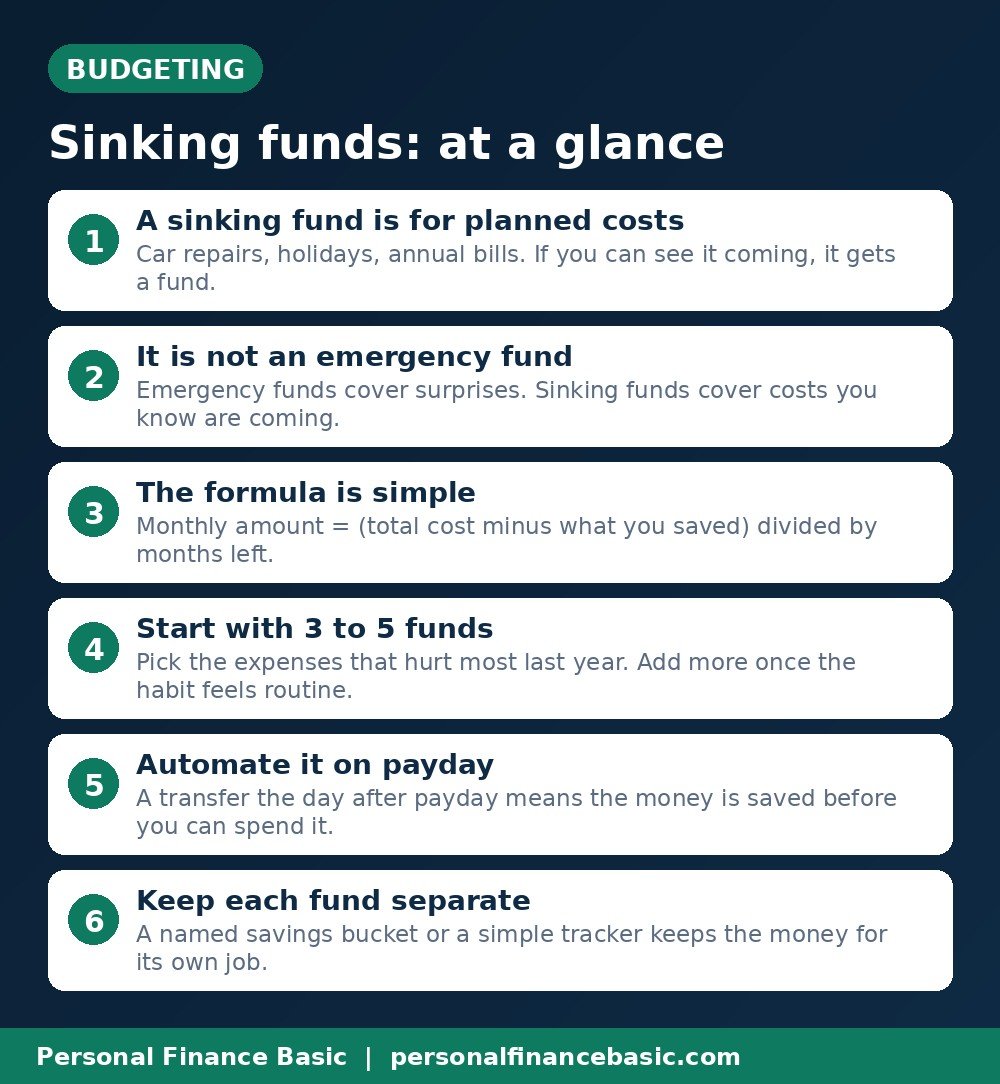
The main points from this guide, in one picture.
Frequently asked questions
How much money should I put in a sinking fund?
Use the formula: total cost minus savings so far, divided by the months until you need it. A $1,200 bill with 12 months to go means $100 a month.
How many sinking funds should I have?
Three to five is a sensible starting point. Pick the expenses that caused the most stress last year, such as car costs or holiday spending, and add more once the habit feels routine.
Is a sinking fund the same as an emergency fund?
No. A sinking fund is for a planned expense you can see coming. An emergency fund is for surprises such as a job loss or a sudden medical bill. Keep them separate.
Where should I keep sinking fund money?
In a savings account, ideally a high-yield one, in a named bucket for each fund. The money earns a little interest, it is FDIC insured, and it is easy to reach when the bill arrives.
What if I cannot afford all my sinking funds?
Start with one. Fund the expense most likely to wreck your month, even at $10 to $25 per paycheck. A small fund that is actually funded beats a perfect plan that never starts.
This guide is general education, not financial advice. The right amounts depend on your income, costs, and goals. Consider speaking with a qualified financial adviser about your own situation.
Related reading: The 50/30/20 Rule With US Examples ($3,000 a Month) and How Much Emergency Fund Do You Need? With $ Examples