Paying off credit card debt on a low income can feel impossible, because little money is left after rent, food, and bills. A payoff plan does not need a large payment to work. It needs a payment you can repeat every month, a clear order for your cards, and no new charges added on top.
Why card debt is so costly on a low income
Credit card interest is charged as an annual percentage rate, or APR. The Federal Reserve reported an average APR of about 22.3% for accounts that were actually charged interest in late 2025. At 24% APR, a $3,000 balance adds about $60 in interest in a single month if nothing is paid.
That interest takes a larger share of a small paycheck. If you pay $75 a month on a $3,000 balance at 24% APR, only about $15 goes to the balance in the first month. The other $60 covers interest. The balance falls slowly, which is why card debt can last for years even when you pay every month. The fix is to change one thing: the payment amount.
Step 1: Write down every card you owe
For each card, write the balance, the APR, the minimum payment, and the due date. Many people find that one card charges far more than the rest, or that the total is smaller than they feared. Either way, the list turns a vague worry into numbers you can work with.
| Card | Balance | APR | Minimum |
|---|---|---|---|
| Card A | $1,400 | 24% | $35 |
| Card B | $900 | 19% | $25 |
| Card C | $700 | 22% | $25 |
| Total | $3,000 | $85 |
The minimum is often 1% of the balance plus that month’s interest, or a flat amount such as $25 to $35, whichever is higher. Your card agreement states the exact formula. If a statement is hard to read, call the number on the back of the card and ask for the balance, APR, and minimum in plain words.
Step 2: Pay every minimum on time
Before you pay extra on any card, pay the minimum on every card by its due date. A late payment can add a fee of $30 or more, and a payment reported late can hurt your credit score. Payment history is 35% of a FICO score, the largest single factor, so on-time payments protect both your money and your score.
Set up automatic payments for at least the minimum if your bank offers it, or set a reminder for two days before each due date. If money runs short, pay the minimums first.
Step 3: Pick one card for extra money
Once every minimum is covered, send any extra money to one card only. The avalanche method sends extra money to the card with the highest APR first. In the example, that is Card A at 24%. This method saves the most interest over time.
The snowball method sends extra money to the card with the smallest balance first, here Card C at $700. Clearing a whole card gives a clear win early. It may cost a little more interest, but a plan you finish beats a perfect plan you quit. When the first card is paid off, move its whole payment to the next card.
A fixed payment changes the math
The minimum payment falls as the balance falls. That sounds helpful, but it stretches the payoff out for years. A fixed payment stays the same, so more of each payment reaches the balance as the interest portion shrinks.
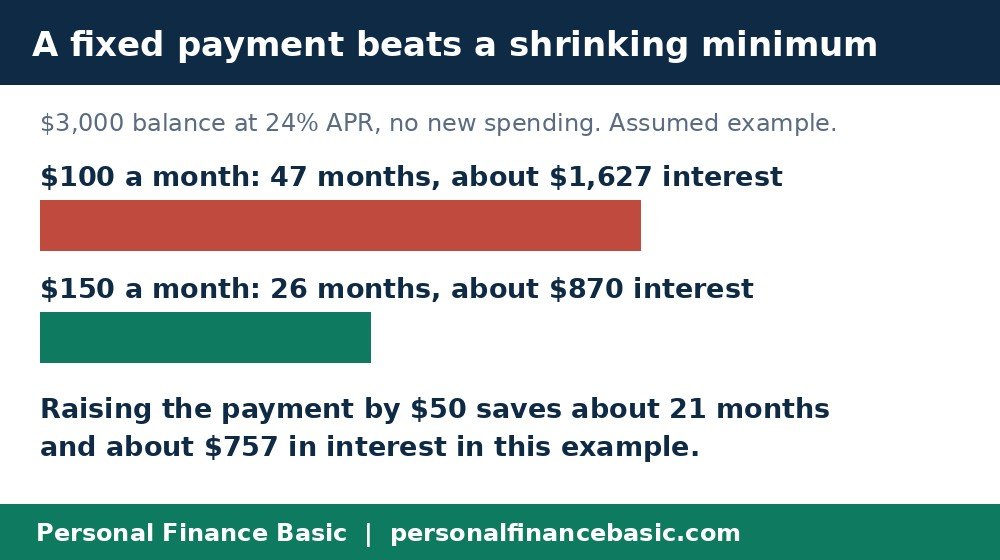
A fixed payment clears the same balance sooner than a shrinking minimum. Figures are a worked example at one APR, not a promise for any card.
On a $3,000 balance at 24% APR, with no new spending and no fees, $100 a month clears it in about 47 months with about $1,627 in interest. At $150 a month, it clears in about 26 months with about $870 in interest. The $50 difference saves about 21 months and about $757 in interest in this example. To set a fixed payment, take your first minimum and round it up to a number you can repeat. If the minimum is $85, try $100, and raise it when a bill drops or your pay rises.
Step 4: Find $25 to $50 a month
Keep the target small. Look for one change worth $25 to $50 a month rather than a full budget overhaul: a streaming service you rarely open, a food delivery habit replaced by one home-cooked meal a week, or a phone plan checked against a cheaper option. Selling items you no longer use can fund the first few extra payments.
Also check benefits you may qualify for, such as utility or food assistance. Every dollar a program covers is a dollar that can go to the card balance.
When even the minimum feels out of reach
If the minimum itself is the problem, call the card issuer before the due date and ask about a hardship program. Many issuers can lower the APR or the payment for a set period, often 6 to 12 months. A hardship plan may close the card to new spending, so ask what changes before you agree.
A nonprofit credit counselor can also review your budget and, if it fits, set up a debt management plan, where you make one monthly payment to the agency and it pays your creditors. Look for an agency that belongs to the National Foundation for Credit Counseling and explains its fees in writing before you sign anything. Avoid any company that charges a large upfront fee or promises to erase your debt.
While the balance is falling, use cash or a debit card for daily spending. Once the cards are paid off, keep the oldest card open with a small charge paid in full each month.
At a glance
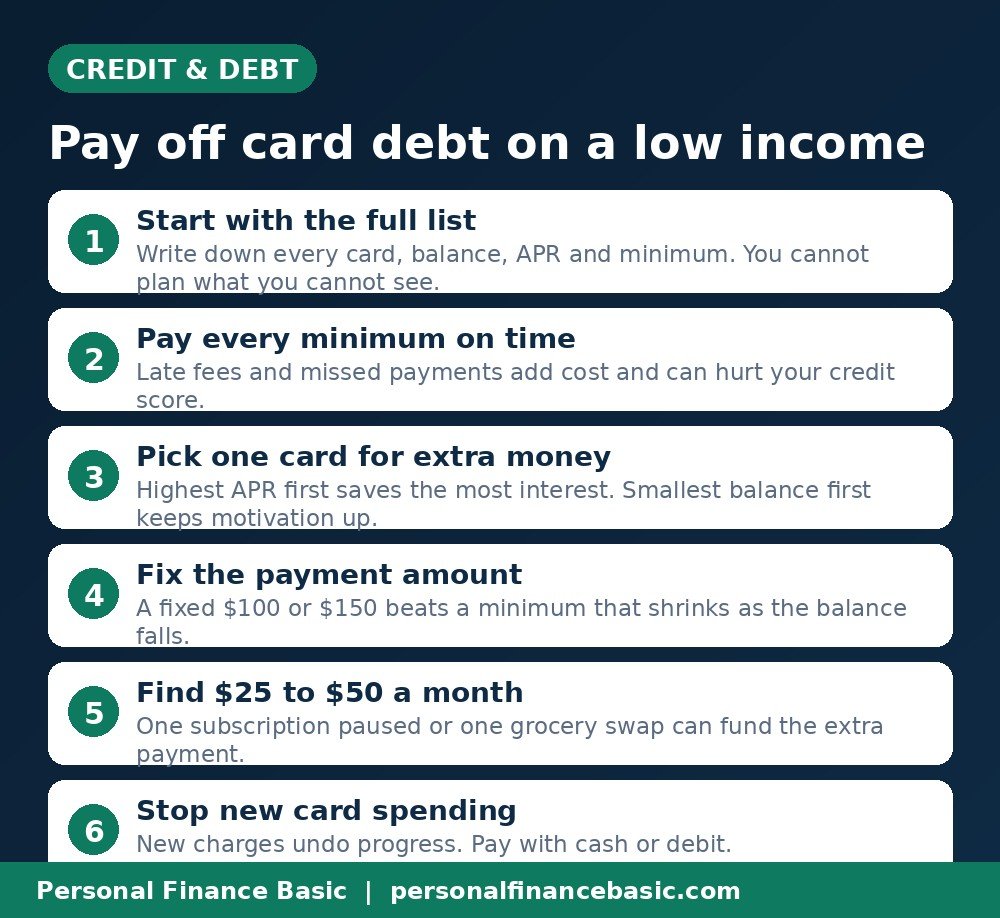
The main points from this guide, in one picture.
Frequently asked questions
How much should I pay on a credit card if I have a low income?
Pay at least the minimum on every card, on time, then send any extra money to one card. Even $25 extra a month shortens the payoff. Pick an amount you can repeat in a tight month.
Should I pay the highest APR card or the smallest balance first?
The highest APR first saves the most interest. The smallest balance first gives a faster win. Both work if you keep paying, so choose the method that keeps you going for the full payoff.
Can I pay off credit card debt without a high income?
Yes, but it takes longer. A $3,000 balance at 24% APR clears in about 26 months at $150 a month in the example above. Smaller payments still work; they take more months and cost more interest.
Will paying only the minimum hurt my credit score?
Paying the minimum on time does not hurt your score the way a missed payment does, though a high balance relative to your limit can still hold it down.
What should I do if I cannot pay the minimum?
Contact the issuer before the due date about a hardship program, or speak with a nonprofit credit counselor. Do not ignore the bill.
This guide is general education, not financial or tax advice. Your card terms, rates, and options depend on your issuer and your situation. If debt feels unmanageable, speak with a nonprofit credit counselor or a qualified financial professional about your own case.
Related reading: Debt snowball vs. debt avalanche: which should you use? and What Is a Good Credit Score in the US?