
Investing can sound like something you do only after you have a large sum saved. In practice, many people start with a small, regular amount and let time do much of the work. One hundred dollars a month is not a large amount on its own, but paid in month after month, it can grow into a meaningful sum. This guide sets out a simple order of operations, a clear example, and the risks to keep in mind.
Before you invest a dollar
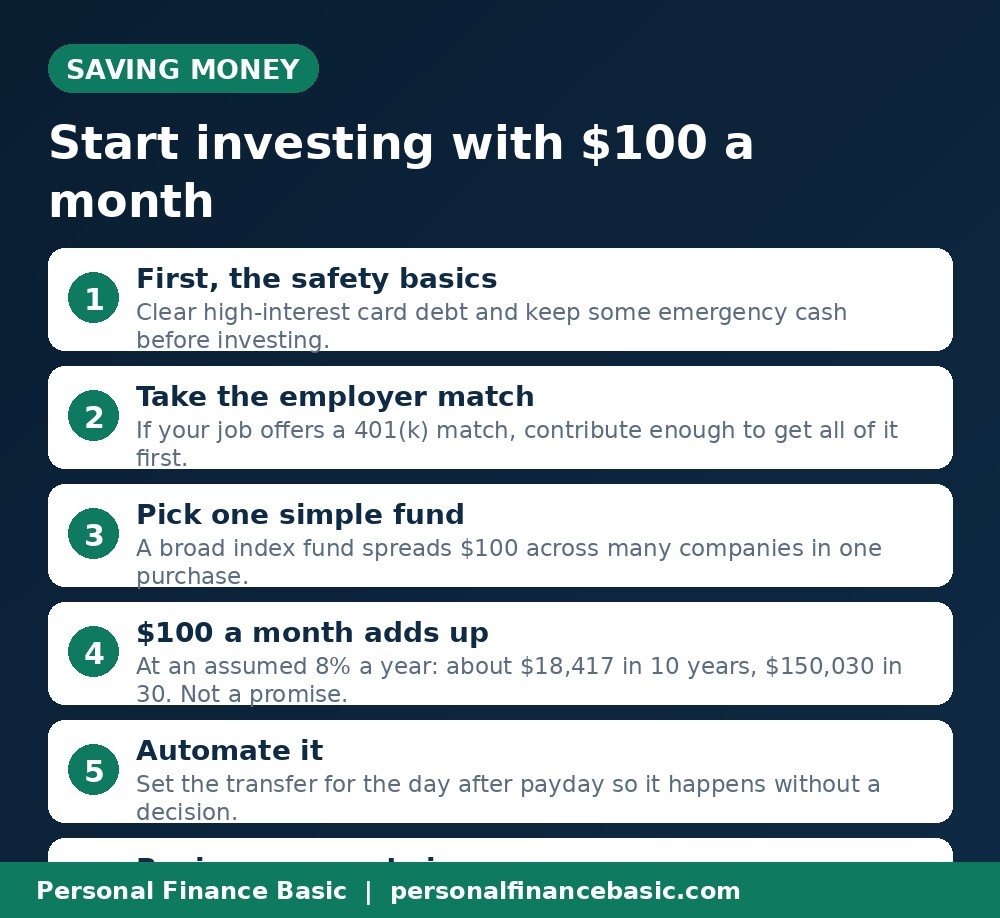
Investing works best when the basics are already in place. Keep some emergency cash aside first, so a sudden bill does not force you to sell investments at a bad time. Our guide to how to build an emergency fund explains how to start with a small starter fund and build from there. A starter fund of $500 to $1,000 covers many common surprises.
Clear high-interest card debt first as well. Card interest often runs far above the return most investments earn in a typical year, so paying that debt down usually beats investing the same money. That does not mean you must be debt-free before you invest at all. It means high-interest debt should come before extra investing, once you have a starter emergency fund and any employer match is covered, as explained below.
Get the full employer match first
If your employer offers a 401(k) match, contribute enough to get the full match before anything else. A match is money your employer adds when you contribute, and turning it down is like leaving part of your pay on the table. For example, if an employer matches the first 3 percent of your pay, contributing at least 3 percent gets the full match. The exact match formula differs by employer, so check your plan documents or ask your human resources team how yours works.
Then a Roth IRA or a regular brokerage account
After the match, a Roth IRA is a common next step for many beginners. You open it yourself, outside your employer, and you contribute after-tax money. Qualified withdrawals in retirement are tax-free, which can be useful if you expect to be in a higher tax bracket later. There are income limits on who can contribute, and a yearly limit set by the IRS, so check the current rules before you open one.
A regular brokerage account is another option. It has no special tax treatment and no yearly contribution limit of the same kind, and you can withdraw money at any time, although you may owe tax on gains. For money meant for retirement, a Roth IRA is often the better first home, if you are eligible.
Pick one broad, low-cost index fund
Beginners often do better with one broad, low-cost index fund than with single stocks. An index fund holds a wide range of companies at once, so one company doing badly does not sink the whole account. A broad fund that tracks a large part of the United States stock market gives you that spread in a single holding. Low cost matters because fees come out of your return every year, and a small fee difference adds up over decades.
Do not try to pick the next winning stock with your first $100. Stock picking takes time, research, and a tolerance for losses that most beginners have not built yet. One fund, held for years, is a simpler plan and an easier one to stick with when markets fall. If you want to test different amounts, try our free mutual fund calculator and change the monthly amount, the time period, and the assumed return to see how the numbers move.
Automate the transfer for just after payday
Set the transfer to leave your account just after payday, before you have a chance to spend it. Automation removes the monthly decision, and it keeps the habit going in busy months. If $100 feels tight at first, start with what you can manage and raise it later. A smaller amount paid every month beats a larger amount paid only when you remember.
A hypothetical example, at 8 percent a year
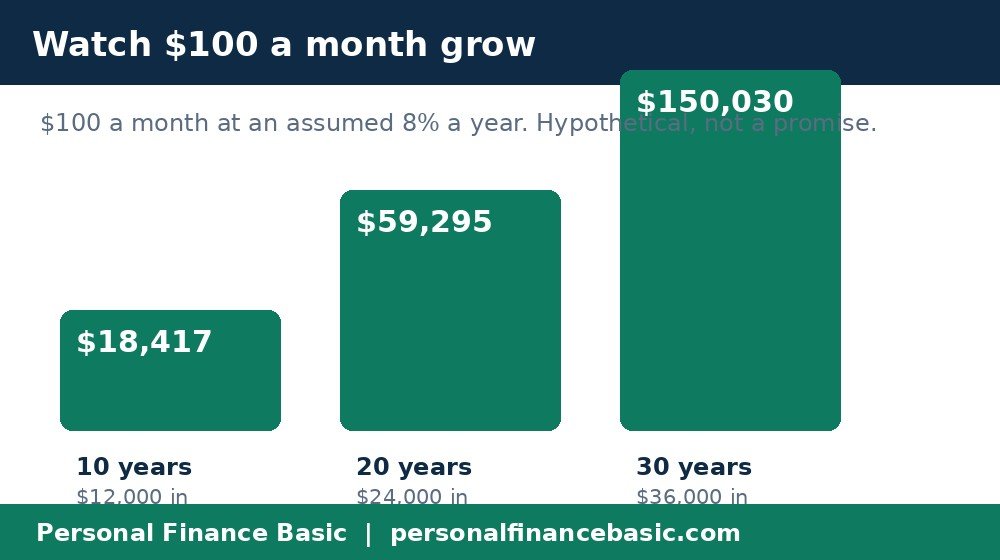
The numbers below are a hypothetical example, clearly labeled as an assumption at 8 percent a year, not a forecast. They match the method used by this site’s own calculator. They assume $100 is paid in each month, with no fees, taxes, or breaks in payment, and with growth compounding over time. Real returns will differ, and some years will be lower or even negative.
After 10 years, you would have paid in $12,000, and the account would be worth about $18,417 in this example. After 20 years, you would have paid in $24,000, and the account would be worth about $59,295. After 30 years, you would have paid in $36,000, and the account would be worth about $150,030. The gap between what you paid in and the final value grows over time, because growth in later years is earned on a larger balance.
Raise the amount when pay rises
When you get a raise, raise your investment amount before you get used to the higher pay. Adding half of a raise to your monthly investment, and keeping the other half for spending, is a workable rule. The same idea works for bonuses and side income. Small, steady increases over a career can matter as much as the starting amount.
Risks to keep in mind
Investment value falls as well as rises. A broad index fund can drop sharply in a bad year, and it can take time to recover. That is why short-term money does not belong in stocks. Money you will need in the next few years for a deposit, a car, or an emergency should stay in cash or a savings account, where its value is steadier.
Check fees before you choose a fund. Look at the yearly expense ratio, any account fees, and trading costs. A fund with a lower expense ratio keeps more of the return in your account.
At a glance
Frequently asked questions
Is $100 a month enough to start investing?
Yes, as a starting point. It builds the habit, and the example above shows how it can grow over decades. Raise the amount when you can, rather than waiting until you can invest a large sum.
Should I pay off debt or invest first?
Get the full employer match first, keep a starter emergency fund, then clear high-interest card debt before extra investing. Low-interest debt is a closer call, and the order depends on the rate and your situation.
What should I invest in as a beginner?
Many beginners start with one broad, low-cost index fund rather than single stocks. It spreads risk across many companies and keeps fees low, which helps over a long period.
Can I lose money investing $100 a month?
Yes. Investment value falls as well as rises, and short-term drops are normal. That is why money needed soon should not be in stocks, and why a long time horizon matters.
How do I start in practice?
Open the account that fits your order of operations, pick one broad fund, and set an automatic transfer for just after payday. Then review it once or twice a year, rather than checking it every day.
This post is general education, not financial or tax advice. Your situation may differ, so check the details that apply to you before you act on them.
Comments
One response to “How to Start Investing With $100 a Month”
[…] also be harder for a beginner. A single broad, low-cost index fund, as described in our guide to how to start investing with $100 a month, is a simple starting point in either […]