On 25 November, the Bureau of Economic Analysis gave the US economy a much better report card than expected. The economy grew 4.3% a year in the third quarter of 2026, revised up from the first estimate of 3.4%.
That is a big revision. It makes the third quarter the fastest-growing quarter since late 2023, and it changes the story heading into the holidays: the economy is running hot, not cooling down. At the same time, inflation is still running hot too, with the PCE price index up 3.8% in the year to October.
Here is what the numbers say, why the revision happened, and what it means for your savings, your borrowing and the December rate decision.
The short answer
The economy grew 4.3% a year in the third quarter, not 3.4%, because consumers spent more and businesses invested more than first thought. Strong growth plus 3.8% inflation makes a December interest rate rise very likely, which keeps borrowing expensive and savings rates up.
The quick framework:
- Growth was revised up 0.9 points, mostly on stronger spending and investment.
- Consumer spending grew 4.2%, and spending is about 70% of the economy.
- Inflation is still far above the Fed’s 2% target.
- Traders now put the chance of a December rate rise at about 97%.
- Check your savings rate, and pay down expensive debt while rates stay high.
Quick decision guide:
- Carrying card debt? Rates stay high into 2027. Paying it down matters more, not less.
- Holding cash in a low-rate account? Inflation at 3.8% eats it. Check what your savings earns.
- Planning a big purchase? A strong economy does not make prices fall. Budget from the numbers.
- Waiting for mortgage rates to drop? A December rise points the other way for now.
What the BEA said on 25 November
The Bureau of Economic Analysis publishes GDP in three rounds: an advance estimate, a second estimate and a third estimate, each with more complete data. The second estimate, released on 25 November, put real GDP growth at 4.3% a year for July, August and September, up 0.9 points from the advance estimate of 3.4%.
Consumer spending did the heavy lifting. It grew 4.2% a year, revised up from 3.8%. Spending by households is about 70% of the US economy, so a strong consumer means a strong quarter. Business investment was revised up as well, and that was the other half of the revision.
The next GDP release, the third estimate, comes on 23 December. It could move the number again, but a revision of this size rarely reverses completely.
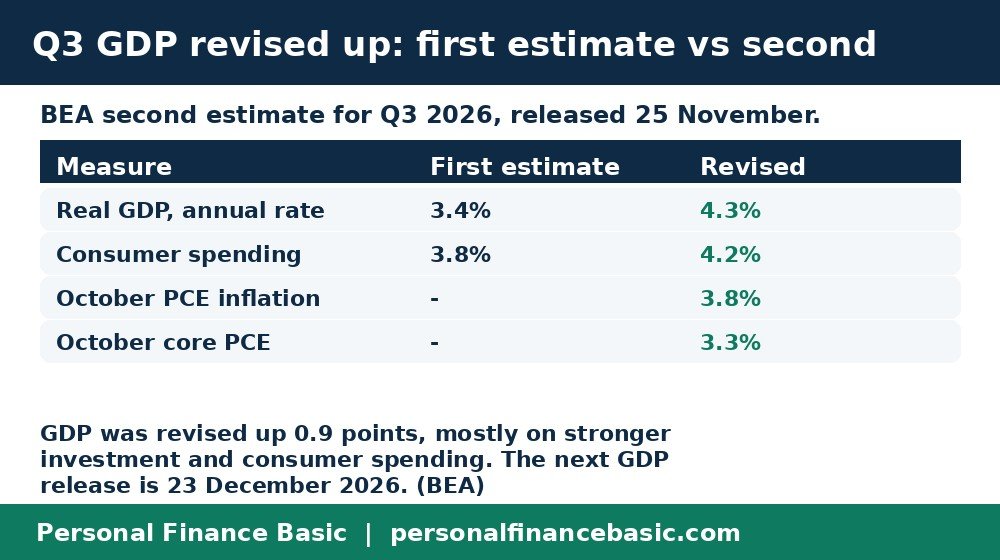
Q3 GDP revised up: first estimate vs second (BEA).
Why strong growth matters for interest rates
Growth of 4.3% would be good news on its own. Paired with inflation of 3.8%, it puts the Federal Reserve in a tight spot. The Fed’s target is 2% inflation, measured by the PCE index. Core PCE, which leaves out food and energy, was 3.3% in October, its highest since November 2023.
When the economy grows fast and prices keep rising, the Fed’s usual answer is higher interest rates. The Fed meets on 8 and 9 December, and the decision comes at 2 p.m. Eastern on 9 December. Traders now put the chance of a quarter-point rise at about 97%, which would lift the target range to 4.00% to 4.25%.
Some banks expect more rises after December, in January and March. Nothing is decided yet, and the Fed will see the November jobs report on 4 December before it votes. But the direction is clear: rates are going up, not down, in the near term.
What it means for your money
For borrowers, the message is simple: expensive debt stays expensive. Credit card rates, car loan rates and mortgage rates all follow the Fed’s rate, with a lag. If you carry a card balance, the interest you pay each month is not about to fall. Paying down the balance is the only reliable way to cut that cost.
For savers, there is a small win. High rates keep savings yields up, and a December rise usually lifts the best savings rates within weeks. If your savings account still pays next to nothing, this is a good moment to check what it earns and move the money to an account that pays more. Inflation at 3.8% means money sitting in a low-rate account loses buying power every month.
For holiday spending, the numbers cut both ways. Pay rose 0.7% in October, faster than prices, and the saving rate climbed to 4.1%. Households have a little more room than a year ago. But prices are still rising about 0.3% a month, so a budget that worked last Christmas buys less this year.
The honest read is that this is a strong economy with a stubborn inflation problem. Growth of 4.3% is good for jobs and pay. Inflation of 3.8% is bad for prices and borrowing. Both are true at the same time, and your money plan has to handle both.
At a glance
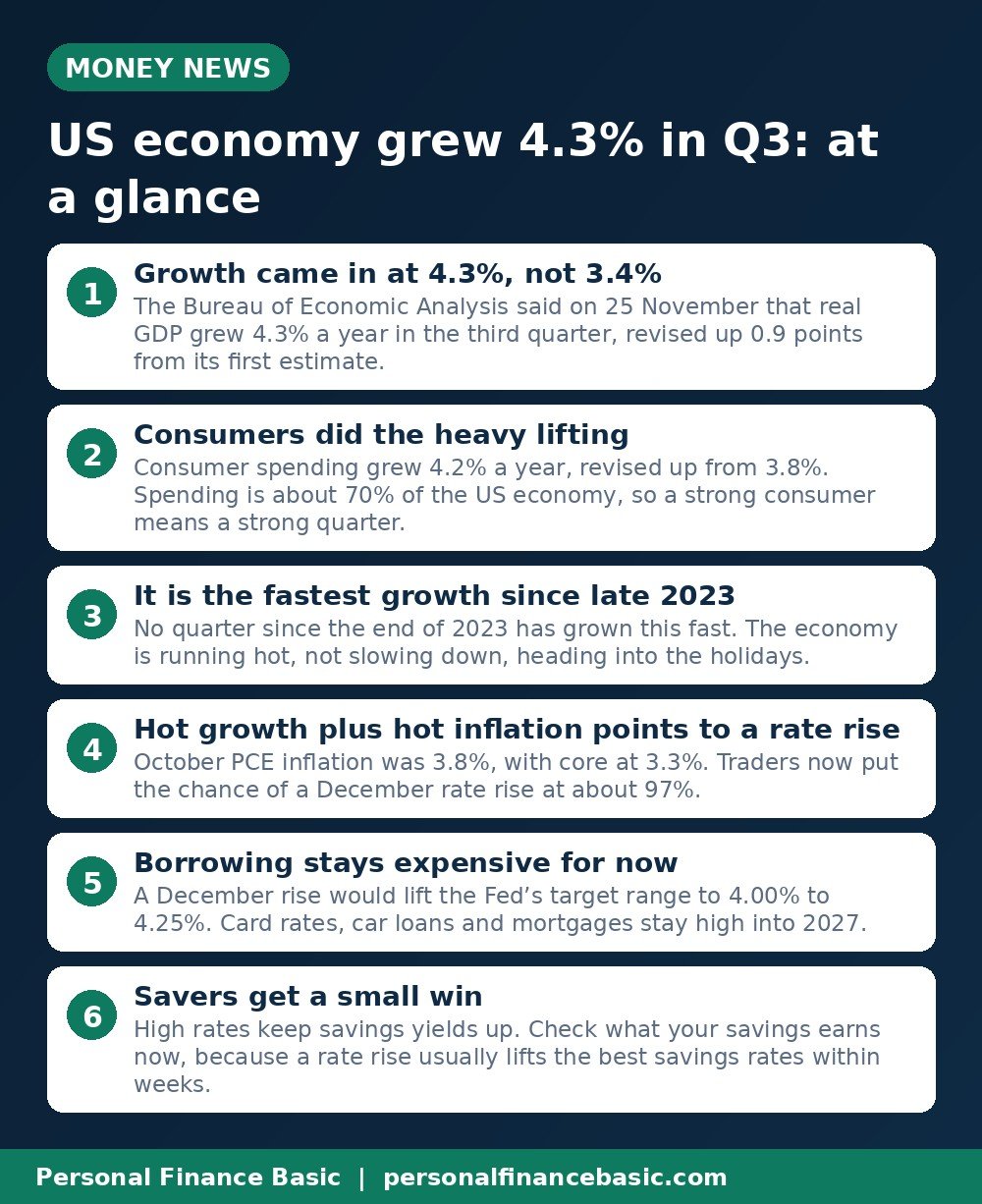
The main points from this guide, in one picture.
Frequently asked questions
What is GDP, in plain terms?
GDP is the total value of everything the US economy produces: goods, services, investment and government spending, minus imports. When GDP grows 4.3% a year, the economy is producing 4.3% more, after adjusting for inflation, than it would at that quarterly pace for a full year.
Why was the GDP number revised up?
The BEA revises GDP as more complete data arrives. The second estimate had fuller figures on consumer spending and business investment, and both were stronger than the first estimate assumed. That lifted growth from 3.4% to 4.3%.
Will the Fed raise rates in December?
Probably. Traders put the chance of a quarter-point rise on 9 December at about 97%. The Fed will see the November jobs report on 4 December first, and the decision is not made until the meeting. A rise would take the target range to 4.00% to 4.25%.
Does strong GDP growth mean my mortgage rate will fall?
No, it points the other way for now. Strong growth plus 3.8% inflation makes a rate rise more likely, and mortgage rates tend to stay high or rise when the Fed is raising rates. Rates may fall later if inflation cools, but the December meeting is not expected to bring that.
The verdict
The US economy grew 4.3% in the third quarter, the fastest since late 2023, and consumers did most of the work. But with inflation still at 3.8%, the reward for that strength is likely to be another rate rise in December.
For your money, that means two moves: check what your savings actually earns, and pay down the most expensive debt first. Read our guide to October inflation at 3.8% for the full inflation picture, and our guide to high-yield savings accounts if your savings rate has not kept up.
This post is general education, not financial or investment advice. Figures are from the Bureau of Economic Analysis release of 25 November 2026; market odds of a rate rise are a snapshot and can change before the Fed meets on 8-9 December.