The holiday hiring season is short, and the window is closing. Retailers are adding staff now for the weeks between Thanksgiving and New Year, and most of those jobs will be filled by the second week of December.
The National Retail Federation expects retailers to hire between 325,000 and 375,000 seasonal workers for the 2026 holidays, about the same as the estimated 356,000 last year but far below the 442,000 in 2024. The jobs are there. They go to the people who apply first.
Here is how to find the seasonal jobs that pay best, pick the one that fits your hours, and turn a few weeks of work into real money.
The short answer
Start with warehouses and delivery for the highest hourly pay, and retail for flexible shifts close to home. Apply this week, not in December. Most hiring happens in October and November, and the best shifts go early.
The quick framework:
- Pick the job type that fits your hours, your car and your energy.
- Apply at the biggest hirers first, where the openings are counted in the thousands.
- Compare the full hourly rate, including night and weekend premiums.
- Subtract travel and childcare costs before you accept.
- Ask about permanent roles on day one.
Quick decision guide:
- Need the most money per hour? Go for warehouse or delivery work.
- Need evenings and weekends only? Retail or customer service fits better.
- No car? Look for retail, a warehouse on a bus route, or remote customer service.
- Want a job after January? Ask which seasonal roles turn permanent.
Step 1: Start with the jobs that pay most for your hours
Not all seasonal jobs pay the same. Warehouse and delivery work usually pays a few dollars an hour more than the shop floor, and overnight shifts often add a premium. Retail pays less per hour, but the shifts are shorter and easier to fit around school or another job.
Here is how the main options compare:
| Job type | What you do | Typical hours | Best for |
|---|---|---|---|
| Retail associate | Serve customers, stock shelves, run the register | Evenings and weekends | Flexible shifts close to home |
| Warehouse associate | Pick, pack and move orders | Day or overnight shifts | Higher hourly pay, physical work |
| Delivery driver | Deliver packages on a set route | Daytime, often 6 days a week | Drivers with a car, or a company van |
| Customer service | Answer calls and chats, often from home | Set shifts, some remote | A quiet home and a headset |
| Event and gift staff | Wrap gifts, run pop-up stalls, help at events | Short shifts, weekends | Students and short-term work |
Here is the catch: the headline rate is not the whole story. A warehouse job with a 40-minute drive can pay less per week than a retail job five minutes from home once you count gas and time.
Step 2: Apply where the hiring is biggest
Start with the employers hiring in the thousands. Amazon announced 300,000 holiday hires for 2026, up 20% from 250,000 in 2025. Spirit Halloween is taking on 52,000 people across a record 1,575 stores, and Michaels plans to add more than 10,000.
Not every big name is hiring more. Dick’s Sporting Goods expects about 8,400 seasonal workers, 40% fewer than last year, and Challenger forecasts about 450,000 retail jobs added in the fourth quarter, down 2.5%. Apply to several places at once instead of waiting on one.
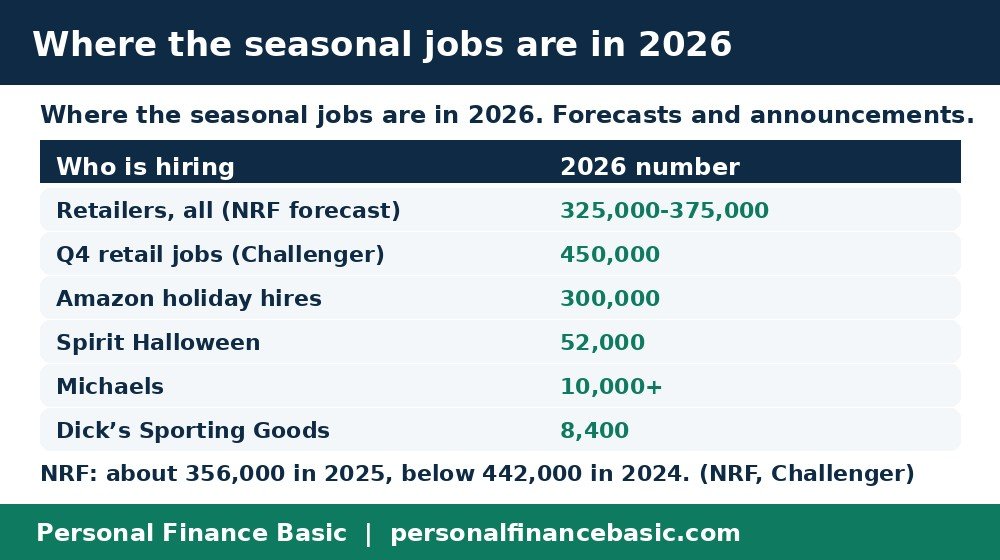
Where the seasonal jobs are in 2026.
Step 3: Pick shifts that fit your life
Seasonal work only pays off if the hours fit your life. Before you accept, write down the hours you can actually work, including travel time, and say so in the application. Managers would rather hire someone honest about 20 hours a week than someone who promises 40 and quits in two weeks.
Overnight and weekend shifts often pay a premium and are easier to get, because most people avoid them. But they are hard on sleep and family time. A premium of a dollar or two an hour is not worth it if you are exhausted by Christmas.
Step 4: Do the math before you say yes
Take Maya, a student in Ohio. She takes a warehouse job at $19 an hour, 20 hours a week, for 6 weeks: 19 x 20 x 6 = $2,280 before tax. But she drives 25 minutes each way, and gas costs about $40 a week, or $240 over six weeks. Her take-home before tax is closer to $2,040, and tax takes a share on top.
Run the same sum for every offer: rate times hours, minus gas, parking, bus fares and childcare. A job that pays $2 an hour more is not better if it costs you $60 a week to get there.
Also check when you get paid. Some employers pay weekly, some every two weeks. If your first paycheck lands after Christmas, the job does not help with holiday spending.
Step 5: Turn a seasonal job into a permanent one
A seasonal job can be a tryout for a permanent one. Michaels said nearly half of its seasonal in-store hires last year moved into permanent roles. That is what happens when you show up on time, learn the job fast and say you want to stay.
Ask about it at the interview, not in the last week. Ask what share of seasonal workers stayed on last year, and what a good seasonal worker needs to do to be kept. Then do exactly that. Turn up for the shifts nobody wants, help the new starters, and let your manager know you are interested in staying.
At a glance
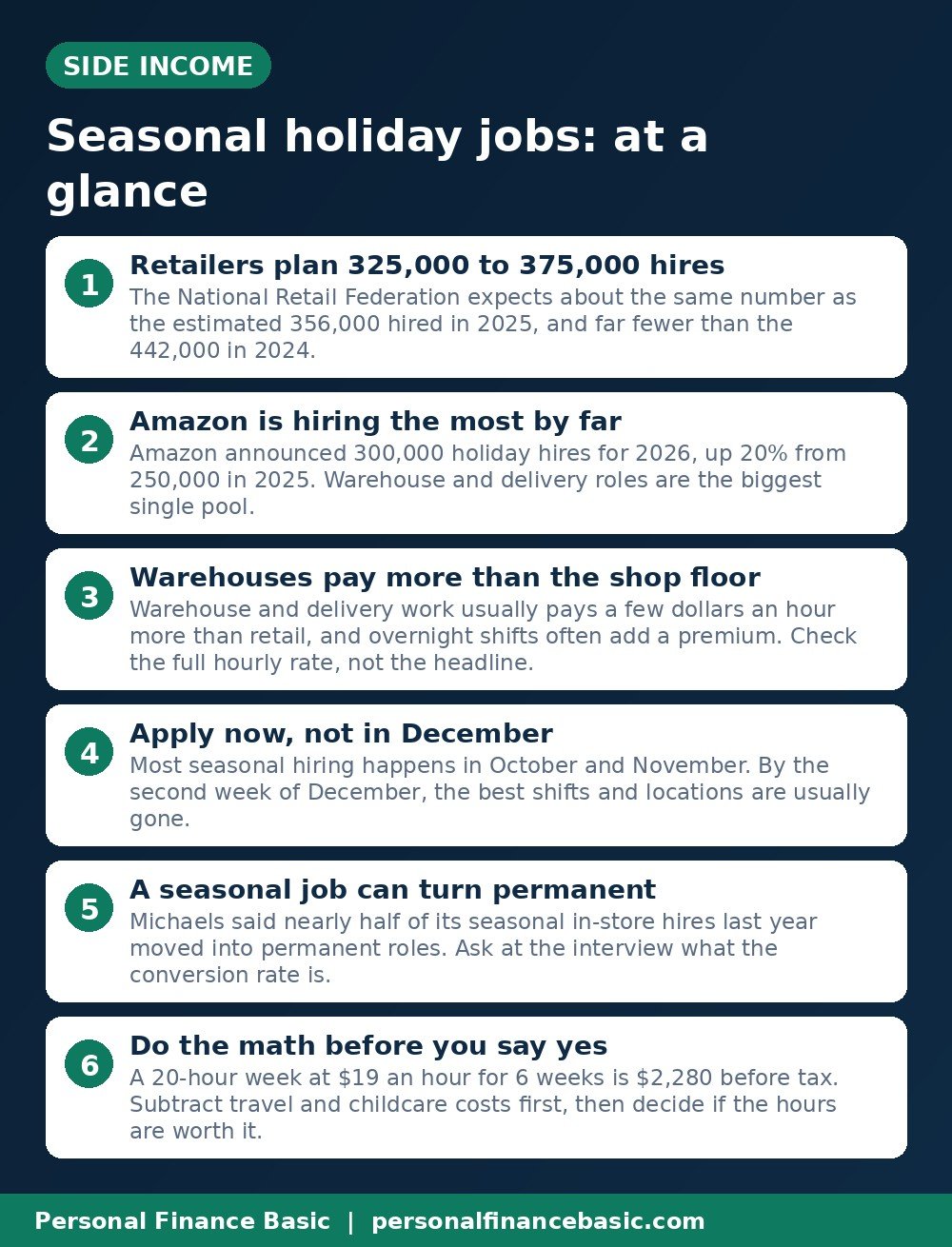
The main points from this guide, in one picture.
Frequently asked questions
When should I apply for a seasonal holiday job?
Now. Most seasonal hiring happens in October and November, and the best shifts and locations are usually gone by the second week of December. Apply to several employers in the same week.
Which seasonal job pays the most?
Warehouse and delivery roles usually pay the most per hour, and overnight shifts often add a premium. The best-paying job for you is the one with the highest pay after travel and childcare costs.
Do I need experience to get a seasonal job?
Usually not. Most seasonal roles are entry level, and employers expect to train you in the first few days. What they want is reliability: showing up on time, every shift, through the busiest weeks of the year.
Can a seasonal job become permanent?
Yes, and it happens often. Michaels said nearly half of its seasonal in-store hires last year moved into permanent roles. Ask at the interview what the conversion rate is, and tell your manager early that you want to stay.
Do I pay tax on seasonal job income?
Yes. Seasonal pay is taxed like any other job income, and your employer will take tax out of your paycheck. If you earn under the standard deduction for the year, you may get some of it back when you file. Keep your pay stubs.
The verdict
Retailers plan to hire 325,000 to 375,000 seasonal workers this holiday season, and the biggest single pool is Amazon’s 300,000 roles. Apply this week, pick the job whose hours and travel costs work for you, and ask about staying on. If the extra pay raises tax questions, read our guide to paying tax on side income.
Want more ways to earn on the side? Read our guide to 10 side hustles you can start with no money.
This post is general education, not financial or tax advice. Hiring figures are from the National Retail Federation, Challenger, Gray & Christmas and company announcements for the 2026 holiday season; pay examples are illustrative and your actual rate will vary by employer and city.