On 12 November 2026, the National Association of REALTORS reported that existing-home sales fell 5.5% in October, to a seasonally adjusted annual rate of 3.75 million. That is the lowest pace since August 2010, and 8.8% below October 2025.
The cause is no mystery. The average 30-year mortgage was 7.33% in October, up from 6.25% a year ago. In the words of the association’s chief economist, Lawrence Yun: “Home buying is difficult when mortgage rates have climbed to their highest levels since 2000.”
Here is what the October report says, what it costs buyers, and what it means for your money.
The short answer
Sales fell to their lowest since August 2010 because mortgage rates averaged 7.33% in October. The same median home now costs about $240 a month more than it did a year ago. But prices did not fall: the median home sold for $416,700, up 0.4% from a year ago, the 40th straight month of year-over-year gains.
That combination, fewer sales and steady prices, is the story. Buyers have more room to negotiate than a year ago, but there is no price crash in this report.
Quick decision guide:
- Buying now? Do not shop the 7.33% average. Get written quotes from lenders. Your rate depends on your credit, down payment and loan size.
- Saving for a down payment? Keep saving. The rate moves the monthly payment, but the down payment is the part you control.
- Selling? The typical home took 35 days to sell. Price it to the market, because buyers at 7% plus rates are scarce.
- Waiting for prices to fall? Nothing in this report points to a crash. The median price has risen for 40 months in a row.
What the October report says
Sales fell in nearly every part of the country. The West fell hardest, down 9.7% in a month and 14.5% in a year, with a median price of $624,300. The South fell 6.5%, the Midwest 3.2%, and the Northeast was flat.
Single-family homes drove the fall: sales down 5.8% to a 3.41 million annual pace, with a median of $421,900. Condos and co-ops fell 2.9% to 340,000, with a median of $365,100.
One number needs care. The 3.75 million is a seasonally adjusted annual rate: the pace if October’s monthly sales ran for 12 months. It is not 3.75 million homes physically sold in October.
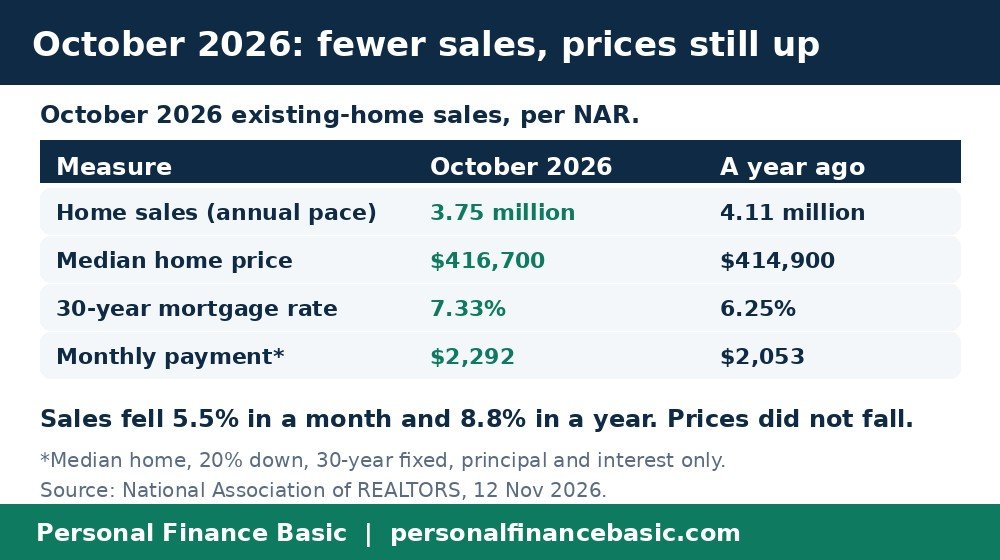
Sales fell 5.5% in a month and 8.8% in a year. Prices did not fall.
The rate is the story
The October average 30-year mortgage rate of 7.33% came from Freddie Mac, via the association. It was up from 6.86% in September and 6.25% a year ago. That is the number that moved the market, and the payment math shows why.
Take the median home at $416,700 with 20% down, which is $83,340. That leaves a loan of $333,360 on a 30-year fixed mortgage, principal and interest only. At October’s 7.33%, the payment is $2,292 a month. A year ago, at 6.25%, the same loan cost $2,053 a month. The difference is about $240 a month for the same house.
Without a down payment at all, the gap is bigger: borrowing the full $416,700 costs $2,865 a month at 7.33%, against $2,566 at 6.25%, about $300 more a month. These payments leave out taxes, insurance and lender fees.
Rates have moved since October. The weekly Freddie Mac survey put the 30-year fixed at 7.11% on 12 November, before the daily rate jumped back to 7.50% the next day. At 7.11%, the same $333,360 loan costs $2,243 a month, about $50 less than at 7.33%.
What it means for buyers
Buyers have more room than they did a year ago. Inventory rose to 1.59 million homes, or 5.1 months of supply, up from 4.4 months a year ago. More homes for sale and fewer buyers competing means more room to negotiate.
But do not expect a bargain. The median price is still up from a year ago, for the 40th month in a row. First-time buyers are also shrinking as a share of sales, down to 29% from 32% a year ago, while cash buyers were 29%.
Here is the catch: the rate matters more than the price. A $10,000 cut in the loan amount saves about $69 a month at 7.33%. A one-point fall in the rate saves about $222 a month on the same loan.
- Best for buyers right now: negotiating. With 5.1 months of supply and fewer competing buyers, an offer below asking is more likely to be heard than it was a year ago.
- Not for: waiting for a crash. Nothing in this report shows prices falling, and 88 million homeowners hold sizable housing wealth, in Yun’s words, which limits forced sales.
What it means for sellers
Sellers face a slower market. The typical home sat for 35 days in October, up from 33 days in September. Buyers at 7% plus rates are scarce, and first-time buyers are a smaller share of the market than they were.
Price it to the market, not to last year’s peak. A home priced above comparable sales will sit. Yun’s note of hope is that there could be sizable pent-up demand if mortgage rates decline, but that is a possibility, not a forecast.
At a glance
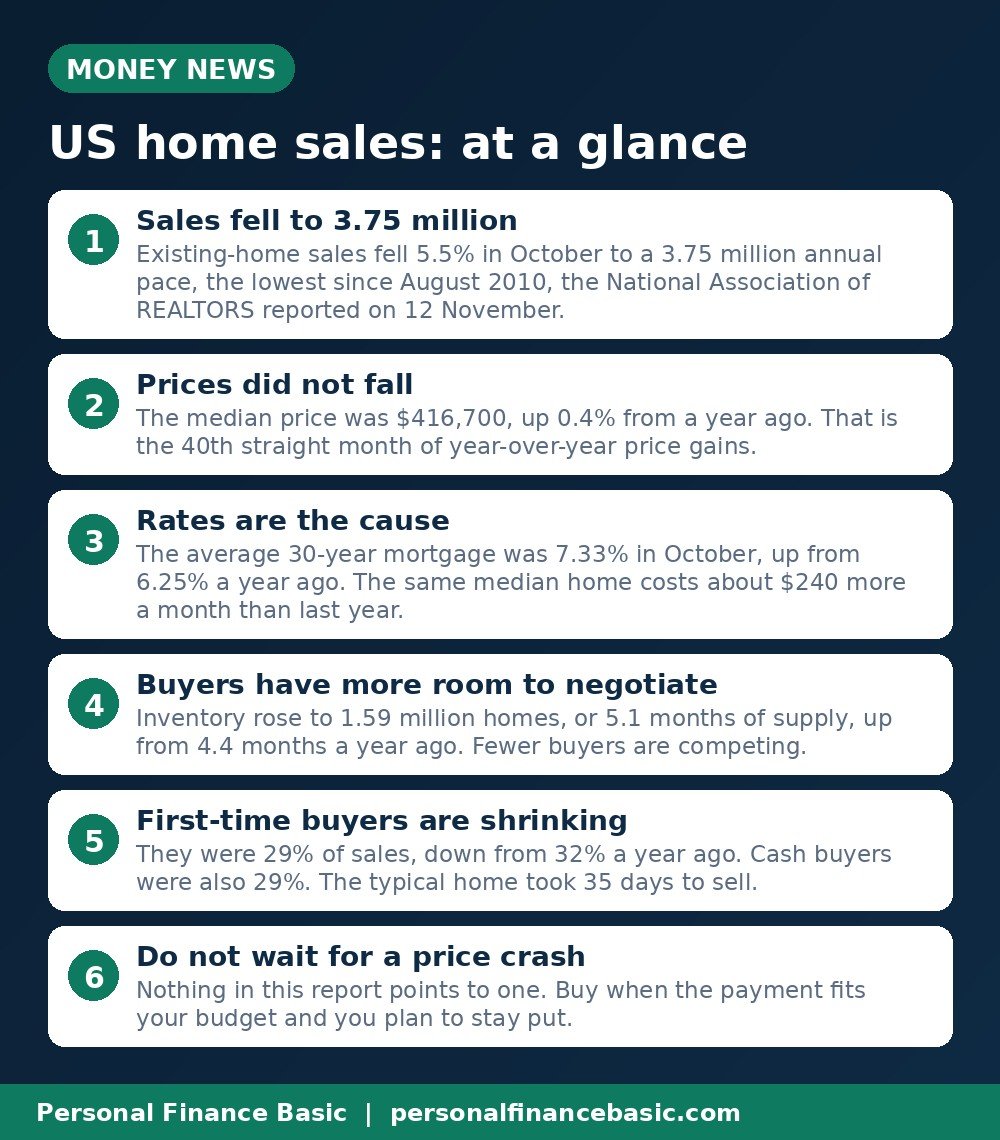
The main points from this guide, in one picture.
Frequently asked questions
Did home prices fall in October?
No. The median existing-home price was $416,700 in October 2026, up 0.4% from a year ago. Sales fell, not prices.
What does 3.75 million home sales actually mean?
It is a seasonally adjusted annual rate: the pace if October’s monthly sales continued for a full year. It is not 3.75 million homes sold in one month.
How much more does the same home cost than a year ago?
About $240 a month. On the median $416,700 home with 20% down, a 30-year loan costs $2,292 a month at 7.33%, against $2,053 at 6.25% a year ago.
Is now a good time to buy?
There is no safe answer. You have more room to negotiate than a year ago, but prices have not fallen and rates are high. Buy when the payment fits your budget and you plan to stay put.
The bottom line: US home sales fell to their lowest since August 2010 because October mortgage rates averaged 7.33%, and the same median home costs about $240 more a month than a year ago. Prices did not fall, and buyers have more room to negotiate. If you are buying, get written quotes and run the payment on your own loan amount.
This post is general education, not financial advice. Figures are from the National Association of REALTORS report of 12 November 2026. Rates change daily, and your own rate depends on your credit, down payment and loan.
Related reading: Mortgage Rates Fell to 7.11% — Then Jumped Back to 7.50% in Three Days and The 50/30/20 Rule With US Examples ($3,000 a Month)