Maya pulled her credit report last month and found a late payment from 2019 still sitting there. She had paid the account off years ago, and she wanted to know one thing: when does it finally go away?
The answer is 7 years for most bad marks: a late payment, a collection, a charge-off and a foreclosure. Chapter 7 bankruptcy is the big exception: it stays for 10 years.
Here is how long each item lasts.
The short answer
Most negative information can be reported for 7 years. The clock starts on the date of first delinquency: the first missed payment that started the account’s slide. It does not start when you pay or when the debt is sold.
Chapter 7 bankruptcy can be reported for 10 years from the filing date. Chapter 13 is usually removed after 7 years. Hard inquiries are the shortest: 2 years on the report, and they usually affect your score for only the first 12 months.
Four moves:
- Find each mark’s date of first delinquency.
- Add 7 years, or 10 for Chapter 7.
- Work out whether paying helps now.
- Dispute anything wrong or past its limit.
Quick decision guide:
- A late payment or collection from years ago? Add 7 years to the first missed payment.
- A Chapter 7 bankruptcy? Count 10 years from the filing date, not the discharge date.
- Something still showing past its date? Dispute it with the bureau. It should come off.
- Applying for a loan soon? Old marks hurt less than fresh ones, but they still count until they fall off.
The timeline, item by item
The Fair Credit Reporting Act sets the limits. Here is what the law allows for each type of mark.
| Item | How long | Clock starts |
|---|---|---|
| Late payment | 7 years | Date of the missed payment |
| Collection account | 7 years | Date of first delinquency |
| Charge-off | 7 years | Date of first delinquency |
| Foreclosure | 7 years | Date of first delinquency |
| Chapter 7 bankruptcy | 10 years | Filing date |
| Chapter 13 bankruptcy | 7 years | Filing date |
| Paid tax lien | 7 years | Date of payment |
| Hard inquiry | 2 years | Date of the inquiry |
Two things sit outside the 7-year rule: criminal convictions, which have no time limit, and credit applications of $150,000 or more.
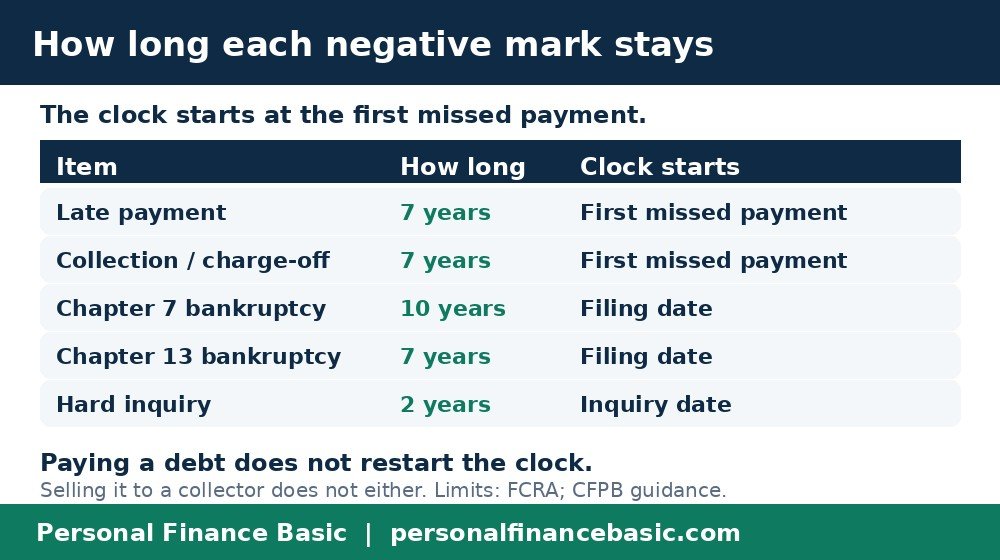
The clock starts at the first missed payment.
- Best for most people: knowing each mark’s fall-off date, so you can tell a real problem from one about to age off.
- Best for a fresh start: the 7-year rule itself. A bad mark does not follow you forever.
Step 1: Find the date of first delinquency
This is the date that matters, and it is the one people get wrong. The date of first delinquency is the first missed payment that began the chain ending in default.
Take Maya’s late payment. She missed a payment in June 2019 and never caught up, and the account went to collections that autumn. The date of first delinquency is June 2019. Add 7 years and the mark falls off around June 2026.
When the debt is sold to a collector, the clock does not restart. The collection account uses the same June 2019 date. A collector that reports a newer date is reporting it wrong.
Pull your free reports from AnnualCreditReport.com. Each negative account shows its date of first delinquency, and the bureaus often print the expected fall-off month too.
Step 2: Know what paying does and does not do
Paying a debt is worth doing. It stops collection calls and can stop a lawsuit. But it does not restart the clock, and it does not erase the mark.
A paid collection still falls off on the original schedule. Maya paid her collection in 2021, and it still falls off around June 2026, seven years from June 2019. The Consumer Financial Protection Bureau is clear: no one has the right to remove accurate negative information.
Paying can still help your score. Newer scoring models, including FICO 9 and VantageScore 4.0, ignore paid collections. Older models, including the FICO 8 version many lenders still use, still count one. So paying helps with some lenders and not with others.
- Best for stopping the damage: paying what you owe. It ends the collection process and can help under newer scoring models.
- Not for: erasing the mark. No company can delete accurate negative information for a fee.
Step 3: Build good history while you wait
Seven years is a long time to sit still, but a bad mark loses power as it ages. A late payment from five years ago hurts far less than one from five months ago.
The fastest way to rebuild is simple: pay every bill on time from now on. Payment history is 35% of a FICO score, the largest single factor. Keep balances low too: utilization, the share of your limits you are using, is 30% of a FICO score, so staying under 30% helps while the old mark ages.
If you have no open accounts at all, a secured card can restart the clock on good history. Use it for one small purchase a month and pay it in full.
Step 4: Dispute anything wrong or past its limit
Marks fall off on their own when the time is up, but mistakes happen. A bureau can keep a mark too long, show the wrong date, or list the same debt twice.
Check each negative item against its fall-off date. If a mark is past its limit, dispute it with the bureau that shows it: Equifax, Experian or TransUnion. You can dispute online, and the bureau has 30 days to investigate. If the item is past its limit, the bureau must remove it. If the same error shows on all three reports, you need three separate disputes.
- Best for errors: a written dispute with the bureau, stating the fall-off date plainly.
- Not for: accurate marks inside their limit.
At a glance
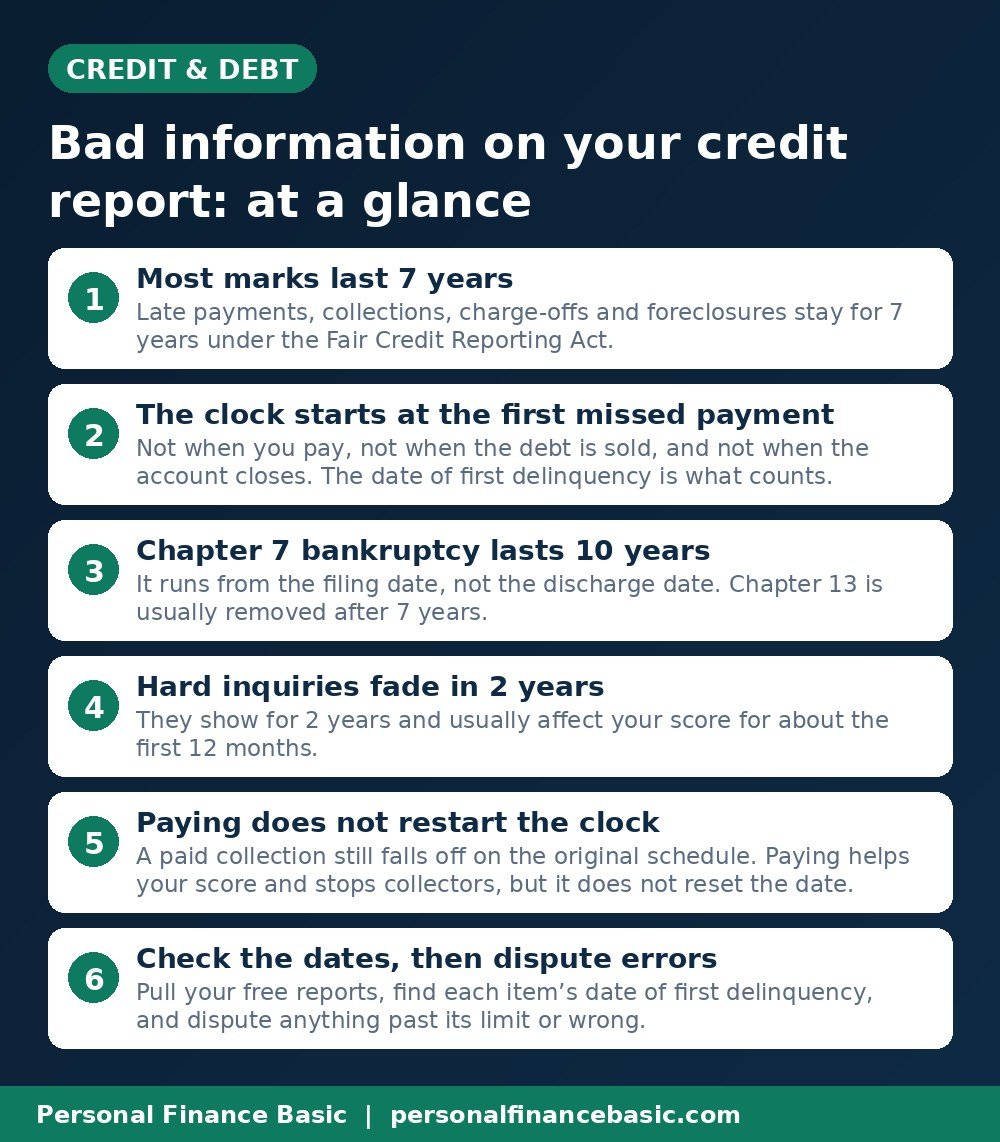
The main points from this guide, in one picture.
Frequently asked questions
Does paying off a collection remove it from my report?
No. Paying changes the status to paid, but the mark stays until its fall-off date, 7 years from the date of first delinquency. It still helps: it stops collections, and some newer scoring models ignore paid collections.
Can a debt collector restart the 7-year clock?
No. Selling a debt to a collector does not restart the clock, and neither does a partial payment. The clock runs from the date of first delinquency on the original account.
How long does a Chapter 13 bankruptcy stay on my report?
Usually 7 years from the filing date. The law allows up to 10 years for any bankruptcy, but the bureaus remove a completed Chapter 13 after 7 years.
Do hard inquiries stay for 7 years too?
No. Hard inquiries show for 2 years and usually affect your score for about the first 12 months. A single inquiry costs only a few points.
What if a bad mark is still there after 7 years?
Dispute it with the bureau that shows it. The bureau has 30 days to investigate, and an item past its limit must come off. Keep a copy of your report showing the date of first delinquency.
The bottom line: most bad marks last 7 years from the first missed payment, and Chapter 7 bankruptcy lasts 10 years from the filing date. Find each item’s date, work out its fall-off date, and dispute anything past its limit. While you wait, pay on time and keep balances low: the mark fades with every month.
This guide is general education, not financial or legal advice. Check your own reports and the Consumer Financial Protection Bureau’s guidance for your case.
Related reading: How to Dispute an Error on Your Credit Report and How to Improve Your Credit Score in 6 Months