If you are 73 or older with a traditional IRA or a 401(k), a date is coming up fast: 31 December 2026. That is the deadline for your 2026 required minimum distribution, the yearly withdrawal the tax law makes you take.
Miss it, and the IRS charges a 25% excise tax on the amount you did not take: $2,500 on a $10,000 withdrawal. There is no extension, and for anyone past their first year, there is no 1 April option either.
Here is how the rule works, how to work out your number, and what to do if you have not taken it yet.
The short answer
A required minimum distribution, or RMD, is the minimum the IRS makes you withdraw each year from a traditional IRA, SEP IRA, SIMPLE IRA, 401(k), 403(b), or 457(b) once you reach the required starting age. For 2026, that age is 73 if you were born between 1951 and 1959, and 75 if you were born in 1960 or later.
Every RMD after your first is due by 31 December. Your 2026 RMD is your balance on 31 December 2025 divided by the IRS factor for your age: 26.5 at 73, about 3.77% of the balance.
Work through it in four moves:
- Check whether the rule applies to you.
- Work out your 2026 RMD from your 31 December 2025 balance.
- Take it by 31 December 2026.
- If you miss it, fix it fast: the penalty falls to 10% within two years.
Quick decision guide:
- Past your first RMD year? Take the 2026 amount by 31 December. There is no later option.
- Turning 73 in 2026? You can wait until 1 April 2027, but then two withdrawals land in one tax year.
- Still working at 73? You may be able to delay your current employer’s plan RMDs until you retire, unless you own 5% of the company.
- Only a Roth IRA? No RMD while you are alive. Roth accounts are exempt for the owner, though beneficiaries still face RMD rules.
What an RMD is, and who it covers
The IRS lets retirement money grow tax-deferred for decades. The RMD is how it starts collecting the tax: once you reach the required age, you must withdraw a set amount each year and pay income tax on it.
The rule covers traditional IRAs, SEP IRAs, SIMPLE IRAs, 401(k)s, 403(b)s, 457(b)s, and other defined contribution plans. It does not cover Roth IRAs while the owner is alive. Money you withdraw cannot be rolled over into another tax-deferred account, and extra taken in one year does not count toward a future year’s RMD.
The IRS says the account owner is ultimately responsible for taking the right amount on time, even if a custodian calculates it for you. Check their number yourself: mistakes here are expensive.
How to work out your 2026 RMD
The formula is simple: your balance on 31 December 2025 divided by the distribution period from the IRS Uniform Lifetime Table for your age in 2026. At age 73, the factor is 26.5.
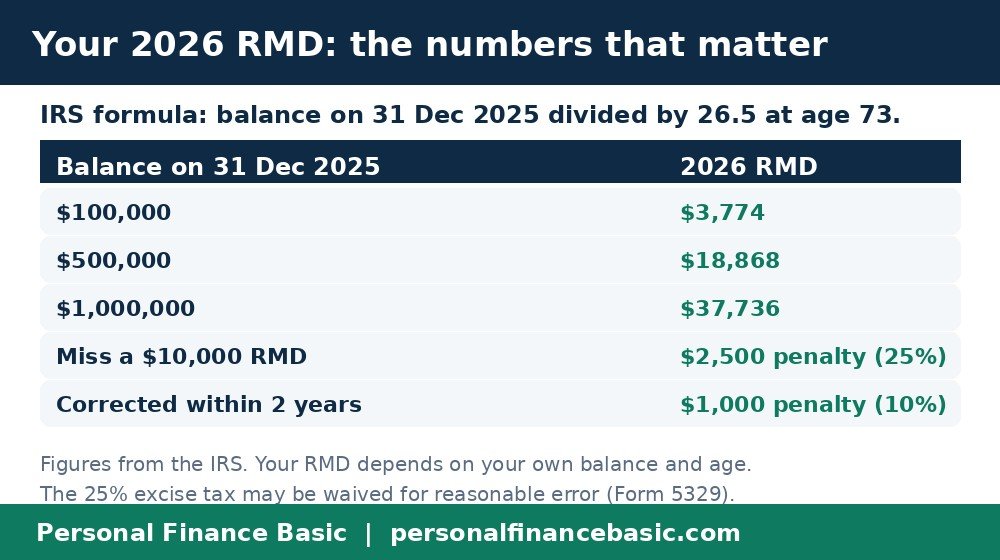
Your 2026 RMD at age 73: divide your 31 December 2025 balance by 26.5.
On a $100,000 balance, the RMD is $3,774. On $500,000, it is $18,868. On $1,000,000, it is $37,736. Those are examples from the IRS formula. Your own number depends on your balance and age.
With more than one IRA, calculate the RMD for each separately, then take the total from one or more of them. That shortcut does not apply to 401(k)s or 457(b)s: each of those needs its own withdrawal.
What happens if you miss it
The penalty is a 25% excise tax on the amount not taken. Miss a $10,000 RMD and the tax is $2,500. Miss the $18,868 example above and it is $4,717. The penalty is reported on Form 5329.
Two things shrink the bite. Fix the miss within two years and the rate drops to 10%: $1,000 on a $10,000 miss. The IRS may also waive the penalty for a reasonable error, if you file Form 5329 with a letter of explanation. The 25% is the starting point, not a certainty, but do not count on a waiver. Take the withdrawal first, then sort out the paperwork.
The first-RMD choice
The one group with a real choice this month is people turning 73 in 2026, born in 1953. Your first RMD is not due until 1 April 2027, but your second RMD is still due by 31 December 2027, so delaying puts two taxable withdrawals into the same year.
Taking the first RMD by 31 December 2026 keeps one withdrawal in each tax year. That can keep you in a lower tax bracket, and keep more of your Social Security benefits untaxed. The IRS itself notes you can take the first withdrawal by 31 December of the year you turn 73 instead of waiting. Neither choice loses the money. The choice is which tax year it lands in.
A charity gift can count toward it
One option: a Qualified Charitable Distribution. If you are 70 and a half or older, you can send money directly from an IRA to a qualifying charity, and it counts toward your RMD. It is also excluded from your income. The 2026 limit is $111,000 per person, and the transfer must complete by 31 December 2026 to count. Donor-advised funds do not qualify.
At a glance
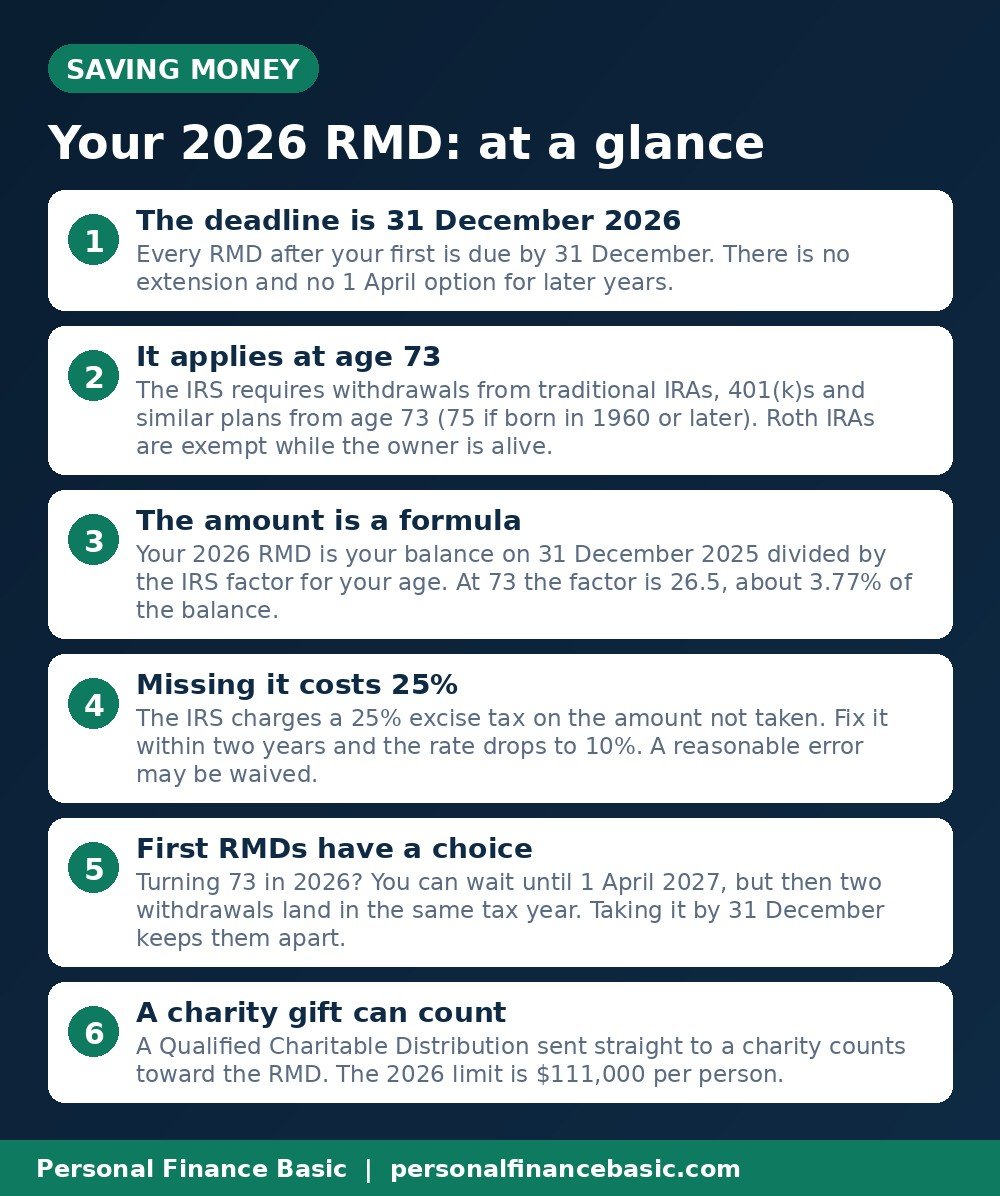
The main points from this guide, in one picture.
Frequently asked questions
Do I have to take an RMD from a Roth IRA?
No, not while you are alive. Roth IRAs are exempt from RMDs for the owner, because the money was taxed when it went in. Beneficiaries are still subject to RMD rules.
What if I am still working at 73?
If you are still working, you can generally delay RMDs from your current employer’s plan until the year you retire, unless you own 5% or more of the company. That delay does not apply to IRAs: IRA RMDs start at 73 even if you are still working. A plan document can still require them at 73, so check yours.
Can I take more than the RMD?
Yes. The RMD is a minimum. You can withdraw more, taxed as income that year, but it does not count toward a future year’s RMD.
What should I do if I already missed the 31 December deadline?
Take the missed amount as soon as you can, then file Form 5329. Correct it within two years and the penalty rate drops from 25% to 10%, and the IRS may waive it for a reasonable error. Do not wait: the two-year window runs from the year the RMD was due.
The bottom line: if you are 73 or older with a traditional IRA or a 401(k), work out your 2026 RMD and take it by 31 December. A missed RMD costs 25%, and the fix is cheapest when fast.
This guide is general education, not financial or tax advice. The IRS pages on required minimum distributions are the source for the figures here.
Related reading: Traditional IRA vs Roth IRA: What Is the Difference? and 401(k) Match Explained: The Part of Your Pay You Should Not Skip