Prices are still rising faster than the Federal Reserve wants, and the Fed is saying so out loud. On 13 November 2026, the Bureau of Labor Statistics reported wholesale prices up 6.5% over the year to October, the biggest yearly rise since November 2022.
The same day, three Fed officials spoke, and all three pointed the same way: inflation is still too high, and rates may need to go higher. Some officials have even discussed a half-point hike at the Fed’s next meeting on 8–9 December.
That matters for your money, not just for Wall Street. Higher Fed rates push up the cost of credit card debt, and they shape what savers earn. Here is what happened, what it costs you, and what to do before December.
The short answer
Wholesale inflation is still hot: the Producer Price Index rose 0.3% in October and 6.5% over 12 months. The Fed raised its rate in September to 3.75%–4.00%, and its officials now say more hikes may be needed.
What this means for you, in order:
- Credit card rates are the first thing to move. A quarter-point hike adds about $12.50 a year for every $5,000 of card balance.
- Fixed mortgage rates do not follow the Fed directly. They track the 10-year Treasury yield more closely.
- Savers may see better rates over time, but banks move at their own pace.
- Nothing is decided yet. The Fed meets on 8–9 December, and the next inflation reports come first.
Quick decision guide:
- Carrying a card balance? Paying it down is the best defence against a hike.
- Shopping for a mortgage? The Fed’s December decision is not the rate to watch; the 10-year Treasury yield is.
- Saving in cash? Higher rates help savers, but check your account’s rate rather than assuming it rose.
What the October reports actually showed
The Bureau of Labor Statistics released the October Producer Price Index on 13 November 2026. Producer prices are what domestic producers receive for their goods and services, before those costs reach store shelves. The index rose 0.3% in October, after a 1.4% jump in September, a touch better than the 0.4% economists expected.
The yearly number moved the other way. Over the 12 months to October, producer prices rose 6.5%, the largest yearly rise since November 2022. Prices for goods rose 10.2% over the year, the biggest rise since October 2022, while services rose 0.2% in the month.
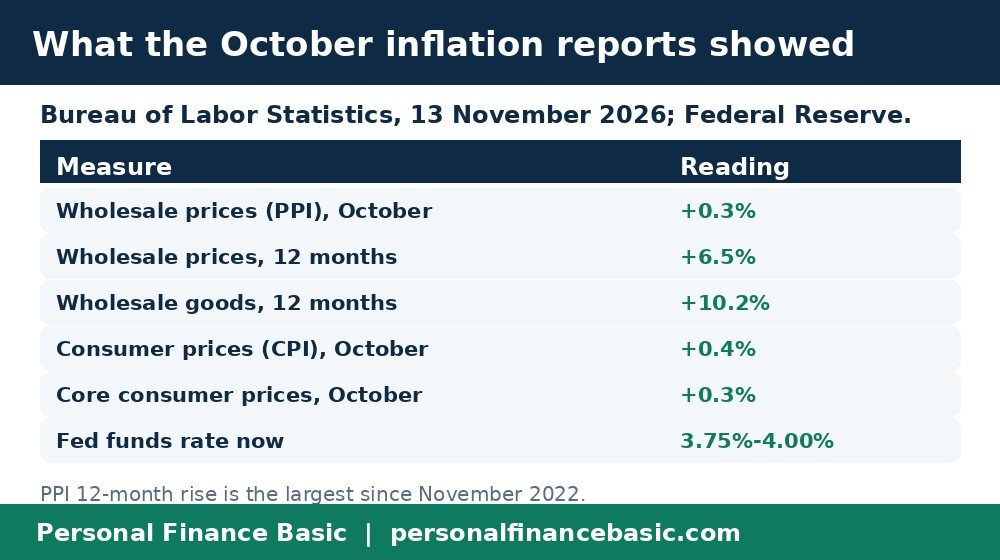
What the October inflation reports showed.
The consumer side told the same story three days earlier. The Consumer Price Index rose 0.4% in October, and core prices rose 0.3% for a third straight month. The jobs report was strong too: 165,000 jobs added in October, unemployment at 4.1%, and wages up 3.1% over the year.
Why the Fed is talking about another hike
The Fed raised its benchmark rate by a quarter point in September 2026, to 3.75%–4.00%, its first hike in three years. It held rates steady in October while it waited for more data. The data since then has pointed one way.
On 13 November, Fed Vice Chair Philip Jefferson said he is taking his policy cues from inflation, with the economy “broadly solid” while inflation shows “persistent price pressures”. New York Fed President John Williams said inflation is “far too high”. San Francisco Fed President Mary Daly said “we’re going to have to tighten policy further”, with the timing and size still to be decided.
Reuters reported on 13 November that some officials have discussed a half-percentage-point hike at the 8–9 December meeting, double the usual quarter-point move. It is a discussion, not a decision: the November inflation data has not been released yet.
What a hike would cost you
The fastest effect of a Fed hike is on variable-rate debt, above all credit cards. Card rates move with the prime rate, which follows the Fed’s rate. A quarter-point Fed hike on a $5,000 card balance costs about $12.50 a year in extra interest if the balance stays the same ($5,000 x 0.25%). A half-point hike costs about $25 a year on the same balance.
Those numbers grow with the balance: on $10,000, a half-point hike adds about $50 a year, and the cost repeats every year the balance stays unpaid. Every dollar paid off now is a dollar that stops costing interest.
Fixed-rate debt works differently. A 30-year fixed mortgage rate does not move directly with the Fed’s rate: it tracks the 10-year Treasury yield, which moves on what investors expect over years, not on one meeting. A December hike would not change the rate on a mortgage you already have.
For savers, higher Fed rates are good news, eventually. Banks tend to raise savings rates when the Fed raises rates, but they move slowly and unevenly. If your account still pays little, a hike is a reason to check the rate, not to assume it rose.
What to do before December
First, look at your card balance. If you carry one, pay down as much as you can before the December meeting. Even $500 off a balance saves interest at any rate.
Second, do not rush a big borrowing decision on Fed news alone. A mortgage or car loan should rest on your budget and the rate you are actually offered, not on a guess about one meeting.
Third, check what your savings account pays. If the rate has not moved in months while the Fed has raised rates, moving the money is worth an hour of your time.
At a glance
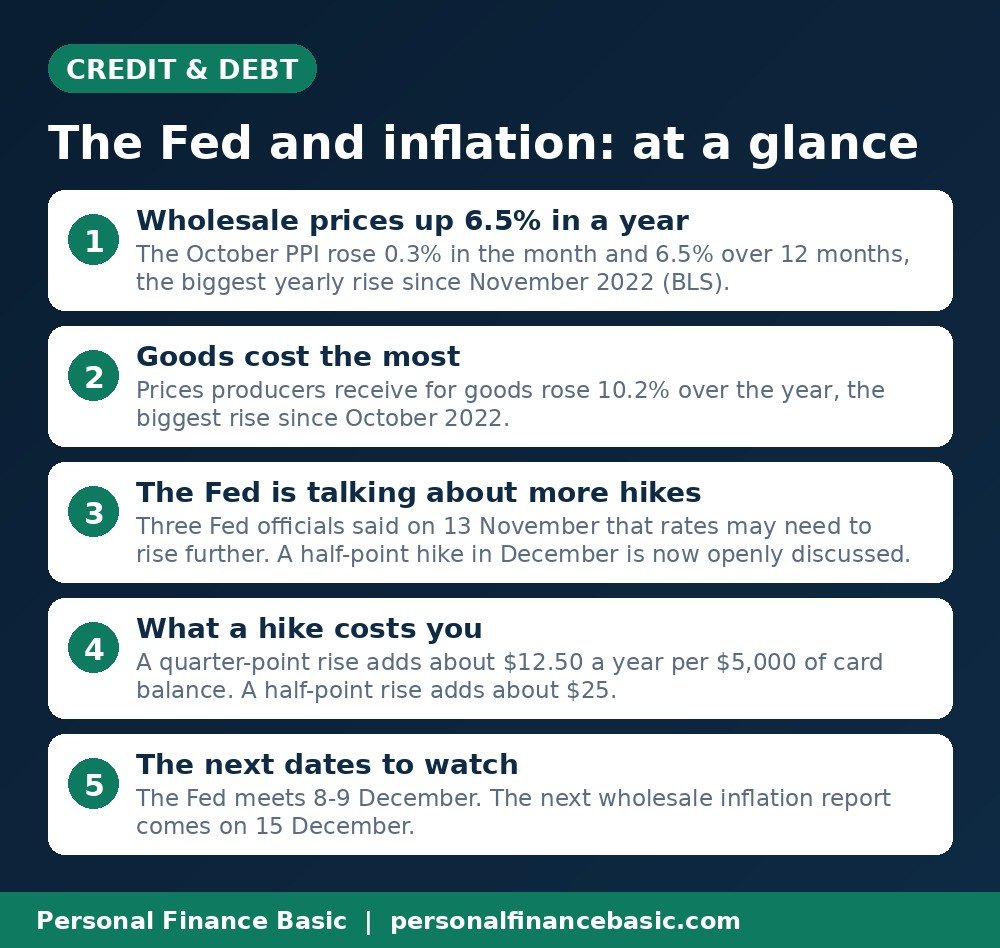
The main points from this guide, in one picture.
Frequently asked questions
Will the Fed definitely raise rates in December?
No. Officials have discussed a hike, including a half-point move, but nothing is decided. The Fed meets on 8–9 December.
Does a Fed hike raise my mortgage rate directly?
No. A 30-year fixed mortgage rate tracks the 10-year Treasury yield more closely than the Fed’s rate. A December hike could push mortgage rates up or leave them flat. It never changes the rate on a fixed mortgage you already hold.
Why did wholesale prices rise 6.5% if the monthly number slowed?
The monthly rise slowed to 0.3% in October from 1.4% in September, but the yearly figure compares prices with a year ago. Goods prices are up 10.2% over that year, so the yearly rate kept climbing even as the month got quieter.
What should I do with my credit card balance now?
Pay down as much as you can, starting with the highest-rate card. A quarter-point hike adds about $12.50 a year per $5,000 of balance, and a half-point hike adds about $25. Paying the balance off removes the cost entirely.
The bottom line: inflation is still running hot, the Fed is openly talking about another hike, and the cost lands first on credit card balances. Pay down variable-rate debt now.
This post is general education, not financial advice. Interest rates and your own finances change what works for you. Consider speaking with a qualified financial adviser about your own situation.
Related reading: Prices Rose 0.4% in October: What the New Inflation Numbers Mean for Your Money and What Is APR? A Plain-English Guide With Examples