A Roth IRA is a retirement account you fund with money you have already paid tax on. There is no tax break in the year you contribute. The payoff comes later: if you follow the withdrawal rules, the money comes out tax-free in retirement, including all the growth it earned over the years. That single trade, tax now instead of tax later, is the whole idea, and it suits some savers far better than others.
The account is open to anyone with earned income who meets the income limits, and you open it yourself rather than through an employer. The yearly limit for 2026 is $7,500 if you are under 50.
How a Roth IRA works, in plain terms
Money goes in after tax. Inside the account, it can be invested in funds, stocks, bonds, or other investments offered by the provider, and it grows without a yearly tax bill on dividends or gains. In retirement, qualified withdrawals are tax-free. Qualified means two conditions are both met: the account has been open for at least five tax years, and you are at least 59 and a half, disabled, or using up to $10,000 for a first home purchase.
Contributions are flexible: you can withdraw the money you put in at any time, at any age, without tax and without penalty. Only the earnings are restricted by the five-year rule and the age condition. That does not make a Roth IRA a good emergency fund, since investments can fall in value.
The 2026 limits and who can contribute
For 2026, the IRS limit is $7,500 a year if you are under 50, and $8,600 if you are 50 or older, with the extra $1,100 as a catch-up contribution. That limit covers all your IRAs combined. If you put $3,000 into a traditional IRA, you can put only $4,500 into a Roth IRA in the same year. You also cannot contribute more than your earned income for the year. If you earned $4,000, your limit is $4,000, whatever the headline figure says.
Income also decides whether you can contribute directly at all. For 2026, single filers can make a full contribution with modified adjusted gross income, or MAGI, below $153,000. The allowed amount shrinks between $153,000 and $168,000, and above $168,000 there is no direct contribution. For married couples filing jointly, the full contribution applies below $242,000, shrinking to nothing at $252,000. Contributions for a tax year can be made until the tax filing deadline, April 15 of the following year, so 2026 contributions can be made until April 15, 2027. Filing an extension does not extend that deadline.
What the numbers look like over time
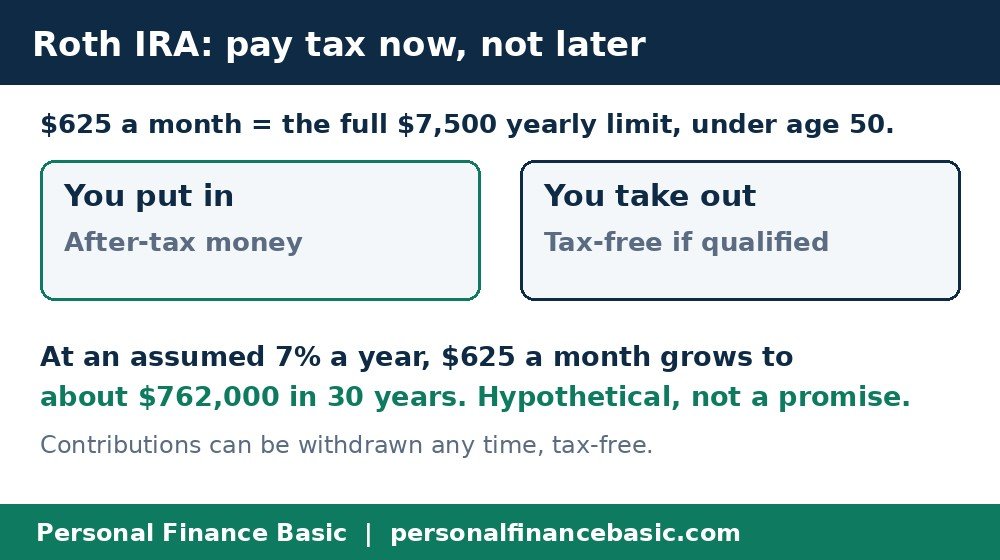
Contributing the full yearly limit adds up over decades. The growth figure is a hypothetical example at an assumed return, not a promise.
At $625 a month, the full $7,500 yearly limit, the total paid in over 30 years is $225,000. At an assumed 7% return a year, that grows to about $762,000. The gap between $225,000 paid in and $762,000 at the end is the point of the account: decades of growth that, if withdrawn under the qualified rules, is never taxed. Real returns vary year to year. The example is a teaching tool, not a forecast.
Starting small still works. At $100 a month, the same assumed 7% return gives about $122,000 in 30 years from $36,000 paid in. At $200 a month, the figure is about $244,000 from $72,000 paid in. Set the monthly transfer for the day after payday.
Who a Roth IRA suits best
A Roth IRA suits you best if you expect your tax rate in retirement to be the same as, or higher than, your tax rate now. That is common early in a career, when income is lower, and for young workers whose earnings are likely to rise. Paying tax at a low rate now to avoid tax later is a good trade in that case. It also suits anyone who values flexibility: the ability to withdraw contributions without penalty, and the absence of required minimum distributions during the account owner’s lifetime, which traditional IRAs and 401(k)s impose from age 73 or 75 depending on birth year.
A Roth IRA suits you less well if your tax rate now is high and you expect it to fall sharply in retirement. In that case, a traditional IRA or a pre-tax 401(k) may leave you with more money overall. High-interest card debt and a missing emergency fund should usually come first.
One order works for many people. First, contribute enough to a workplace 401(k) to get the full employer match, if one is offered, since that is part of your pay. Next, fund a Roth IRA up to what you can afford. Then, if money remains, go back to the 401(k) or a traditional IRA.
How to open one and what to invest in
Opening a Roth IRA takes a few steps. Choose a provider, such as a brokerage firm, bank, or robo-advisor, and complete an application with your personal details and bank account for funding. Once the account is open, set up a recurring monthly transfer, even a small one, so contributions happen automatically.
Inside the account, beginners usually do best with one simple, broad investment, such as a low-cost index fund that holds hundreds of companies at once. This guide does not recommend any specific fund or provider.
Two mistakes are worth avoiding. The first is leaving the money in cash, uninvested, for years: contributions alone do not grow. The second is contributing more than the limit, or without earned income, which can trigger a 6% excise tax on the excess for each year it stays in the account.
At a glance
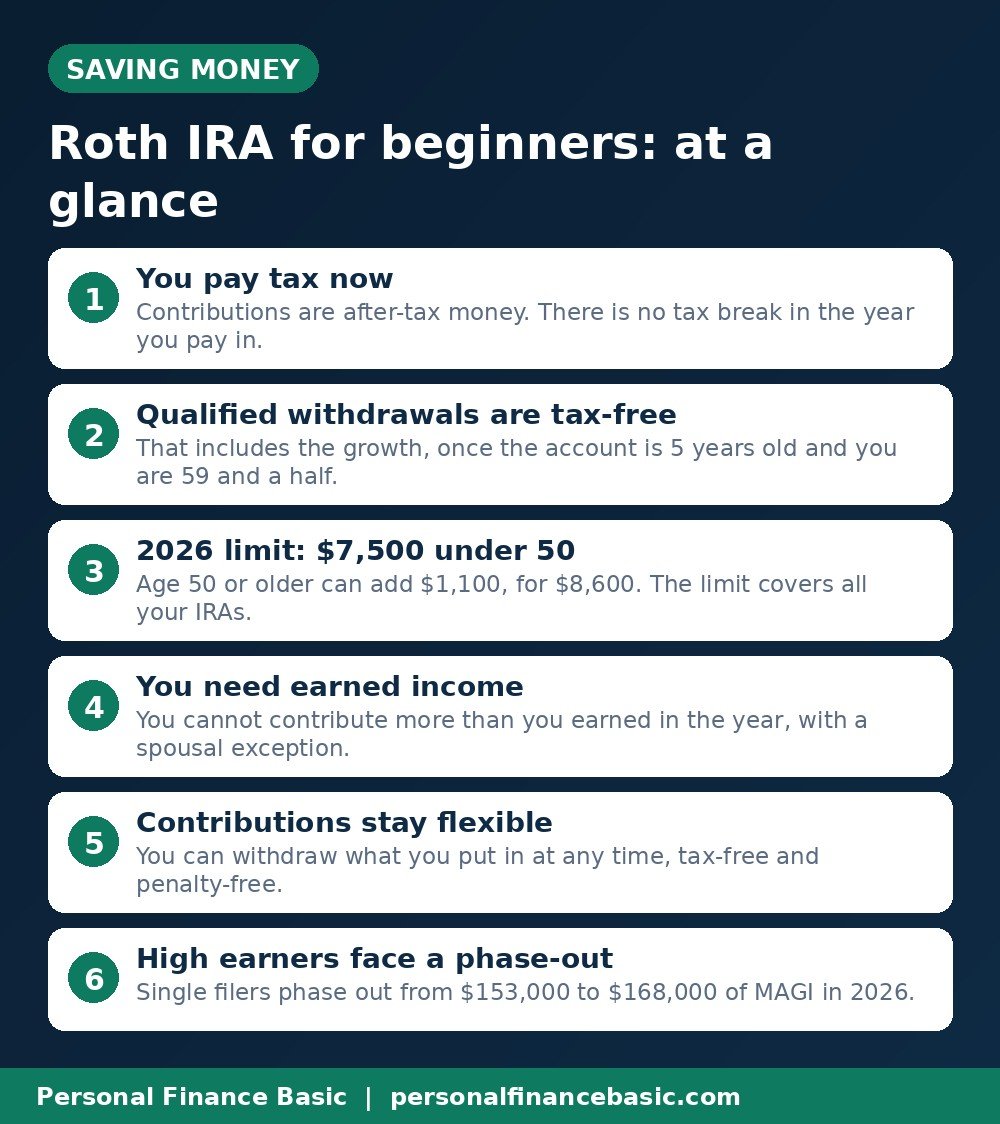
The main points from this guide, in one picture.
Frequently asked questions
How much can I put in a Roth IRA in 2026?
$7,500 if you are under 50, and $8,600 if you are 50 or older. The limit covers all your IRAs combined, and you cannot contribute more than your earned income for the year.
Can I take money out of a Roth IRA before retirement?
You can withdraw your contributions at any time, tax-free and penalty-free. Earnings are tax-free only if the withdrawal is qualified, which generally means the account is at least five years old and you are 59 and a half or meet another qualifying condition. Early earnings withdrawals can face tax and a 10% penalty, with exceptions.
Do I need a job to open a Roth IRA?
You need earned income, such as wages or self-employment income, at least equal to your contribution. A spouse’s earned income can support a spousal IRA contribution for a spouse with little or no earnings of their own.
What happens if I earn too much for a Roth IRA?
Your direct contribution shrinks through the income phase-out range and stops above it. For 2026, single filers phase out from $153,000 to $168,000 of MAGI, and married couples filing jointly from $242,000 to $252,000. Some high earners use a backdoor Roth IRA, but that has its own tax rules.
Is a Roth IRA better than a 401(k)?
Neither is simply better. A 401(k) often comes with an employer match, which is part of your pay and should usually come first. A Roth IRA offers tax-free qualified withdrawals and no lifetime required withdrawals. Many people use both, in that order.
This guide is general education, not financial or tax advice. IRA rules, limits, and tax treatment depend on your income, filing status, and situation, and limits change from year to year. For decisions about your own retirement savings, speak with a qualified tax or financial professional.
Related reading: 401(k) vs Roth IRA: Which Should a Beginner Choose First? and Mutual Fund Calculator