On 25 November, the Bureau of Economic Analysis released the October inflation numbers. They moved in the wrong direction. The PCE price index rose 3.8% in the year to October, up from 3.7% in September. Core inflation rose to 3.3%, its highest since November 2023.
The PCE index is the Federal Reserve’s favorite inflation measure, the one it watches most when it sets interest rates. This is the last full inflation reading before the Fed’s 8-9 December meeting. So these numbers matter for your savings, your borrowing and your holiday budget.
The short answer
Inflation is still running well above the Fed’s 2% target, and it rose in October instead of falling. Prices rose 0.3% in the month, the same as in September. Pay rose faster than prices, up 0.7%, and the saving rate climbed to 4.1%.
The quick framework:
- Headline inflation is 3.8% over the year; core is 3.3%.
- At 0.3% a month, prices would rise about 3.7% in a year.
- Pay rose 0.7% in October, while spending rose 0.3%, so saving improved.
- The Fed decides on rates on 8 and 9 December, and a rate rise stays on the table.
Quick decision guide:
- Holding cash in a low-rate account? Inflation at 3.8% eats it. Check what your savings earns.
- Carrying card debt? Rates stay high while inflation stays high. Paying it down matters more, not less.
- Planning a big purchase? Prices are rising about 0.3% a month. Waiting does not make things cheaper.
- Budgeting for Christmas? Your pay rose, but so did prices. Budget from the numbers.
What the numbers say
The Bureau of Economic Analysis publishes Personal Income and Outlays each month. The headline number is the PCE price index, up 0.3% in October after a 0.5% rise in September. Over the year it is up 3.8%, the highest since May 2023.
Core PCE, which leaves out food and energy, also rose 0.3% in the month. Over the year it is up 3.3%, against 3.1% in September and above the 3.2% economists expected. That is the number the Fed watches most, and it is moving the wrong way.
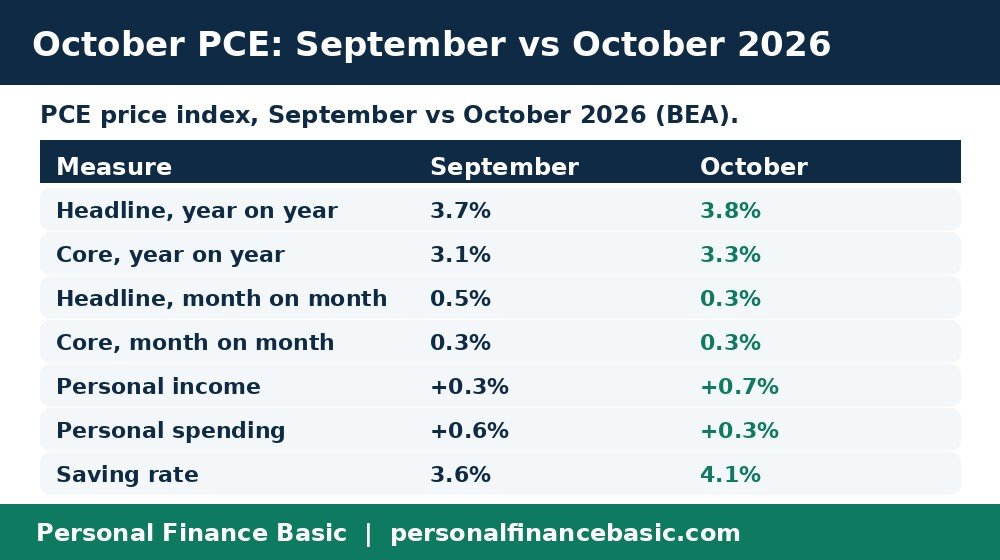
October PCE: September vs October 2026. September figures as revised in the October release (BEA).
The rest of the release was better news. Personal income rose 0.7% in October, well above the 0.4% economists expected. Disposable income, what is left after tax, rose 0.8%, and after inflation it rose 0.5%, the most since January.
Spending rose 0.3%, and after inflation it was flat. Households earned more and spent the same, so the saving rate climbed to 4.1% of disposable income, up from 3.6% in September. That is a small cushion after a year of prices rising faster than pay.
What it means for your money
Start with the basket. Goods and services that cost $100 a year ago cost $103.80 now, on the headline PCE measure. And 0.3% a month, kept up for a year, works out to about 3.7% a year. Three months at 0.3% is not a blip. It is a pace.
For savers, the news is mixed. Your pay rose 0.7% in October while prices rose 0.3%, so real pay went up. But money sitting in a low-rate account still loses ground. At 3.8% inflation, $1,000 held for a year buys about $963 worth of goods at the end of it. Check what your savings account actually pays.
For borrowers, high inflation keeps rates high: the Fed will not cut while inflation is rising, and card rates near 20% do not fall while a rise is on the table.
What it means for the Fed
The Federal Reserve targets 2% inflation, and core PCE at 3.3% is well above that. The three-month annualized rate of core PCE is 3.63%, the highest since March. The Fed meets on 8 and 9 December, and this report is the last full inflation reading it will see before then.
September’s hot reading had already raised talk of another rate rise, and October’s numbers keep that talk alive. A rise is not certain: the Fed also watches jobs and spending, and spending was flat in real terms in October. But with core inflation at its highest since November 2023, the Fed has little reason to cut rates.
What to do with this
First, do not panic or make a big money move on one report. One month of data is not a trend, even when it points the wrong way. Check your numbers against 3.8%.
If your account pays less than inflation, your money is shrinking. Moving it to a higher-rate account is the simplest response.
Check your card balance. At rates near 20%, a $1,000 balance costs about $200 a year in interest if you only pay the minimum. Rates are not coming down soon, so the debt is not getting cheaper to carry. See what your balance really costs with our credit card payoff calculator.
Keep your holiday budget in dollars. Prices rose 0.3% in October and 0.5% in September. That is real money on a $1,654 holiday budget, the average Deloitte expects this year.
At a glance
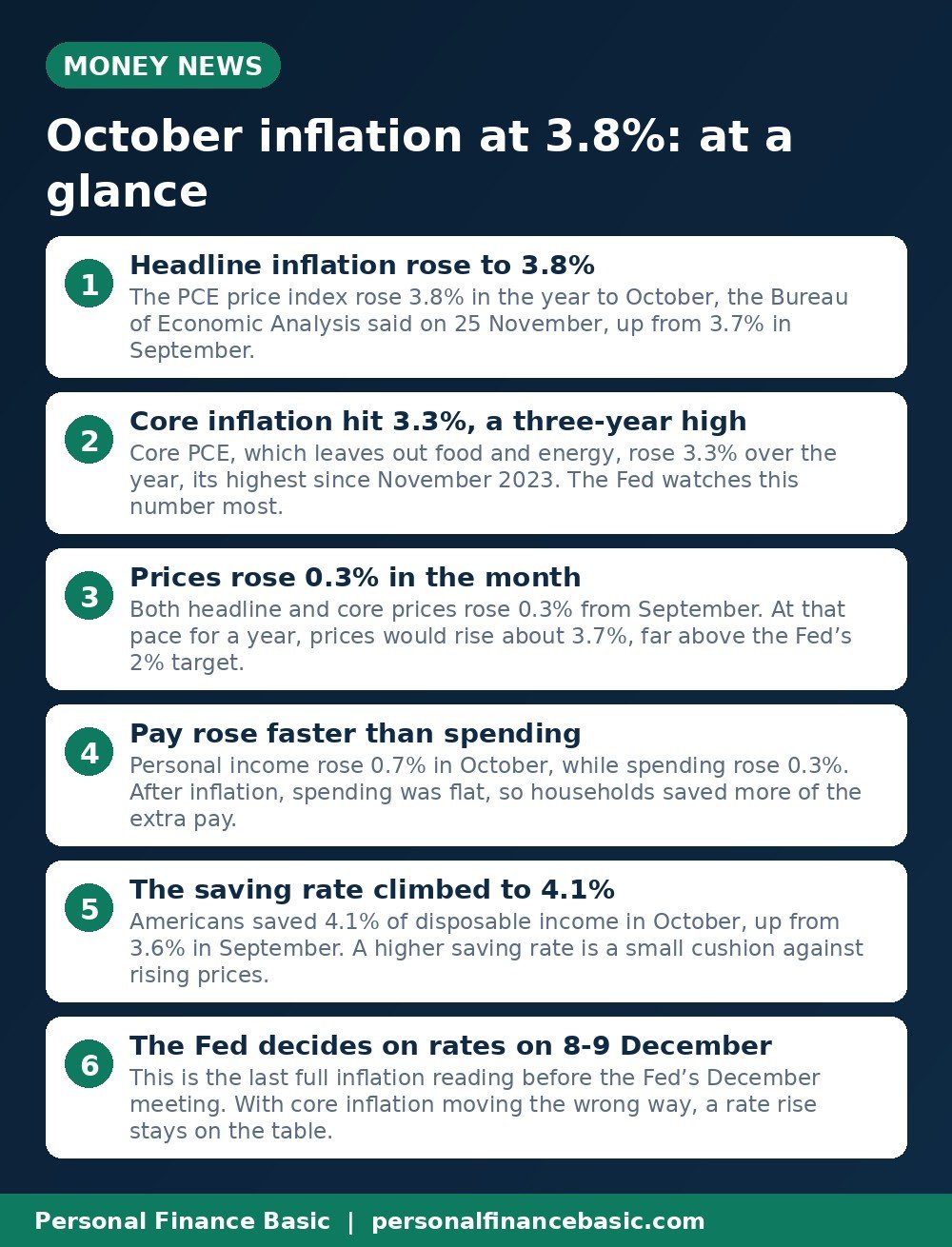
The main points from this guide, in one picture.
Frequently asked questions
What is the PCE price index?
It is the Bureau of Economic Analysis measure of what Americans pay for goods and services, and the Fed’s preferred inflation gauge. Unlike the CPI, which tracks a fixed basket, PCE tracks what people actually buy, including when they switch to cheaper options.
What is the difference between headline and core PCE?
Headline PCE covers everything, including food and energy. Core PCE leaves food and energy out because their prices jump around. In October, headline inflation was 3.8% over the year and core was 3.3%. Both rose 0.3% in the month.
Why does the Fed care about 3.8% inflation?
The Fed targets 2% inflation. At 3.8%, prices are rising almost twice as fast, and core inflation at 3.3% shows the pressure is broad. The Fed meets on 8 and 9 December, and with core inflation at its highest since November 2023, a rate rise stays on the table.
Does 3.8% inflation mean my pay is falling behind?
Not in October. Personal income rose 0.7% in the month while prices rose 0.3%, so real disposable income rose 0.5%, the most since January. But prices have risen faster than pay for much of the last two years, so one good month does not undo that.
The verdict
October inflation came in at 3.8%, and core inflation hit 3.3%, its highest since November 2023. Prices are still rising about 0.3% a month, and the Fed’s December decision now has a rate rise firmly on the table. Check your savings rate against 3.8% and pay down expensive debt while rates stay high.
For the last inflation reading, read our post on October CPI, up 0.4%, and our post on retail sales rising only 0.2% in October.
This post is general education, not financial advice. All figures are from the Bureau of Economic Analysis Personal Income and Outlays release for October 2026, published 25 November 2026; September figures are as revised in that release. The Federal Reserve’s next rate decision is 8-9 December 2026.