Black Friday is tomorrow, and the sales are already everywhere. Adobe expects Americans to spend $12.9 billion online on Black Friday alone, up 9.2% on last year.
The National Retail Federation expects 126 million Americans to shop on Black Friday, and 182.7 million across the Thanksgiving weekend. Deloitte expects the average household to spend $1,654 this holiday season. The money is real, and so is the risk of spending more than you planned.
Here is how to shop the sales without overspending, from a budget you set before the sales start to the traps that undo it.
The short answer
Set a total budget before you look at a single deal, make a list of what you actually need, and buy only what is on it. Check the price before Black Friday so you know whether the discount is real. Pay with money you have, not with buy now, pay later.
The quick framework:
- Set one total budget for the whole weekend, in dollars, not in feelings.
- Write the list before you open any sale page.
- Check today’s price for each item, so a fake discount cannot fool you.
- Buy the list, then stop. The sale ends, and so does your spending.
- Pay it off in January, or do not buy it.
Quick decision guide:
- Buying electronics or toys? The deepest discounts are here, up to 30%.
- Buying clothes or a TV? Expect about 23%, and check the price first.
- Tempted by something not on your list? Wait 24 hours. The price will still be there, and the urge usually will not.
- Thinking about buy now, pay later? Only if you can clear it in January.
Step 1: Set your number before the sales start
Every Black Friday budget starts with one number: the total you will spend across the whole weekend. Not per store, not per person, one total. Deloitte expects the average household to spend $1,654 this season, but your number should come from your own bank balance, not an average.
Work it out from what you can pay off in January. If you can put $300 toward holiday spending without touching rent, bills or your emergency fund, your budget is $300. A budget you can clear in January beats a bigger haul you are still paying for in March.
Write the number down where you will see it while you shop. A budget in your head is not a budget. It is a wish.
Step 2: Make the list and check prices now
Write down exactly what you plan to buy, who it is for, and the most you will pay for each item. A list with prices is a plan. A list without prices is a suggestion.
Then check today’s price for each item before Black Friday starts. A TV marked down from $800 to $500 looks like a 38% saving, but if it sold for $550 all month, the real saving is $50. The only way to know is to look before the sale.
Take the TV example. A $500 TV at 30% off costs $350, and you save $150, but only if the TV was already on your list. Add $200 of extras you did not plan on, and the $150 saving is gone.
Step 3: Know where the real discounts are
Not every category is discounted the same way. Adobe expects the deepest peak discounts on electronics at 30% and toys at 29%, with apparel, TVs and computers at about 23%. Those numbers are close to last year’s actuals, so the deals are about the same as last year.
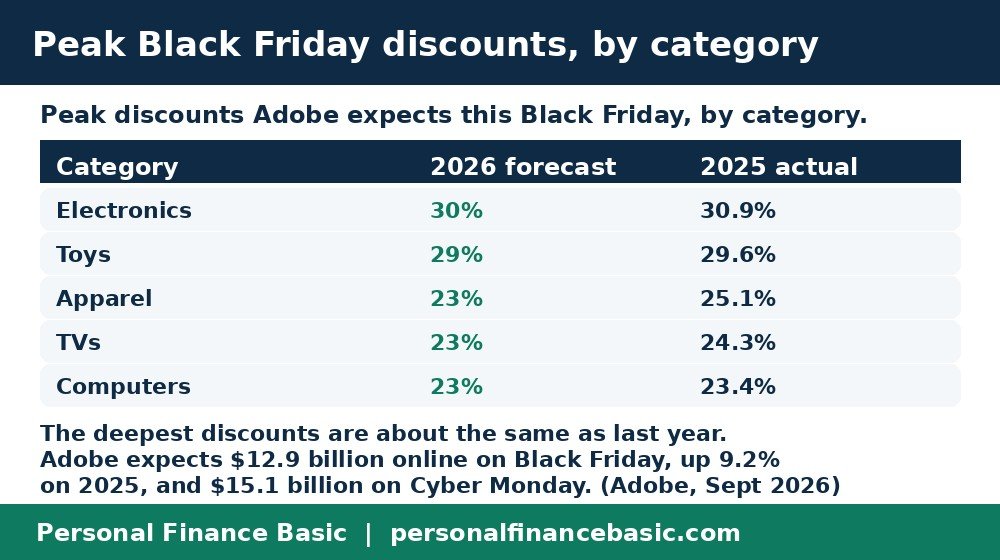
Peak Black Friday discounts, by category.
Use that table to set your expectations. For a laptop, 23% is a good result, and waiting for 40% means waiting forever. For a game console or tablet, 30% is the number to look for.
Step 4: Pay in a way you can clear in January
How you pay matters as much as what you pay. Adobe expects $807 million of Black Friday spending to go through buy now, pay later, and $21.3 billion across the season. Splitting the cost into four payments feels easier, but it is still debt, and late fees add up fast.
Last December, 37% of shoppers took on holiday debt, averaging $1,223, according to a LendingTree survey. The spending feels small in November and lands hard in January, when the bills and the card statement arrive together.
The rule is simple. If you cannot pay it off in January, do not buy it in November. Use a debit card or a card you pay in full. If the only way to afford it is to split it across months, the item is too expensive for this year.
Step 5: Know when to walk away
Black Friday is not the only sale day, and it is not even the biggest one online. Adobe expects $15.1 billion in online spending on Cyber Monday, November 30, more than the $12.9 billion on Black Friday. If the price is not right on Friday, wait three days.
Walk away from any deal that needs you to decide in minutes. Countdown timers, “only 2 left” warnings and one-time offers are designed to stop you thinking. A real deal is still a deal tomorrow.
At a glance
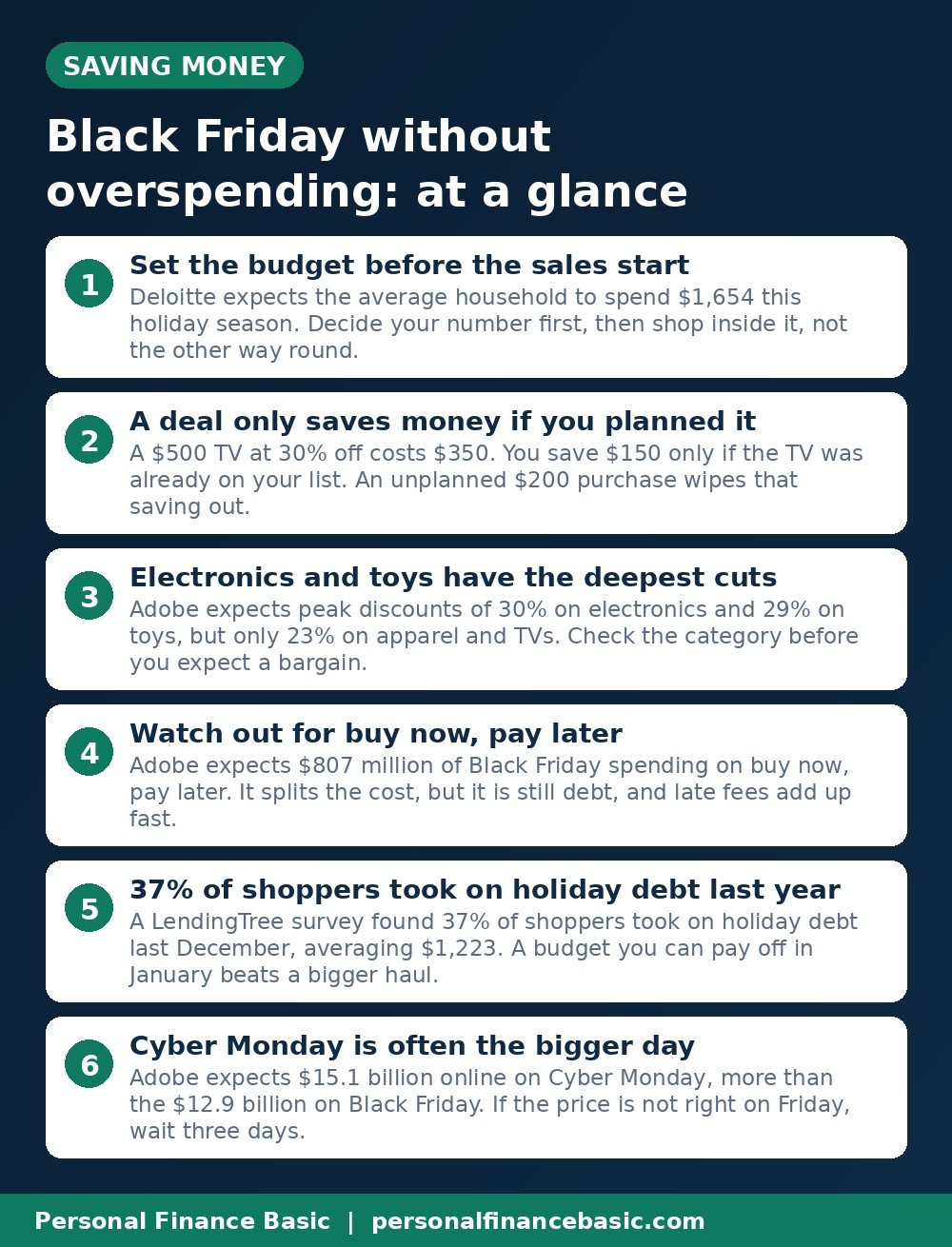
The main points from this guide, in one picture.
Frequently asked questions
How much will Americans spend on Black Friday 2026?
Adobe expects $12.9 billion in online spending on Black Friday, November 27, up 9.2% from $11.8 billion in 2025. The National Retail Federation expects 126 million Americans to shop that day, and $1.013 trillion in total retail sales across the season.
Are Black Friday discounts real?
Some are, and some are not. Adobe expects peak discounts of 30% on electronics and 29% on toys, close to last year’s actuals. But some prices are raised before the sale so the discount looks bigger. Check the price before Black Friday.
Is Cyber Monday better than Black Friday?
Online, yes. Adobe expects $15.1 billion on Cyber Monday, November 30, against $12.9 billion on Black Friday. The deepest discounts on TVs, toys and appliances land on Friday, but Cyber Monday is often better for online-only deals.
Should I use buy now, pay later on Black Friday?
Only if you can clear it in January. Adobe expects $807 million of Black Friday spending on buy now, pay later. It splits the cost, but it is still debt, and missed payments bring late fees.
How do I stop overspending on Black Friday?
Set one total budget before you shop, write a list with a maximum price for each item, and buy only what is on it. Pay with money you have, not credit you will carry into next year. Give yourself a 24-hour wait on anything not on the list.
The verdict
Black Friday 2026 will be a record online, with $12.9 billion expected in a single day, but the discounts are about the same as last year. Set your budget before the sales start, buy only what is on your list, and pay it off in January.
If you want a plan for the whole season, read our guide to the 50/30/20 rule with US examples, and check what your card balance really costs with our credit card payoff calculator.
This post is general education, not financial advice. Spending and discount figures are forecasts from Adobe Analytics (September 2026), the National Retail Federation (October 2026) and Deloitte’s 2026 holiday survey; actual results may differ, and your local prices will vary.