A traditional IRA and a Roth IRA are the two main types of individual retirement account in the United States. They share the same contribution limit and hold the same kinds of investments. The difference comes down to one question: do you pay tax now, or later?
This guide explains how each account works, the limits that apply in 2026, and how to choose between them.
How a traditional IRA works
A traditional IRA is an account you open yourself, outside your employer, usually with a bank or a brokerage. You put money in, it grows over time, and you pay tax when you take it out in retirement. The tax break comes first.
Your contribution may be tax-deductible in the year you make it, which can lower your taxable income. If you contribute $7,500 and you are in the 22 percent tax bracket, the deduction could save you about $1,650 in federal income tax for that year. That is a simple illustration, not a promise. Your actual saving depends on your income and whether you qualify for the deduction.
Whether the contribution is deductible depends on your income and on whether you or your spouse are covered by a workplace plan, such as a 401(k). If neither of you has one, the full contribution is deductible at any income. If you do, the deduction phases out as income rises. For 2026, the phase-out range for a single filer with a workplace plan is $81,000 to $91,000 of modified adjusted gross income. For married couples filing jointly, where the contributing spouse is covered, it is $129,000 to $149,000.
Withdrawals from a traditional IRA in retirement are taxed as ordinary income. Money taken out before age 59 and a half is usually taxed too, plus a 10 percent early withdrawal penalty, with a few exceptions. Starting at age 73, the law requires minimum withdrawals each year, called required minimum distributions.
How a Roth IRA works
A Roth IRA works the other way round. You contribute money you have already paid tax on, so there is no deduction in the year you contribute. In return, your money grows tax-free, and qualified withdrawals in retirement are completely tax-free, including the growth.
Qualified means two conditions are met: the account has been open for at least five years, and you are at least 59 and a half. If you take earnings out early and the withdrawal is not qualified, you may owe tax and a 10 percent penalty on the earnings.
One feature makes a Roth IRA different in daily life. The money you contributed, not the earnings, can be taken out at any time without tax or penalty. That does not make it an emergency fund, but it does mean your own contributions are not locked away in the same way as money in a traditional IRA.
A Roth IRA has no required withdrawals for the owner. You can leave the money in the account for as long as you like. The rules for people who inherit a Roth IRA are different, so check them if that applies to you.
Traditional IRA vs Roth IRA, side by side
Put the two accounts next to each other and the trade-off is clear. A traditional IRA gives you a tax break now and taxes you later. A Roth IRA taxes you now and gives you tax-free withdrawals later. The limits are the same for both.
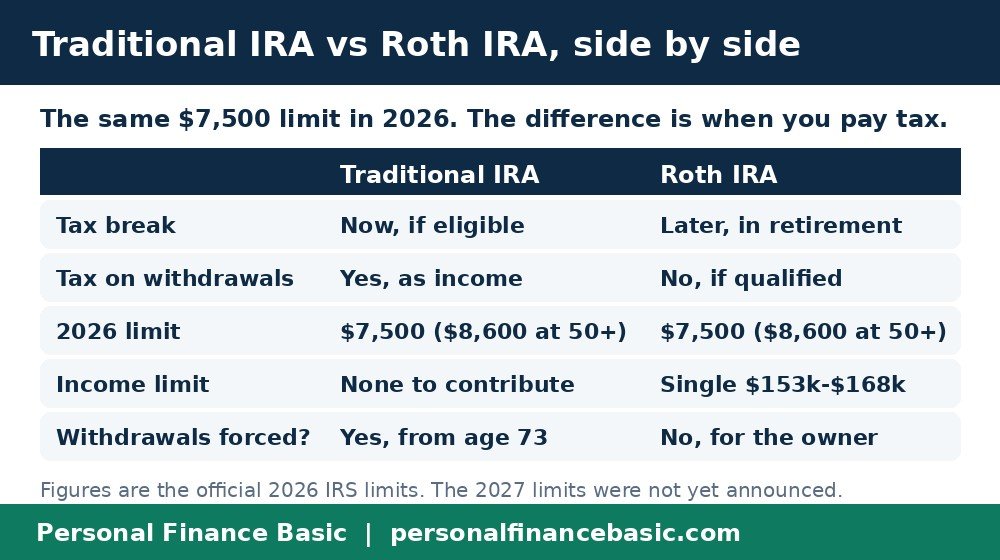
Traditional IRA vs Roth IRA, side by side. The 2026 figures are the official IRS limits.
The 2026 limits and income rules
For 2026, the IRS set the total IRA contribution limit at $7,500 a year for people under age 50. If you are 50 or older, you can add a $1,100 catch-up contribution, for a total of $8,600. That limit covers all of your IRAs combined. If you put $4,000 into a traditional IRA, you can put at most $3,500 into a Roth IRA in the same year.
You need earned income to contribute, and your contribution cannot be more than you earned in the year. The deadline for 2026 contributions is the tax filing deadline, 15 April 2027. The IRS had not yet announced the 2027 limits when this guide was written in November 2026, so check IRS.gov for the current year before you contribute.
A Roth IRA has income limits that a traditional IRA does not. Anyone can contribute to a traditional IRA at any income, even if the deduction is limited. A Roth IRA is different: for 2026, your ability to contribute directly phases out between $153,000 and $168,000 of modified adjusted gross income for single filers, and between $242,000 and $252,000 for married couples filing jointly. Above the top of the range, you cannot contribute directly to a Roth IRA at all.
Which one fits you?
The tax-rate question is a useful starting point. If your tax rate is low now and you expect it to be higher in retirement, a Roth IRA usually looks better, because you pay the low rate now and take the money out tax-free later. That is common early in a career, or in a year when income is temporarily low.
If your tax rate is high now and you expect it to be lower in retirement, a traditional IRA usually looks better, because the deduction saves you tax at the high rate now and you pay tax at the lower rate when you withdraw. That is common in peak earning years.
Many people end up with both types of account over time. Having some pre-tax money and some Roth money gives you more choice about which pot to draw from in retirement. If your employer offers a 401(k) with a match, that usually comes first, before either IRA, because the match is extra money toward retirement.
If you are not sure, start with the account that matches your current tax rate, then review the choice once a year, or when your job, pay, or family situation changes. The habit of contributing regularly matters more than picking the perfect account on the first try.
At a glance
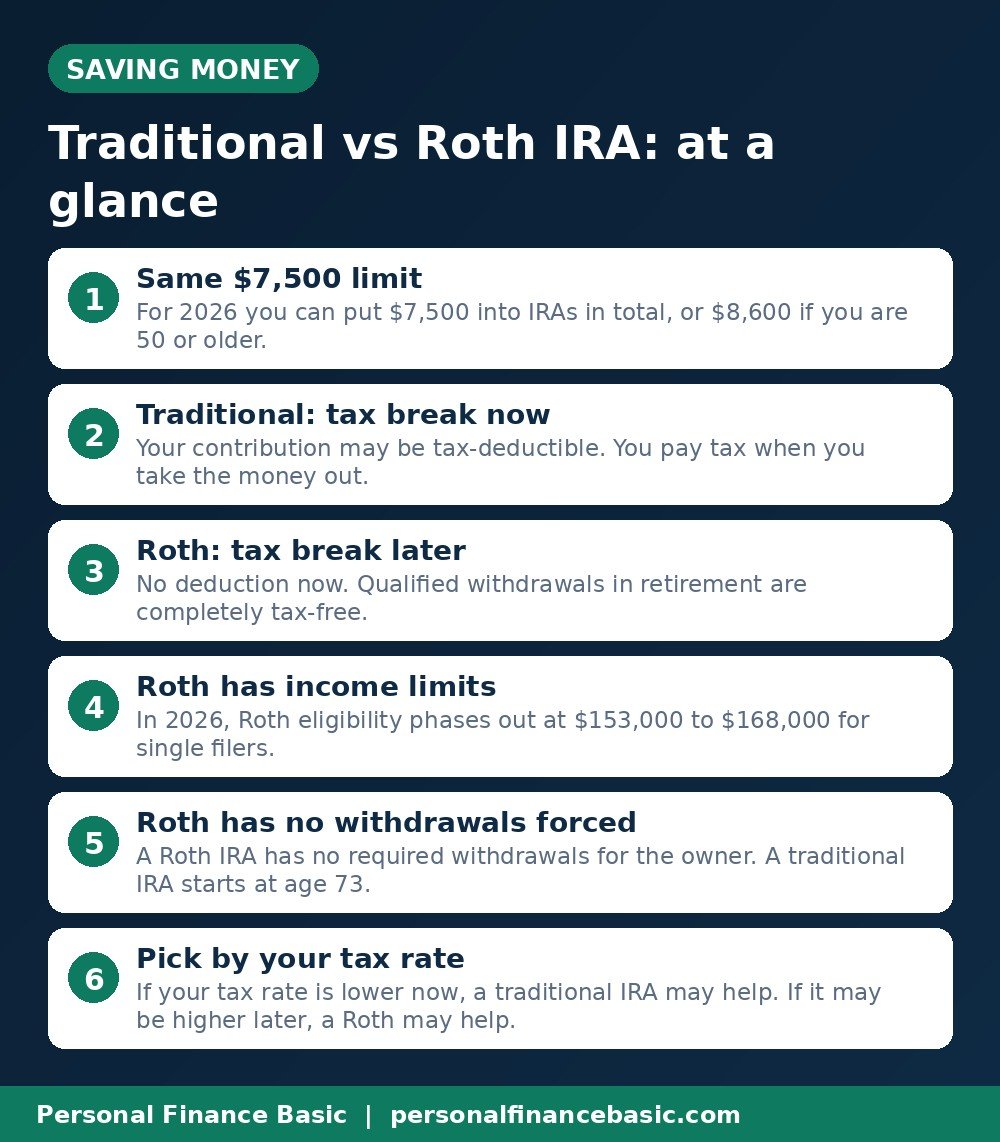
The main points from this guide, in one picture.
Frequently asked questions
What is the difference between a traditional IRA and a Roth IRA?
The difference is when you pay tax. A traditional IRA may give you a deduction now, and you pay tax when you withdraw the money in retirement. A Roth IRA gives you no deduction now, but qualified withdrawals in retirement are tax-free.
How much can I contribute to an IRA in 2026?
Up to $7,500 in total across all your IRAs, or $8,600 if you are 50 or older. The limit covers traditional and Roth IRAs combined.
Can I have both a traditional IRA and a Roth IRA?
Yes. Many people hold both. The $7,500 limit for 2026 applies to the two accounts together, not to each one separately.
What income limits apply to a Roth IRA in 2026?
For single filers, direct Roth contributions phase out between $153,000 and $168,000 of modified adjusted gross income. For married couples filing jointly, the range is $242,000 to $252,000.
Do I have to take money out of a Roth IRA in retirement?
No. A Roth IRA has no required withdrawals for the owner, unlike a traditional IRA, where they start at age 73. You can leave money in a Roth IRA for as long as you like.
This guide is general education, not financial or tax advice. IRA rules are detailed and change over time, so check the current rules on IRS.gov and consider speaking with a qualified tax adviser about your own situation before you act.
Related reading: Roth IRA for Beginners: How It Works and Who It Suits and 401(k) vs Roth IRA: Which Should a Beginner Choose First?