
A mutual fund calculator turns a simple question — “If I invest this much, what might it become?” — into a clear, hypothetical estimate. Use it to compare a regular monthly investment with a one-time lump sum, and to see how time and compounding change the result. All results here are estimates based on the return you assume. Mutual fund returns are market-linked and are not guaranteed.
Mutual Fund Calculator
Estimated maturity value: —
Total invested: —
Estimated gains: —
Hypothetical estimate only. Mutual funds are market-linked and returns are not guaranteed.
What is monthly investing?
Monthly investing means putting a fixed amount into a mutual fund at regular intervals, usually monthly. Instead of trying to time the market with one large amount, you invest a fixed amount on a regular date. When prices are lower, the same amount buys more units. When prices are higher, it buys fewer. Over time, this averaging can smooth out some of the ups and downs, although it does not remove market risk.
Monthly investing vs lump sum
| Feature | Monthly | Lump sum |
|---|---|---|
| How you invest | A fixed amount every month | One amount at once |
| Best for | Regular income and building a habit | Money you already have and do not need soon |
| Market timing | Less timing pressure, thanks to averaging | More exposed to the price on that one day |
| Cash flow | Easier on a monthly budget | Needs a large amount ready at once |
| Risk | Still market-linked, but spread over time | Still market-linked, concentrated at entry |
Neither option is automatically better. Monthly investing suits most people with monthly income. A lump sum can make sense for a bonus, a matured deposit or another one-time amount, provided you can leave it invested for a long period and accept market ups and downs.
How compounding works
Compounding means your returns can start earning returns of their own. In the early years, most of the growth comes from the money you put in. Later, if returns are positive, growth on earlier growth becomes a bigger share. That is why starting early, even with a small amount, and staying invested for a long time often matters more than trying to pick the perfect fund.
Worked example
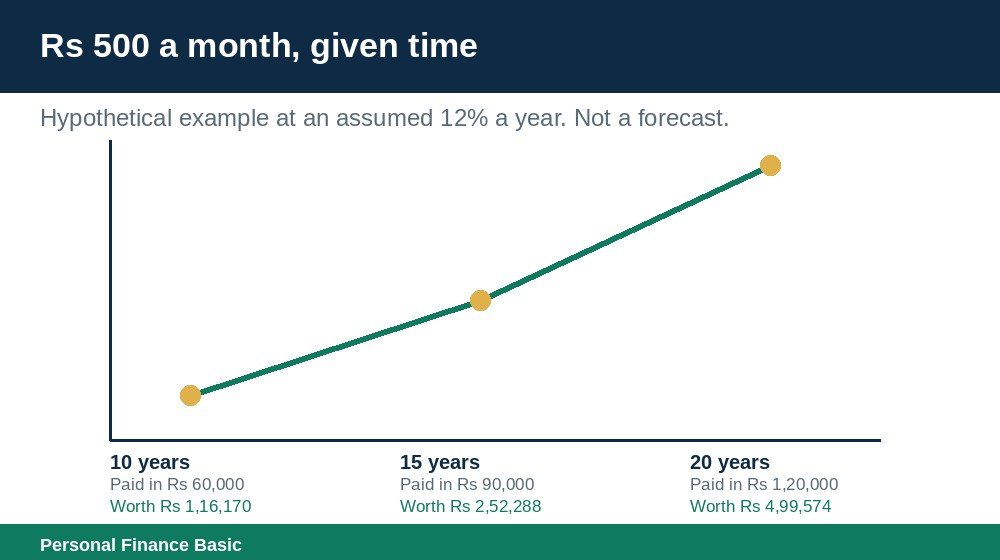
Try the pre-filled monthly example: $500 a month, an assumed 12% annual return, and 10 years, with no step-up. You invest $60,000 in total. The calculator shows an estimated maturity value of about $116,170, which means estimated gains of about $56,170. Change the period to 20 years and the estimate rises sharply, because compounding has twice as long to work. Remember: 12% is only an assumption. Actual returns will be different, and could be lower or higher.
How to choose the return assumption
- Use a conservative assumption for planning, not the best year a fund has ever had.
- Test a lower return too. If your plan only works at a very high return, it is fragile.
- Remember inflation. A return that only matches inflation does not increase your real purchasing power.
- Do not compare a short, strong period with a long-term average without checking the full history.
Mistakes to avoid
- Stopping a monthly investment during a market fall, which can lock in losses and break the averaging benefit.
- Chasing last year’s best-performing fund without checking risk, fees and consistency.
- Investing money you need in the next year or two in a market-linked fund.
- Ignoring fees and taxes, which reduce the amount you actually keep.
- Treating a calculator estimate as a promise. It is a planning tool, not a guarantee.
Frequently asked questions
Is monthly investing guaranteed to make money?
No. Mutual funds invest in markets, so values go up and down. Monthly investing can reduce timing risk, but it cannot guarantee a return.
What does step-up mean?
A step-up increases your monthly investment by a set percentage each year, for example 10%. It is useful if your income is expected to rise, because it keeps your investing in line with your earnings.
How much should I invest each month?
Start with an amount you can maintain even in a tight month, after essentials and a small emergency cushion. It is better to start small and continue than to start large and stop.
Can I change or stop a monthly investment?
Usually yes, subject to the fund’s terms. Pausing or stopping is possible, but frequent stopping can weaken the long-term benefit of regular investing.
What return should I expect?
There is no fixed expected return. Past performance does not guarantee future results. Use the calculator with several different return assumptions, and speak to a qualified professional for advice about your own situation.
All results on this page are hypothetical estimates for education only and are not financial advice. Mutual funds are market-linked and returns are not guaranteed. Before investing, consider your goals, time horizon and risk tolerance. You may also find the Car Loan Calculator useful for debt planning, and How to build an emergency fund for the safety cushion to set up first.