Two accounts show up in almost every beginner guide to retirement saving in the United States: the 401(k) and the Roth IRA. Both can help you save for retirement, but they work in different ways, they are opened in different places, and they are taxed at different times. Choosing between them is less about picking a winner and more about using each one in the right order for your situation.
How a 401(k) works
A 401(k) is a retirement account offered through an employer. You contribute part of your pay, often straight from your paycheck, and the money is invested for retirement. Contributions are usually pre-tax, which means they lower your taxable income now. You do not pay tax on the money when it goes in, but withdrawals in retirement are taxed as income.
Many employers match part of what you put in. For example, an employer may add 50 cents for each dollar you contribute, up to a set share of your pay. That match is extra money toward retirement, and it is one of the main reasons a 401(k) is often the first step. For 2026, the IRS contribution limit for a 401(k) is $24,500 a year for people under age 50. Limits are set by the IRS and change over time, so check the current figure on IRS.gov.
How a Roth IRA works
A Roth IRA is an individual retirement account that you open yourself, outside your employer, usually with a bank, a brokerage, or another financial firm. Contributions are after-tax, which means you pay tax on the money before it goes in. In return, qualified withdrawals in retirement are tax-free, including the growth, as long as you meet the rules for age and holding period.
There are two features that make a Roth IRA different in practice. First, income limits apply to who can contribute, so not everyone can put money directly into a Roth IRA in a given year. Second, the money you contributed, not the earnings, can be taken out at any time without penalty. That flexibility does not make it an emergency fund, but it does mean your own contributions are not locked away in the same way as money in a 401(k).
For 2026, the IRA contribution limit is $7,500 a year for people under age 50. That limit covers all your IRAs combined, not each account separately. As with the 401(k) limit, the figure is set by the IRS and can change over time.
401(k) vs Roth IRA side by side
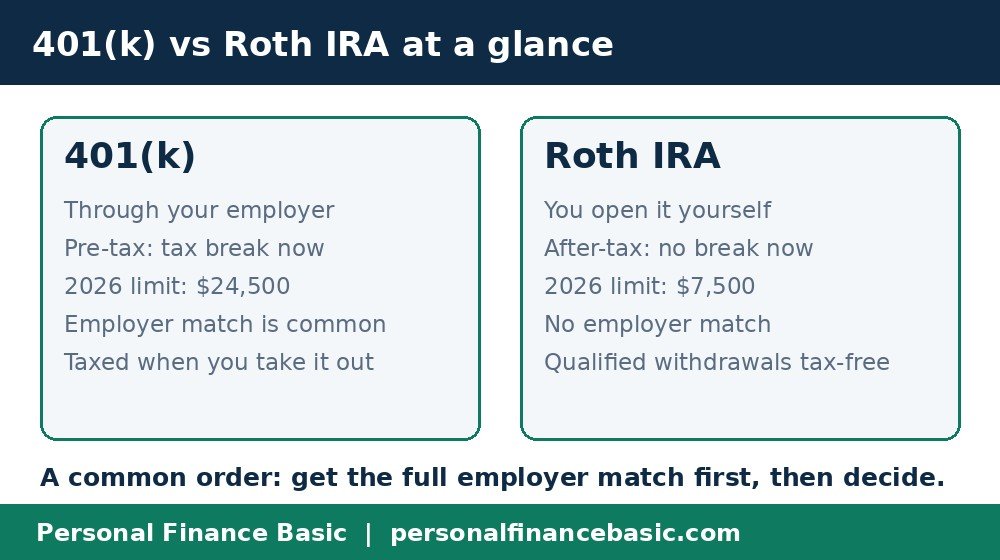
Put side by side, the differences are easy to see. A 401(k) comes through an employer, uses pre-tax contributions, and is taxed when money comes out in retirement. A Roth IRA is opened by you, uses after-tax contributions, and allows qualified withdrawals in retirement to be tax-free. The 401(k) limit for 2026, at $24,500 for people under 50, is much higher than the IRA limit of $7,500, which matters if you want to save a large share of your pay.
Investment choice also differs. A 401(k) usually offers a short list of funds chosen by your employer plan, while a Roth IRA opened on your own usually offers a wider range. That wider choice can be helpful, but it can also be harder for a beginner. A single broad, low-cost index fund, as described in our guide to how to start investing with $100 a month, is a simple starting point in either account.
The tax question: now or later?
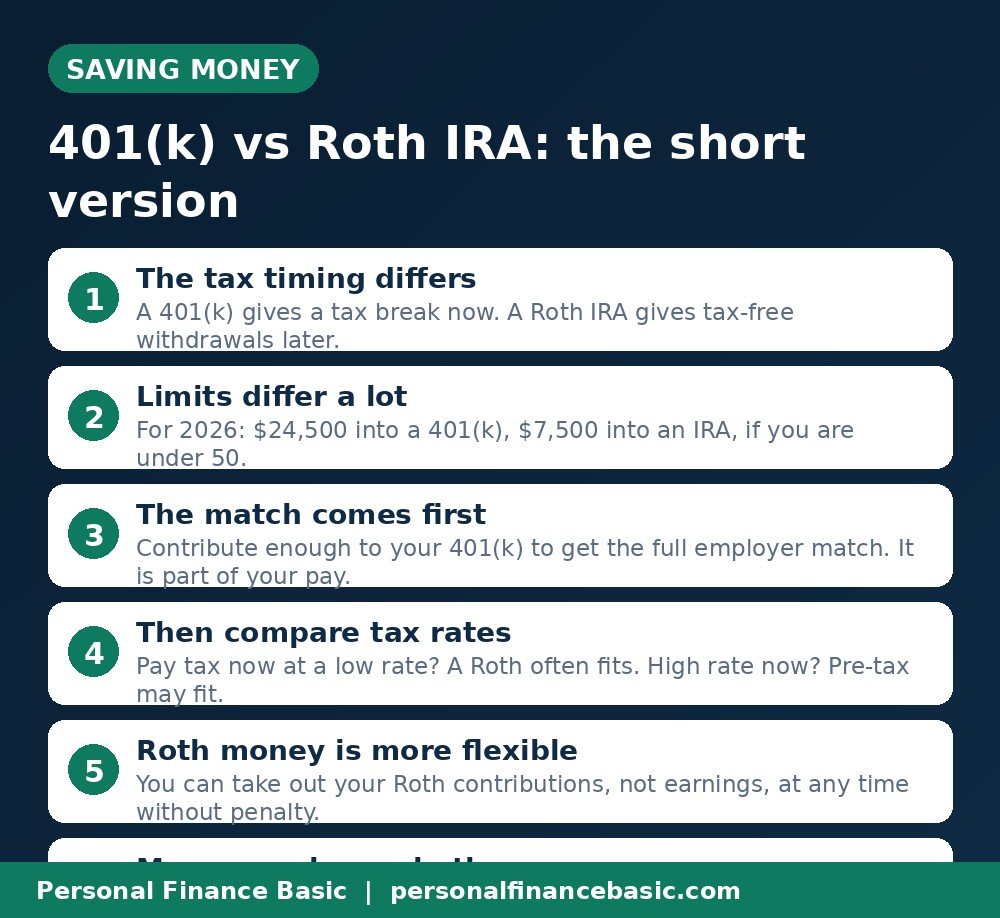
The core choice is about tax timing. With a pre-tax 401(k), you save tax now and pay tax later. That can help if you expect your tax rate in retirement to be lower than your rate now. With a Roth IRA, you pay tax now and take qualified withdrawals tax-free later. That can help if you expect your tax rate in retirement to be higher than your rate now.
No one can know future tax rates for sure, and your income, your state, and tax law can all change over a career. That uncertainty is one reason many people end up with both types of account over time. Having some pre-tax money and some Roth money gives you more choice about which pot to draw from in retirement, although the best mix depends on your full situation.
A common order for beginners
A common order is to contribute enough to the 401(k) to get the full employer match, then a Roth IRA, then back to the 401(k) if there is money left. The match comes first because it is an immediate addition to your savings. The Roth IRA comes next because it adds tax-free retirement income and wider investment choice. Returning to the 401(k) after that makes sense because its higher limit lets you save more, and contributions are taken straight from pay.
This order is a starting point, not a rule for everyone. If you have no employer match, the case for starting with a Roth IRA is stronger. If you are in a high tax bracket now and expect a lower rate later, putting more in a pre-tax 401(k) may make more sense. If you want to model different monthly amounts, try our free mutual fund calculator to see how time and regular contributions change the result.
What to check before you choose
Check four things before you decide. First, does your employer offer a match, and how much do you need to contribute to get it in full? Second, are you eligible to contribute directly to a Roth IRA, given the income limits for the year? Third, what are the fees and fund choices in your 401(k) plan? Fourth, how much can you save each month without cutting into emergency cash or high-interest debt payments?
If you change jobs, check what happens to your 401(k). You may be able to leave it, move it to a new employer plan, or roll it into an IRA. Each choice has tax and fee effects, so take time to compare them rather than cashing out, which can trigger tax and penalties. Keep records of each account, and review your choices once a year or when your job, pay, or family situation changes.
At a glance
Frequently asked questions
Can I have both a 401(k) and a Roth IRA?
Yes. Many people use both, starting with the 401(k) match and then adding a Roth IRA. The limits for each account are separate, although the IRA limit covers all IRAs combined.
What are the 2026 limits for people under 50?
The 401(k) limit is $24,500 a year, and the IRA limit is $7,500 a year. These figures are set by the IRS and change over time, so check IRS.gov for the current year.
Is a Roth IRA really tax-free in retirement?
Qualified withdrawals in retirement are tax-free, as long as you meet the rules for age and holding period. Contributions are made with after-tax money, so the tax is paid up front.
Can I take Roth IRA contributions out early?
Yes, the money you contributed, not the earnings, can be taken out at any time without penalty. Earnings taken out early may be taxed and penalized, so check the rules first.
What if my employer does not offer a 401(k)?
Then a Roth IRA, if you are eligible, is a natural first step, along with a regular brokerage account for extra saving. The order still starts with emergency cash and high-interest debt.
This post is general education, not financial or tax advice. Retirement and tax rules are detailed and change over time, so check the current rules on IRS.gov and consider professional advice for your own situation before you act.